

Great advertising campaigns rarely sell products; they manufacture memory architecture. In Indian fast-moving consumer goods (FMCG), hard-boiled candy (HBC) has historically operated in one of the most punishing commercial environments imaginable: low-involvement impulse purchases, hyper-fragmented unorganized competition, thin margins, and strict price anchoring at nominal coin denominations (50 paise to ₹1).
Yet, Parle’s Kaccha Mango Bite did not merely survive this cutthroat impulse category—it defined it.
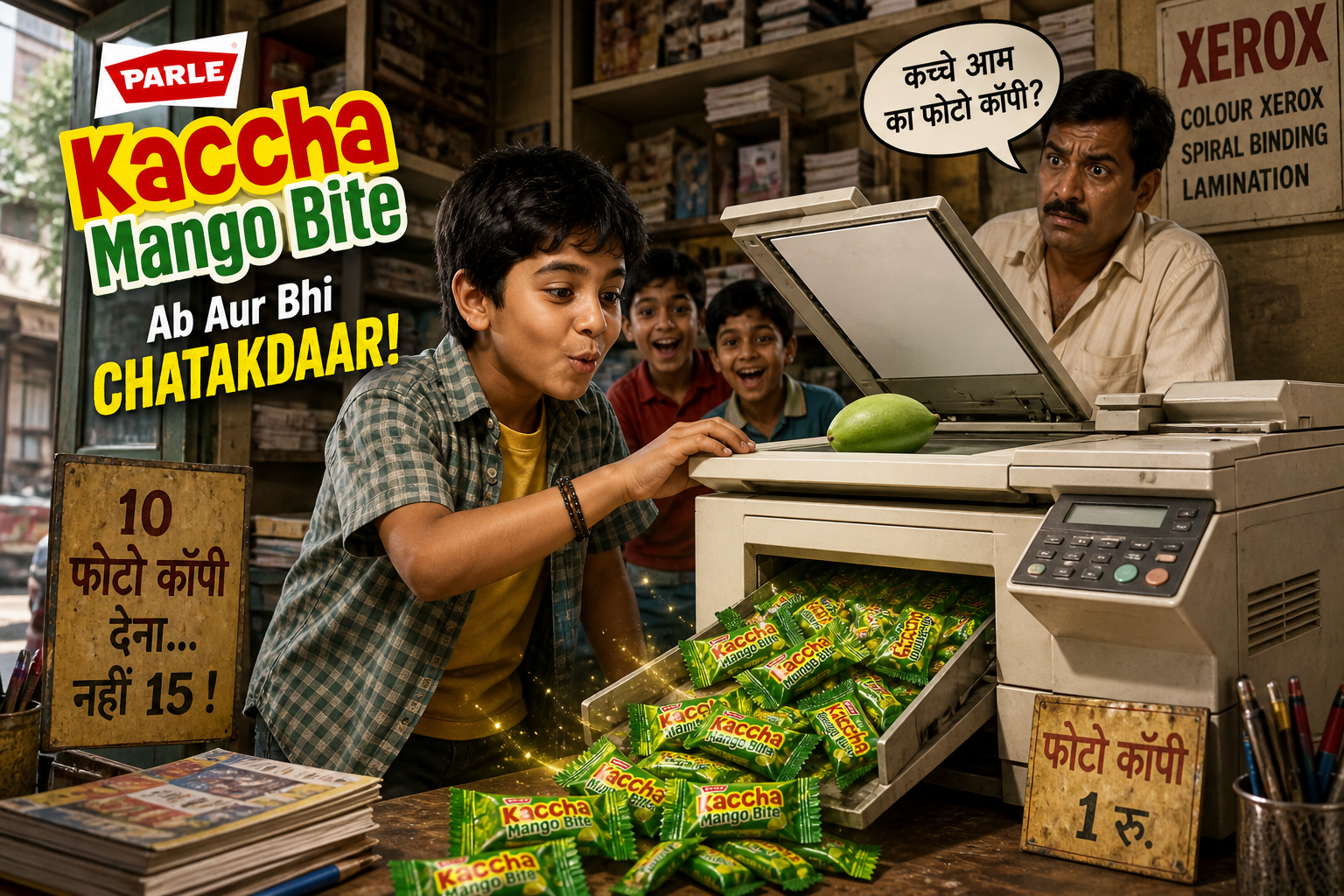
When Parle introduced the brand as an extension of its foundational Mango Bite legacy, the challenge was twofold: differentiate from conventional sweet mango confectionery and carve an unshakeable sensory monopoly in the consumer’s palate. The turning point arrived with one of Indian advertising’s most celebrated creative leaps: the iconic “Photocopy Machine” commercial, driven by the enduring tagline “Kaccha Aam Copy Nahi Ho Sakta” (Raw mango cannot be photocopied) under the umbrella proposition “Ab Aur Bhi Chatakdaar.”
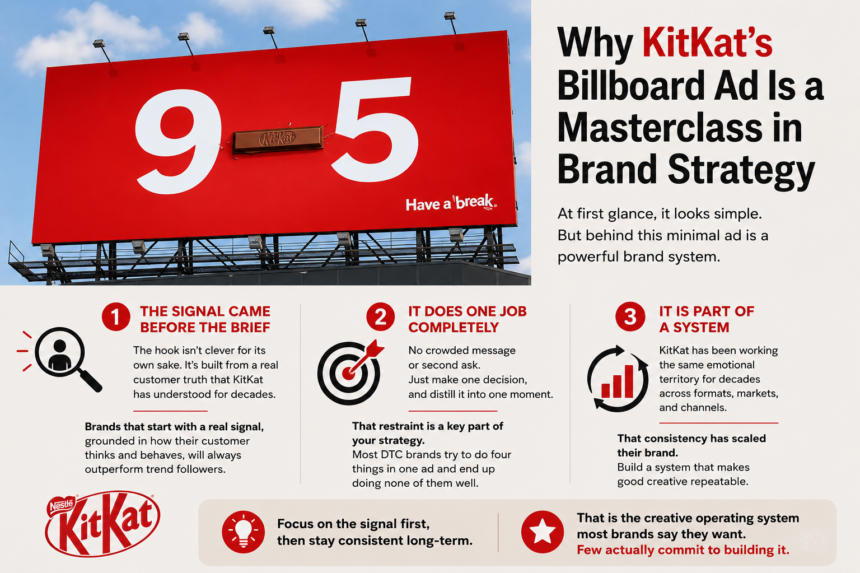
Much like why KitKat’s minimal billboard ad is a masterclass in brand strategy, Parle demonstrated that enduring brand recall comes from stripping down an insight to its absolute, uncluttered essence. This analysis deconstructs how creative conception, sensory neuromarketing, distribution machinery, and competitive brand positioning converged to transform a 50-paise hard-boiled drop into an evergreen cultural institution.
Category Context: The Hard-Boiled Candy Battlefield
Confectionery in India has historically been governed by stringent economic and operational barriers:
- The Psychological Price Ceiling: For decades, sugar confectionery was locked at 25 paise, 50 paise, and eventually ₹1. Brands had virtually zero pricing elasticity; a 20% price increase meant doubling the consumer outlay or redesigning unit economics entirely.
- The Unorganized Menace: Local regional players could produce localized sugar drops with synthetic flavoring, bypassing national ad spends and undercutting established FMCG players on trade margins.
- Impulse-Led Purchasing: Nobody puts a hard-boiled candy on a grocery list. Transactions occur spontaneously at the kirana counter, frequently as a substitute for loose change (chutta).
Traditional Category Dynamic:
Commoditized Sugar Boiled Drop ──> Extreme Trade Push / Margin Slashing ──> No Consumer Loyalty ──> Churn

Parle's Strategic Shift:
Distinct Visceral Flavor Profile ──> High-Salience Creative Pull ──> Absolute Trade Dominance ──> Brand Monopoly
Until the early 2000s, mango confectionery leaned almost exclusively into ripe mango flavor profiles—sweet, mellow, and predictable (epitomized by Parle’s original Mango Bite launched in 1989). However, raw mango (kairi) occupied a deeply distinct cultural space in India: rebellious, tangy, seasoned with salt and chili, and evocative of summer school vacations.
Parle launched Kaccha Mango Bite in 2004 to tap directly into this sensory reservoir. Yet launching the product was only half the battle. Communicating raw sensory intensity through a television screen required a radical creative execution.
Creative Deconstruction: The “Photocopy Machine” Campaign
Devised by Everest Brand Solutions, the campaign bypassed sterile FMCG product demonstrations. It anchored itself on absurdism, visual metaphor, and childlike ingenuity.


Narrative Architecture
| Scene / Element | Creative Execution | Underlying Strategic Intent |
| The Setup | A cheeky young schoolboy saunters into an ordinary neighborhood photocopy shop carrying a freshly plucked raw mango. | Establishes immediate relatability. The local xerox shop is a universal Indian suburban fixture. |
| The Preposterous Demand | The boy places the raw green mango on the scanner glass and demands a “photocopy” of it. | Hooks the viewer via surrealism, disrupting predictable commercial tropes. |
| The Mechanical Incubation | The machine hums, gears turn, green light scans the mango, and the output tray spits out Parle Kaccha Mango Bite candies instead of paper. | Translates an impossible sensory task into physical reality: the candy isn’t an artificial flavor; it is an exact, molecular replica of the fruit. |
| The Climax & Payoff | The cynical shopkeeper tastes one, his eyes pop open from the sour zing, and the kid smiles slyly. | Provides the consumer with a visible sensory proxy—the physical reaction of intense tanginess. |
| The Verbal Punchline | “Kaccha Aam Copy Nahi Ho Sakta… Isliye Parle Laya Hai Kaccha Mango Bite: Ab Aur Bhi Chatakdaar.” | Flips the logic: because natural raw mango cannot actually be photocopied, Parle did the impossible by bottling it into candy. |
The Creative Leap: Metaphor Over Explanation
Lesser brands would have showcased orchards, splashing juices, or laboratory-tested flavor beads. Parle understood that consumers do not evaluate candy analytically; they evaluate it through visceral association. By utilizing a photocopy machine—a tool meant for 1:1 identical reproduction—the ad executed an unmatched semiotic claim: this is not candy pretending to be mango; this is the literal fruit replicated in crystallized form.
Sensory Semiotics and Neuromarketing
Confectionery advertising must overcome a fundamental physiological hurdle: television screens have no taste or smell. To bridge this sensory divide, the campaign deployed sophisticated semiotic codes that reflect why emotional and experiential marketing matters most when engineering brand desire.
Synesthetic Storytelling
The commercial relied on “synesthesia”—stimulating one sensory pathway through another:
- The Visual Green Scan: The fluorescent green scan bar moving across the glass mimicked the vivid, unripe hue of a fresh raw mango skin, cueing acidity before the fruit was even tasted.
- The Cranial Reaction: The shopkeeper’s sudden facial contortion upon tasting the candy communicated sourness instantly. In neuro-advertising, mirroring facial reactions triggers mirrored gustatory responses in the viewer’s brain, stimulating salivation.
- The Onomatopoeic Hook: The descriptor “Chatakdaar” is uniquely rooted in Indian vernacular. It is not merely “tangy”; it signifies a sharp, tongue-smacking sensory jolt.
Visual Cue (Neon Green / Raw Texture)
  + Auditory Cue ("Chatakdaar" / Crunch)
  + Mirror Neuron Reaction (Facial Wince)
  = Instant Gustatory Anticipation (Salivation)
Competitive Brand Strategy: Parle vs. The Confectionery Universe
To assess the longevity of Kaccha Mango Bite, one must evaluate its strategic positioning against both predecessor brands and subsequent challengers.
                      High Tang / Tart Profile
                                 │
                                 │      ★ Parle Kaccha Mango Bite
                                 │        (The Benchmark)
                                 │
           ★ Pulse Candy         │
             (Filled / Spice)    │
                                 │
Low Price Point ─────────────────┼───────────────── Premium Gifting
(Mass Impulse)                   │                  (Chocolates/Mints)
                                 │
                                 │
                                 │      ★ Parle Mango Bite
                                 │        (Sweet / Traditional)
                                 │      ★ Alpenliebe
                                 │        (Caramel / Creamy)
                                 │
                     Sweet / Creamy Profile
Strategic Counter-Moves:
- Cannibalizing Its Own Sovereign (Mango Bite): Rather than letting competitors steal market share in the emerging “tangy” segment, Parle proactively competed against its own iconic yellow-wrapped Mango Bite. This portfolio diversification protected its dominance across both mango flavor profiles.
- Defending Against Perfetti Van Melle: While international giants like Perfetti captured market share with creamy toffees (Alpenliebe) and center-filled innovations (Chlor-mint, Mentos), Parle held an impregnable moat in indigenous, localized fruit flavor profiles that resonated deeply with Tier-2, Tier-3, and rural demographics.
- The Later Battle with DS Group’s Pulse (2015): When DS Group launched Pass Pass Pulse—a raw mango candy with an amorphous core of amchur (tangy spice powder)—it created ripples across the industry. Pulse amplified the very consumer insight Parle unearthed a decade prior: Indians crave chatpata over pure sweet. However, Parle’s decade-long brand equity and unmatched physical availability preserved Kaccha Mango Bite as the category’s baseline volume driver.
5. The Distribution Moat: The Unsung Hero of Impulse FMCG
An extraordinary advertising campaign without absolute retail availability is wasted capital—especially in confectionery, where the conversion funnel is compressed into a 3-second decision window.
Mass Media Advertising (High Salience)
                 │
                 ▼
Demand Creation at the Subconscious Level
                 │
                 ▼
Kirana Store Visit (Search for Change / Impulse)
                 │
                 ▼
The Transparent Counter Jar (Visual Retrieval)
                 │
                 ▼
Immediate Transaction (Zero Friction Conversion)
The Battle for Countertop Real Estate
In an Indian kirana store or corner paan shop, counter real estate is the ultimate competitive advantage:
- The Transparent Plastic Jar: Hard-boiled candy isn’t sold from back shelves; it is sold from eye-level countertop jars. Parle flooded retail points with branded, transparent dispensers, allowing the vibrant green wrappers to catch the gaze of children and adults waiting at checkout.
- The Currency Substitute Strategy: For years, retail merchants lacked coins in 50 paise and ₹1 denominations. Parle cemented its position with wholesalers such that shopkeepers adopted Kaccha Mango Bite as informal legal tender in place of loose change. This operational tactic transformed logistical friction into millions of daily trial opportunities.
Today, modern digital brands leverage the best AI tools for social media marketing to orchestrate precise micro-conversions, but the fundamental mechanics of the impulse sales funnel remain unchanged: maximize visibility, eliminate purchase friction, and satisfy a sudden, instinctual craving.
Strategic Takeaways for Modern Brand Builders
The Parle Kaccha Mango Bite playbook provides foundational lessons for contemporary brand custodians:
1. Conceptual Simplicity Trumps Narrative Complexity
The ad’s core proposition can be articulated in five words: Raw mango in a candy. It avoided convoluted backstories or artificial emotional appeals. It isolated a single product truth and exaggerated it through an absurd, unforgettable visual hook.
2. Own a Vernacular Sensory Anchor
By anchoring its message to “Chatakdaar,” Parle tapped into an indigenous emotional and taste reality that Westernized branding lexicons cannot replicate. Winning mass-market volume requires speaking the direct sensory language of the core consumer.
3. Build Distinctive Brand Assets (DBAs)
The combination of the vivid green color palette, the sharp mechanical hum of the xerox machine, the sour facial contortion, and the “Copy Nahi Ho Sakta” slogan built enduring brand assets. These cues ensure instantaneous brand recognition, even amid a cluttered retail countertop.
Summary Matrix
| Strategic Vector | Parle Kaccha Mango Bite Execution | FMCG Industry Benchmark |
| Core Value Proposition | Literal taste replication of raw mango (Kairi). | General fruit-flavored hard-boiled sugar confectionery. |
| Creative Device | Surrealist mechanical metaphor (The Xerox Machine). | Slice-of-life schoolyard drama or orchard farming imagery. |
| Cultural Anchor | Street-smart Indian childhood mischief & “Chatakdaar” tang. | Generic joy, sweetness, or family bonding. |
| Sensory Transmission | Facial contortions, vivid green color palette, onomatopoeia. | Verbal claims (“tasty”, “sweet”, “real juice”). |
| Route to Market | Countertop jar placement + currency-replacement integration. | Standard wholesale push via tiered margins. |
Sources & Industry References
- Parle Products Pvt. Ltd. — Corporate Brand History & Confectionery Portfolio Overview (parleproducts.com)
- Everest Brand Solutions — Campaign Concept & Creative Direction Archives for Parle Kaccha Mango Bite
- All Marketing Updates Case Studies:
- The Economic Times / Brand Equity — “How Candy Brands Built Moats at the Kirana Counter” (FMCG Impulse & Change-Replacement Dynamics)
- Indian Council of Market Research (ICMR) — Case Study on Hard-Boiled Confectionery Market Trends and Point-of-Sale Dynamics in India