

Guerrilla advertising is a low-cost, high-surprise marketing strategy that uses unconventional placements — streets, transit, buildings — to create memorable brand moments. Outdoor advertising (OOH) is the broader category it belongs to: any ad seen outside the home, from billboards to bus shelters, while its digital cousin (DOOH) uses LED screens with real-time creative. The 15 campaigns below are the best examples of 2025–26 because they all solved the same problem — how to stop a moving, distracted audience — with creativity instead of media budget.
What Is Guerrilla Advertising (and How Does It Differ From OOH/DOOH)?
Before the examples, three definitions worth locking in — Google rewards pages that clearly define their keyword entities:
- Guerrilla marketing (coined by Jay Conrad Levinson): unconventional, low-budget tactics that rely on surprise and interaction with public space rather than paid media weight.
- OOH (Out-of-Home): all advertising seen outside the home — billboards, transit ads, street furniture, murals.
- DOOH (Digital Out-of-Home): the digital subset — LED screens that swap creative in real time, often synced to weather, traffic, or news.
Guerrilla sits inside OOH but adds one rule: creativity over budget. The McDonald’s crosswalk (below) cost almost nothing in media; its ROI came from the photos people took of it.
Why Outdoor Advertising Still Works in 2026
Three structural reasons physical ads are back in the conversation:
- Ad fatigue online — feeds are crowded, skippable, and increasingly filtered; the street is the last unskippable medium.
- Post-digital fatigue — as digital burnout grows, brands are returning to real-world moments that reward a second look (BBC’s Dracula billboard and street-level stunts point at this trend directly).
- Sight-unseen trust — physical presence signals legitimacy that a banner can’t, especially for local and legal services.
The 15 Best Guerrilla & Outdoor Advertising Campaigns
1. Yoigo x Netflix’s 24-Metre Suspended Sofa (Madrid)
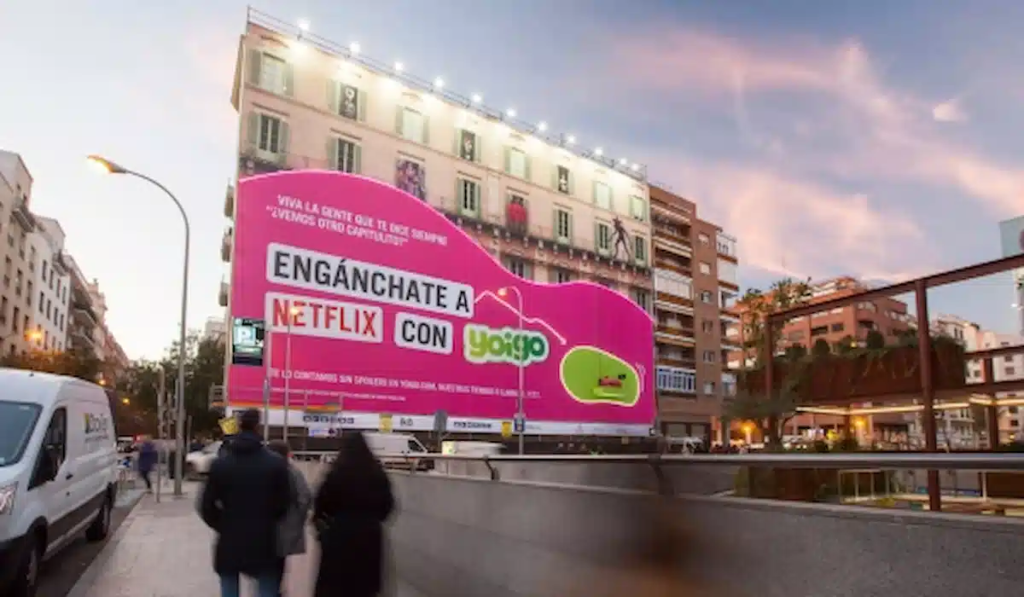
Yoigo’s brazen Netflix viewing stunt turned a Black Friday billboard (28 Nov 2025, Calle Antonia Merc, Salamanca) into a live stage: a real sofa, TV, and mannequin mounted 6+ metres up, then a mannequin-swap rappel from 24 metres by influencer Leto (2.2M TikTok followers), who live-streamed six full hours of Netflix from the sofa. Slogan: “Engánchate a Netflix con Yoigo.” Created with Pingino Torreblanca and Dentsu, it was engineered for two audiences at once — street passers-by and phone screens.
Takeaway: prove your product’s promise as a performance people can watch; presence beats pricing.
2. Fevicol’s Metro Ads: Wordplay the Commuter Already Knows
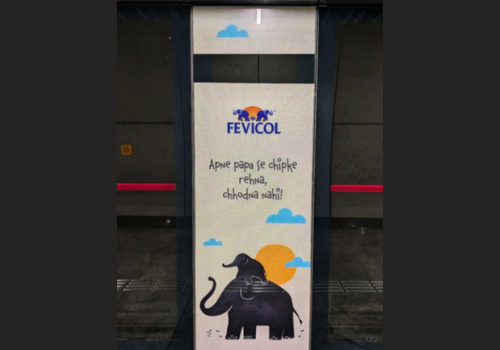
Fevicol’s metro campaign used escalator doors and station panels with copy that reads like household speech — “Apne papa se chhupke rehna, chhodna nahi” (Keep it hidden from your dad — don’t leave it). As the doors open and close, the sentence breaks and reassembles, visually enacting Fevicol’s core promise: strong bonding. No clutter, no CTA — just placement that makes the medium part of the message.
Takeaway: familiar language + medium-as-metaphor = recall without extra budget.
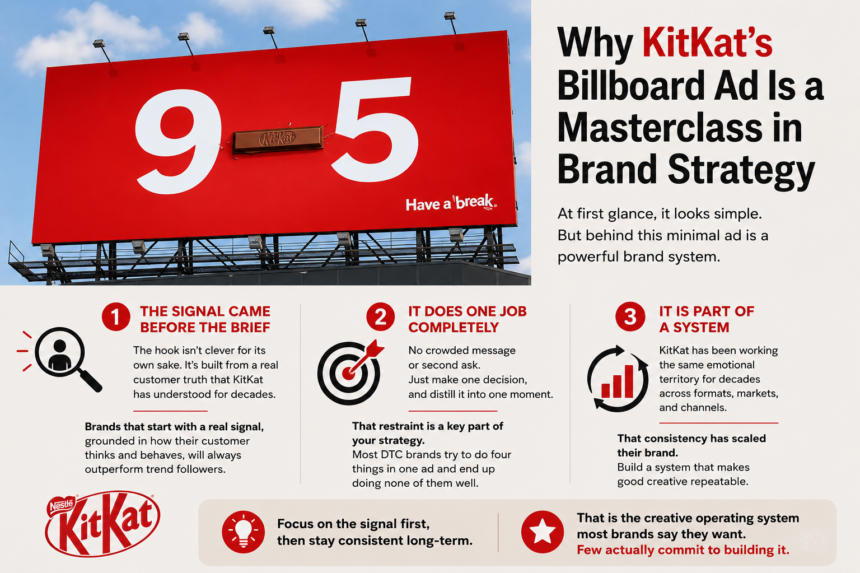
3. KitKat on the Bandra–Worli Sea Link: Context-Led Advertising
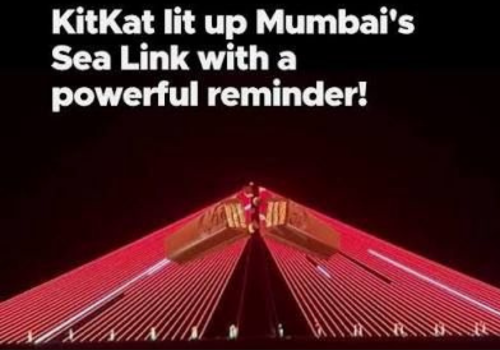
KitKat’s Sea Link campaign is a masterclass in working with a structure instead of fighting it. Mumbai’s most complex outdoor location has flowing cables and natural symmetry; KitKat’s creative followed the bridge’s geometry rather than imposing hard rectangles — restraint that made the message feel native to the structure.
Takeaway: when you stop fighting context, context starts selling for you.
4. Blinkit’s Sweater Billboard: A Winter Ritual, Reflected Back
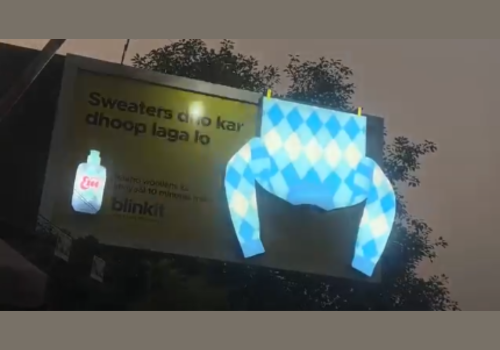
Blinkit’s sweater-themed billboard is a sweater-shaped cut-out, softly lit to mimic sunlight, with the line “Sweater dho kar dhoop lagalo” (Wash the sweater and dry it in the sun). It makes zero product claims — it just mirrors a shared household ritual and makes the viewer feel seen.
Takeaway: behaviour beats claims; timing (winter) does the persuading.
5. Oatly’s Paris Mural: The Ad That Admitted Nobody Likes Ads
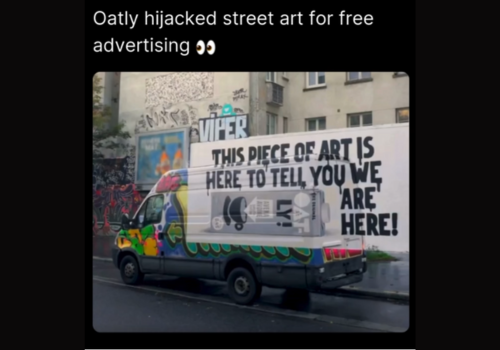
Oatly’s self-aware Paris mural exploited a rule in Paris requiring commercial murals to look “artistic” and carry no logos. The wall read: “This piece of art is here to tell you we know that ads are not appreciated here.” Delivery workers then placed Oatly cartons in front of it, filmed in forced perspective — compliant on paper, promotional in practice. Local graffiti followed within days; global conversation followed faster.
Takeaway: honesty disarms skepticism; sometimes you win by being noticed, not liked.
6. BBC’s Dracula Billboard: One Board, Two Experiences
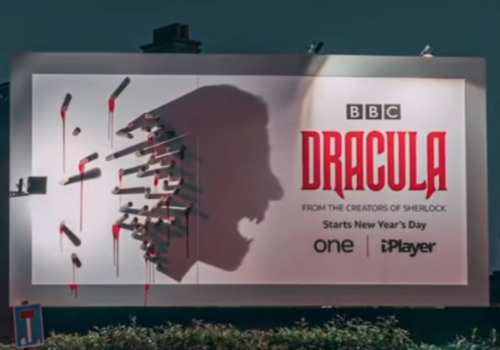
BBC’s Dracula billboard used zero QR codes or AR. By day: a senseless cluster of stakes. By night: hidden lights cast shadows that resolve into Dracula’s face. It’s the poster child of the post-digital 2026 shift — fewer gimmicks, more real-world moments that reward a second look and get strangers talking to each other.
Takeaway: design for the second look; the reveal is the share.
7. Nescafé’s Factory-Smoke Steam Billboards (Student Concept)
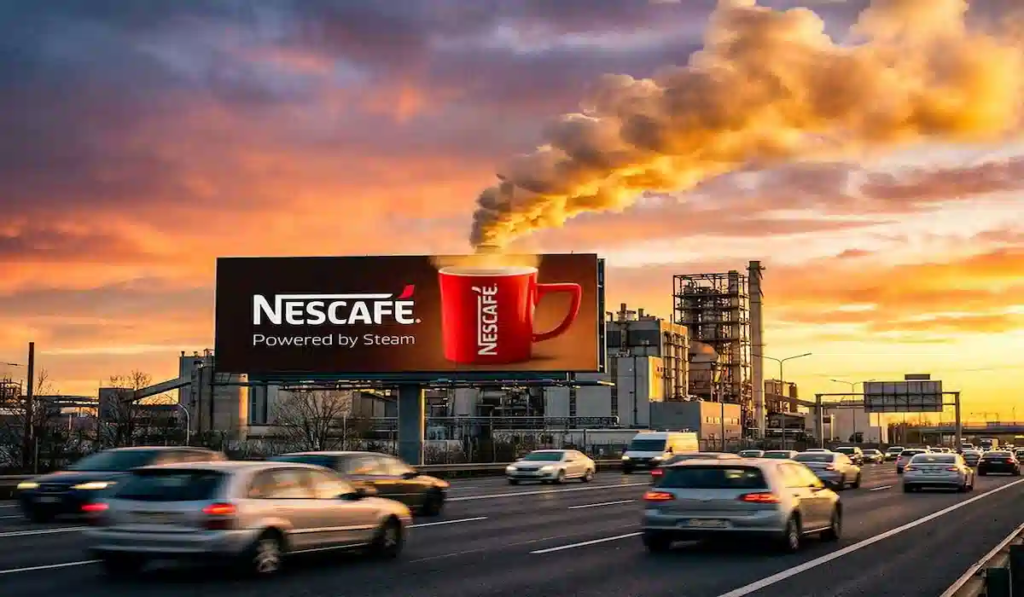
Nescafé’s chimney illusion — flagged explicitly in its source as a concept, not an official campaign — is a student project by Ziad Waleed (Helwan University, Egypt, Jan 2026): a minimalist mug billboard aligned so factory smoke visually pours from the cup. Tagline: “Fueled by more than just machinery.” The environment supplies the visual; wind and weather change the “steam” every day.
Takeaway: observation beats production budget — and universities are a free ideas pipeline.
8. Coca-Cola x WWF’s Living Billboard: Ahead of Its Time
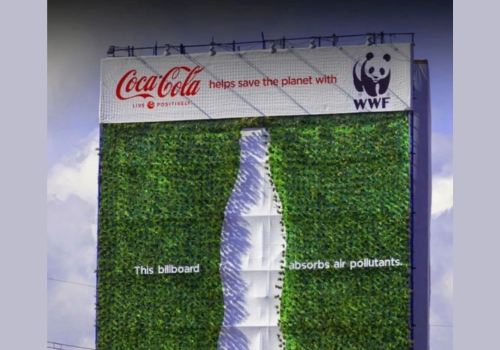
Coca-Cola x WWF’s living billboard (2011) was built from real plants designed to absorb air pollutants while forming the Coke bottle. It felt experimental a decade ago; against India’s recurring winter air-pollution crises it now reads prophetic. Impact-driven, brand-lite, and aging brilliantly — the opposite of a disposable stunt.
Takeaway: meaningful ideas outrank viral moments on lifespan.
9. McDonald’s Fries Pedestrian Crossing: Guerrilla 101
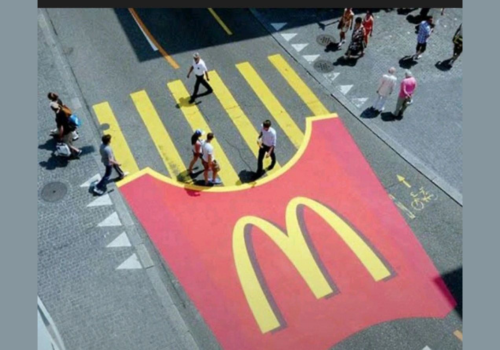
McDonald’s crosswalk activation repainted a crossing so its stripes became fries emerging from a red carton. No screens, no celebrities — a humble street corner converted into a photo moment. Textbook guerrilla: unexpected placement → curiosity → organic virality.
Takeaway: simplest ideas, biggest impact — advertising just needs to be unexpected.
10. Ethnix by Raymond x Shaadi.com: One Sentence, Two Brands
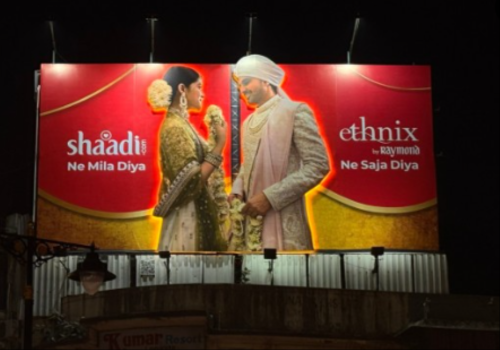
Ethnix by Raymond and Shaadi.com’s joint billboard split one narrative across two panels in wedding season (Dec–Jan): bride and groom face each other; Shaadi.com’s red panel says “…Ne Mila Diya” (brought together), Ethnix completes it — “…Ne Saja Diya” (dressed up). Two brands, one lifecycle, zero feature-stacking.
Takeaway: cross-category partnerships win when they mirror a real consumer journey.
11. IndiGo vs. InstaAstro: The Billboard Battle of 2025
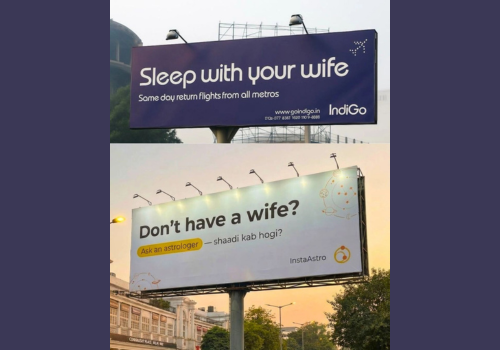
IndiGo’s “Sleep with your wife” ad (fine print: same-day return flights) earned a Delhi commuter double-take — then InstaAstro clapbacked with “Don’t you have a wife?” and the most desi punchline of the year: “Ask an astrologer — shaadi kab hogi?” A perfect segmentation joke: IndiGo solved the married couple’s problem; InstaAstro caught everyone who wasn’t eligible for the first ad.
Takeaway: humour + cultural context + timing turns a commute into entertainment.
12. DealShare’s Auto-OOH in Jaipur: Hyper-Local and Cheap
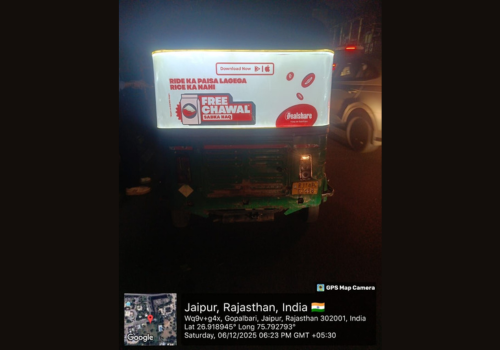
DealShare’s Jaipur auto-rickshaw campaign (Dec 2025) fitted backlit panels on autos: “Ride ka paisa lagega, rice ka nahi. FREE CHAWAL – Sabka Haq.” (You’ll pay for the ride, not the rice.) Moving through congested markets, autos deliver repeated local exposure at a fraction of hoarding cost — with app-store icons on board for an instant CTA.
Takeaway: local language + frequency + humour beats big-budget visuals in Bharat.
13. Blinkit & Zomato: Billboards as Cultural Moments
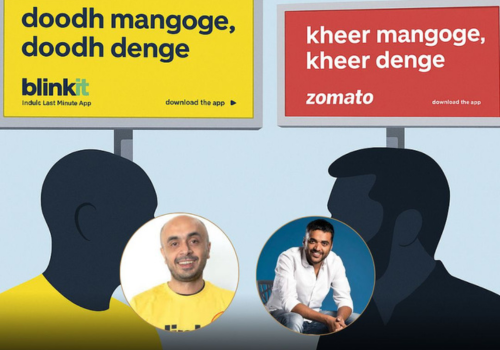
Blinkit and Zomato’s outdoor work has quietly redefined the Indian billboard: copy that reads like a friend’s WhatsApp message, timed to culture and memes, with branding kept light. The standard isn’t “seen” anymore — it’s “worth photographing.”
Takeaway: better relatable than perfect; make the billboard the start of a conversation, not its end.
14. The Divorce Lawyer Billboard: Why Simple + Human + Bold Wins
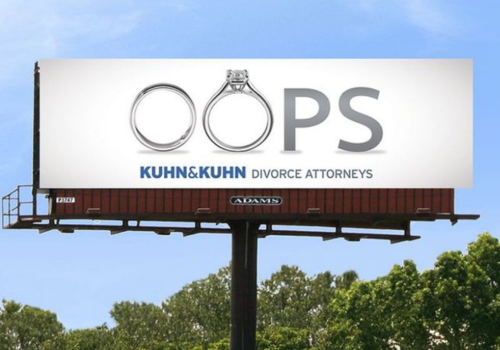
The divorce-lawyer billboard analysis explains why most legal ads fail: identical headshots, dark backgrounds, credential lists — pattern the brain ignores. The one that works breaks the pattern: readable in seconds, emotionally connected, a touch of humour, a clear CTA, and no credential-ego.
Takeaway: advertising is connection, not credential display — clarity over complexity.
15. Digital Billboards Reach Tier-3 India (The Etawah Signal)
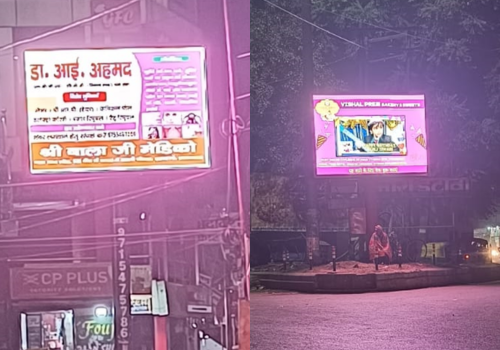
The DOOH expansion into Etawah is the quietest structural shift on this list: falling LED costs, local media entrepreneurs, rising aspirational consumption in Bharat, and integrated national campaigns are pushing digital screens beyond Mumbai–Delhi–Bengaluru. Early movers get premium visibility before rates rise.
Takeaway: Tier-2/3 India is the growth market; the brands that treat Bharat as primary will lead the next phase.
5 Patterns Every Best Outdoor Ad Has in Common
- Context is the creative — KitKat, Nescafé, Oatly, BBC all work with their environment.
- Restraint beats noise — Fevicol, Blinkit’s sweater, and the lawyer billboard prove quiet wins.
- The street is a stage, not a poster — Yoigo, McDonald’s, and DealShare design for the phone camera as much as the passing eye.
- Timing is the silent half of the idea — Black Friday (Yoigo), wedding season (Ethnix × Shaadi.com), winter (Blinkit), December (DealShare).
- Cultural language builds trust — from “Apne papa se chhupke rehna” to “shaadi kab hogi,” local words are remembered words.
Guerrilla Advertising FAQ
What is guerrilla marketing?
A low-cost, unconventional marketing strategy (coined by Jay Conrad Levinson) that uses surprise, public-space interaction, and creativity — not media budget — to create memorable brand moments. Examples: McDonald’s fries crosswalk, Ikea’s “Free Snowman,” 3M’s “Break Me if You Can.”
What is the difference between OOH and DOOH advertising?
OOH (Out-of-Home) is any advertising seen outside the home — billboards, transit, street furniture. DOOH (Digital Out-of-Home) is the digital version: LED screens with real-time creative rotation, often weather- or traffic-reactive.
Do billboards still work in 2026?
Yes — increasingly so. With digital feeds crowded, skippable, and expensive, physical visibility builds trust, local authority, and shareable moments digital alone can’t create. Several 2025 campaigns (BBC, McDonald’s, Fevicol) deliberately went offline to stand out.
What makes a billboard memorable?
Simplicity, emotional resonance, and something slightly unexpected — the strongest examples here use one core idea, familiar cultural language, and a placement that makes the message feel native to its surroundings.
How much does guerrilla advertising cost?
By definition, far less than traditional media. DealShare’s auto-OOH and the Nescafé student concept show insight and placement matter more than budget; costs range from materials-only street stunts to low-five-figure ambient placements — a fraction of a national TV buy.
Can small brands use guerrilla marketing?
Absolutely — guerrilla marketing is defined by creativity over money. Local businesses can start with sidewalk chalk, stickers, auto panelling, or a single well-placed contextual billboard.