

Conventional business folklore celebrates the 20-something founder building a unicorn out of a suburban garage. Mainstream culture routinely associates entrepreneurship with youthful abandon, unlimited energy, and early risk-taking.
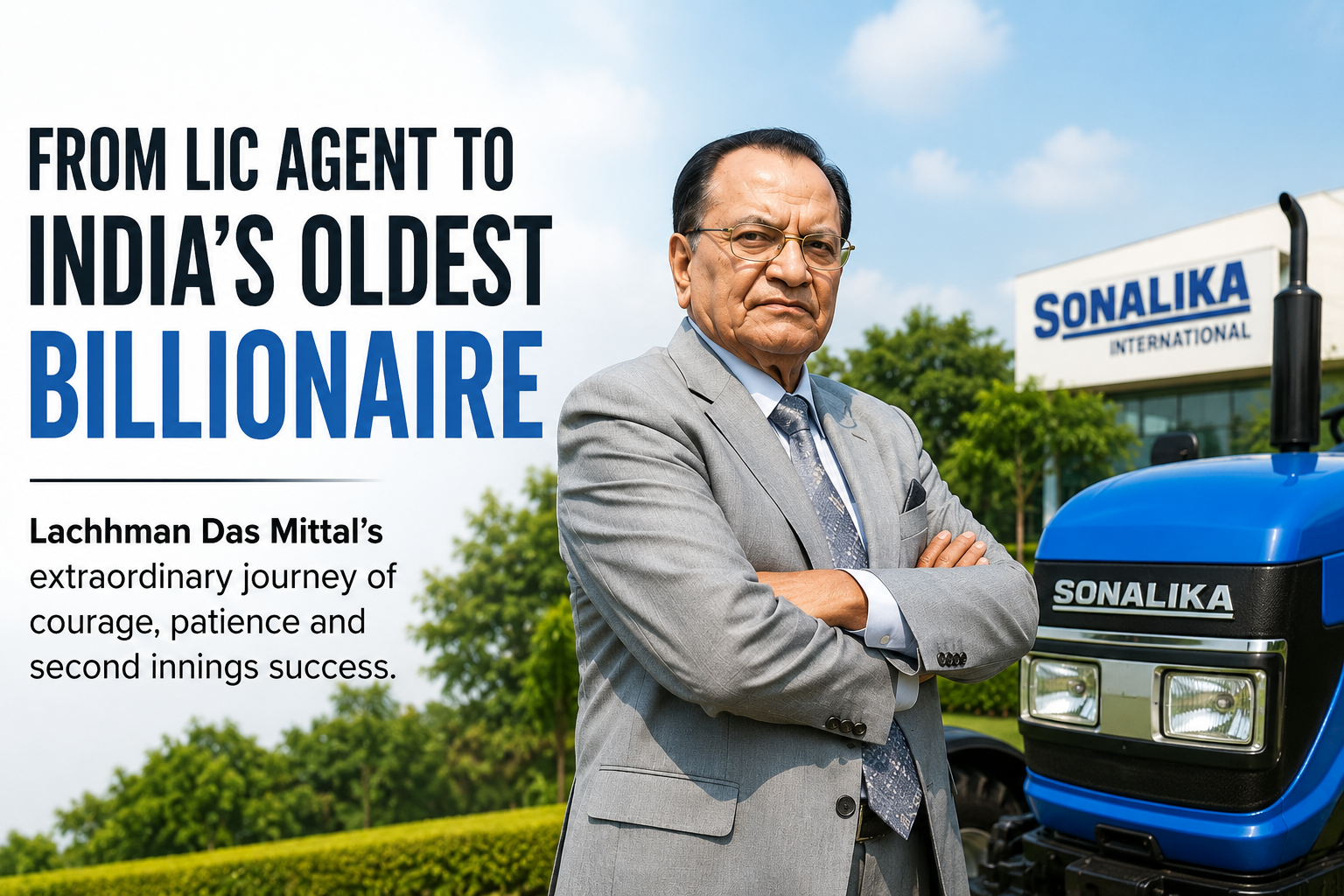
The story of Lachhman Das Mittal shatters this paradigm.
Mittal did not establish a tech platform, chase venture capital in his twenties, or enter the corporate fast track early in life. Instead, he spent decades working steadily within the corporate machinery of the Life Insurance Corporation of India (LIC). He weathered crushing personal bankruptcy in middle age and chose not to retire when he turned 60 in 1990.
Instead of moving toward a quiet retirement, Mittal founded what would become the multi-billion-dollar empire known as International Tractors Limited (ITL) and the Sonalika Group. Today, recognized in his nineties as one of India’s oldest billionaires with a net worth reaching into the multi-billions, Mittal stands as a masterclass in late-stage entrepreneurship, operational discipline, and industrial resilience.
Executive Summary & Company Profile
| Metric / Dimension | Overview |
|---|---|
| Founder | Lachhman Das Mittal (Born August 1931, Hoshiarpur, Punjab) |
| Flagship Brand | Sonalika Tractors / International Tractors Limited (ITL) YouTube |
| Foundational Age | Began dedicated commercial business transition at age 60 (1990) YouTube |
| Industry | Farm Mechanization, Automotive, Heavy Agricultural Machinery YouTube |
| Market Position | 3rd largest tractor manufacturer in India by domestic market share; top Indian tractor exporter YouTube |
| Global Footprint | Active distribution across 150+ countries across Africa, Europe, Asia, and the Americas YouTube |
| Core Leadership Clan | Amrit Sagar Mittal, Deepak Mittal, Raman Mittal, Sushant Mittal, Rahul Mittal YouTube |
Modern business discourse heavily lionizes early-stage software breakthroughs—often highlighting founders who raise venture capital in their early twenties. However, as documented across our in-depth Case Study collection, sustainable enterprise value is frequently forged in traditional industries through operational resilience.
Early Life, Intellectual Roots, and The Insurance Years
Lachhman Das Mittal was born in 1931 in Hoshiarpur, a small town nestled in the foothills of Punjab. He demonstrated high academic aptitude from youth, earning a Master of Arts in Urdu and English from Panjab University, where he topped his academic class. His deep appreciation for classical Urdu literature and poetry stayed with him for life, providing an intellectual calm that would later steady his high-stakes industrial negotiations.
In 1955, Mittal took a secure job at the newly state-owned Life Insurance Corporation of India (LIC). For decades, he worked across branches and managerial ranks, eventually rising to Deputy Zonal Manager.
Working inside LIC gave him two distinct advantages that most startup founders lack:

- A Granular Understanding of Rural Finances: LIC policies took Mittal straight into India’s agrarian heartland. He sat with farmers, rural money-lenders, small shopkeepers, and semi-urban cooperative heads. He saw how agrarian household balance sheets operated, how monsoon cycles dictated spending power, and how rural Indians weighed risk and trust.
- Financial Prudence and Compounding: While his peers banked their savings in standard low-yield accounts, Mittal directed his modest salary into prudent investment funds and diversified schemes. He prioritized capital preservation, debt aversion, and patience.
The Forgotten Collapse: The 1970 Bankruptcy
The modern perception of Mittal as an overnight post-retirement success overlooks a painful trial twenty years prior.
In the late 1960s, observing the earliest waves of India’s Green Revolution, Mittal attempted an early side business: Sonalika Implements. Partnering with local blacksmiths in Hoshiarpur in 1970, he set out to build threshers and rudimentary farm tools.
The venture collapsed almost immediately. Driven by technical missteps, undercapitalization, and distribution bottlenecks, the initiative went belly-up by 1971. His family lost their savings, reducing Mittal’s personal net worth to a meager ₹100,000 (1 Lakh). Around this time, he sought an auto dealership from Maruti Udyog to rebuild his footing, but his application was rejected.
“Once I applied for a dealership of Maruti Udyog but was rejected. Today, I give out dealerships.”
— Lachhman Das Mittal
Rather than abandoning enterprise altogether, Mittal returned his daily focus to LIC. For the next twenty years, he continued serving policyholders while quietly studying farm machinery, visiting workshops, refining thresher designs, and planning his eventual return.
The 60-Year-Old Pivot (1990–1996)
By 1990, Mittal reached LIC’s mandatory retirement age of 60.
In traditional Indian society—and across developing markets globally—retirement at 60 is viewed as a definitive exit from active professional life. Professionals move into leisure, religious contemplation, or multi-generational family care.
Mittal, however, saw retirement as the removal of a barrier. Unburdened by government employment rules, he had his pension, clear savings, and sons who had finished their professional education.
The Thresher Comeback
Mittal reactivated his farm implement business in Punjab. He analyzed Japanese harvesting machinery designed to separate wheat and hay cleanly without damaging grain kernels. By incorporating those mechanical insights into local thresher models, Sonalika manufactured agricultural implements that were sturdier, lighter, and more fuel-efficient than standard regional designs. Within eight years, Sonalika became one of northern India’s recognized names in threshing equipment.
The Bold Leap: International Tractors Limited (1995–1996)
Mittal realized that while threshers were seasonal equipment, tractors were the lifeblood of agrarian logistics. In rural emerging markets, a tractor is not merely a tilling implement; it functions as a multi-purpose workhorse—hauling sugarcane to mills, transporting construction aggregates, operating water pumps via power take-offs (PTO), and functioning as family transport during festivals.
In 1995, at age 64, Mittal formally incorporated International Tractors Limited (ITL), rolling out the flagship Sonalika tractor line in 1996. The name Sonalika—meaning “lines of gold”—was chosen in homage to the high-yield wheat seed variety that powered the Green Revolution.
To scale assembly, Mittal needed significant capital. Having earned immense goodwill among rural dealers during his implement years, he raised ₹22 crore largely backstopped by the advance deposits and unconditional trust of his independent dealer network.
Strategic Playbook: How Sonalika Won
Entering the Indian tractor sector in the late 1990s was widely considered commercial folly. The sector was dominated by entrenched titans: Mahindra & Mahindra, Escorts, TAFE (Mass-producing Massey Ferguson under license), and state legacy producers like HMT.
Mittal carved out ITL’s competitive moat through four strategic pillars:
                  ┌────────────────────────────────────────┐
                  │      The Sonalika Growth Flywheel      │
                  └────────────────────────────────────────┘
                                      │
       ┌──────────────────────────────┼──────────────────────────────┐
       ▼                              ▼                              ▼
┌──────────────┐              ┌──────────────┐              ┌──────────────┐
│  Hyper-Local │              │  Deep Plant  │              │ Zero-Debt &  │
│  Engineering │ ───────────► │  Integration │ ───────────► │ High Margin  │
│   Agility    │              │ (Hoshiarpur) │              │  Financials  │
└──────────────┘              └──────────────┘              └──────────────┘
       │                                                             │
       └───────────────────────◄─────────────────────────────────────┘
                                      │
                                      ▼
                      ┌──────────────────────────────┐
                      │  Global Market Arbitrage &   │
                      │   Strategic JVs (Yanmar)     │
                      └──────────────────────────────┘
Pillar A: Hyper-Local Agronomic Engineering
Standard tractors built by legacy conglomerates were designed for uniform, broad-acre farming. Punjab, Haryana, and western Uttar Pradesh featured varied soil textures: dense clay loam, alluvial sand, and flooded paddy basins.
- Sonalika engines were configured for high backup torque at lower RPMs, drastically curtailing diesel burn during heavy haulage. YouTube
- They deployed tighter turning radiuses, enabling smallholder farmers to maneuver within fragmented one- and two-acre land holdings.
Pillar B: Extreme Vertical Integration at Hoshiarpur
To counter supply chain vulnerabilities, Mittal built ITL’s primary manufacturing facility in Hoshiarpur, Punjab. Over two decades, it transformed into the world’s largest integrated tractor plant under a single roof, with a production capacity scaling past 200,000 units annually.
- The plant integrated automated foundry units, robotic paint shops, and test tracks.
- ITL builds its own engines, transmission assemblies, sheet-metal bodies, and hydraulic gears internally, giving the company cost advantages and the ability to update models rapidly without waiting on tier-1 suppliers.
Pillar C: Radical Balance-Sheet Conservatism
Drawing directly from his 35 years in life insurance, Mittal operated the business with a strict aversion to high debt:
- When global private equity giants like Blackstone circled the company in the 2000s and 2010s to acquire significant control, Mittal limited outside stakes. He maintained strong cash balances and EBITDA margins hovering near 20–22% (outperforming the 14–15% industry standard).
- Low debt enabled ITL to ride out monsoon droughts, demonetization, and raw material inflation cycles that bankrupted over-leveraged competitors.
Pillar D: Global Arbitrage and Smart Partnerships
While domestic incumbents fought bitter price wars solely within India, Mittal viewed the global south as his addressable market.
- The Solis Line: Mittal launched the “Solis” export sub-brand, engineering compact tractors that complied with strict European emission norms while offering rugged utility for smallholders across East Africa, Latin America, and Southeast Asia. YouTube
- Strategic Alliances: Rather than surrendering equity control to acquire foreign technology, ITL entered focused joint ventures. France’s Renault Agriculture provided early transmission guidance, and later, Japanese giant Yanmar acquired a 13% strategic minority stake to co-develop compact agricultural equipment.
Global Expansion: Beyond Indian Borders
From its base in Punjab, Sonalika systematically developed export operations to counter domestic tractor market cycles.
                 GLOBAL REACH: 150+ COUNTRIES
                 ────────────────────────────
      ┌────────────────┬────────────────┬────────────────┐
      ▼                ▼                ▼                ▼
   AFRICA           EUROPE       LATIN AMERICA         ASIA
 (Tanzania,        (Germany,        (Brazil,          (Myanmar,
  Kenya, etc.)     France, etc.)    Chile, etc.)      Nepal, etc.)
  Haulage and      Compact/Turf     Orchard and      Smallholder
  Tillage        Farming         Row Crop        Paddy Work
- Sub-Saharan Africa: In markets like Kenya, Tanzania, Nigeria, and South Africa, tractors must handle difficult regional terrain and operate far from maintenance stations. Sonalika built simple, highly mechanical tractors with minimal complex electronics, allowing regional mechanics to maintain them easily using standard tools. YouTube+ 1
- Europe & North America: Through the Solis imprint, the company found a profitable niche in compact hobby-farming, gardening, and equestrian center maintenance across Germany, France, and the UK, competing with Japanese brands like Kubota.
- Regional Assembly Hubs: To counter regional import tariffs, the group deployed knocked-down assembly operations in international trade hubs like Turkey and Brazil.
Multi-Generational Family Governance
A major risk for late-starting founders is the succession cliff: the vulnerability of a business when the visionary founder steps away. Mittal resolved this by building a multi-tiered, family-led governance structure early on.
YouTube
                     Lachhman Das Mittal
                     (Founder & Chairman)
                              │
         ┌────────────────────┴────────────────────┐
         ▼                                         ▼
   Amrit Sagar Mittal                        Deepak Mittal
    (Vice Chairman)                         (Managing Director)
         │                                         │
 ┌───────┴───────┐                         ┌───────┴───────┐
 ▼               ▼                         ▼               ▼
Raman Mittal   Sushant Mittal            Rahul Mittal   (Extended Operations)
(Joint MD,     (Commercial Strategy,     (Real Estate &
 International  Global Brands)         Diversification)
 Business)
- First Generation (Lachhman Das Mittal): Provided foundational values, balance sheet discipline, rural distribution networks, and strategic oversight. YouTube
- Second Generation (Amrit Sagar & Deepak Mittal): Spearheaded heavy industrialization, scaled the Hoshiarpur manufacturing mega-plant, and forged international joint-venture alliances. YouTube
- Third Generation (Raman, Sushant, and Rahul Mittal): Modernized brand architecture, digitized international supply chains, scaled export operations, and introduced next-generation tractor platforms (including electric tractor prototypes). YouTube
Mittal’s daughter, Usha Sangwan, carved her own historic trail—rising through the ranks of the Life Insurance Corporation of India to become the first woman Managing Director in LIC’s history, showcasing the family’s deep connection to financial discipline.
Five Core Business Lessons from the Mittal Case
1. Domain Fluency Trumps Early Velocity
The startup world often praises speed over deep preparation. Mittal spent 35 years observing the Indian rural economy before manufacturing his first tractor. When he launched ITL, he knew rural cash reserves, dealer operations, and customer pain points better than executive teams with expensive corporate degrees. Deep domain insight reduces costly missteps.
2. Bankruptcy Can Be an Educational Asset
Mittal’s initial implement venture failed completely in 1971. Instead of viewing that failure as a permanent disqualification, he treated it as expensive tuition. He learned how distribution breaks down, the risks of flawed design, and the dangers of undercapitalization. When he returned to the market in the 1990s, he corrected every previous error.
3. Financial Prudence As a Competitive Shield
By maintaining high EBITDA margins and avoiding heavy reliance on institutional debt, ITL built an enduring balance sheet. In heavy manufacturing—where tractor sales rise and fall with monsoon patterns and agricultural commodity prices—a zero-debt or low-debt balance sheet keeps a company solvent when indebted peers are forced to cut production.
4. Solve Real Needs, Not Just Perceived Ones
Mittal did not design tractors based on abstract design theories. He went to farms and observed where machines broke down. He noted how haulage workers overloaded trailers and watched operators work in mud. By engineering machines specifically for real-world field conditions—incorporating high fuel efficiency and dependable low-end torque—he turned farm operators into loyal brand advocates.
5. Age Is an Asset, Not a Limitation
Mittal’s story directly challenges the idea that entrepreneurship belongs solely to the young[cite: 1]. Launching an industrial enterprise at 60 brings seasoned emotional stability, an established network, life perspective, and immunity to fleeting market hype[cite: 1].
Comparative Blueprint: Early vs. Late Entrepreneurship
| Dimension | Typical Early-Career Entrepreneur (Age 20–35) | The Mittal Model: Late-Career Entrepreneur (Age 60+)[cite: 1] |
|---|---|---|
| Capital Sourcing | Venture Capital, Angel Investors, Dilutive Equity | Internal Retained Capital, Dealer Advances, Non-Dilutive Debt |
| Domain Insight | Theoretical or newly discovered; rapid experimentation | Decades of direct observational immersion in sector workflows[cite: 1] |
| Risk Profile | Growth-at-all-costs; accepts burn rates for rapid scale | Capital preservation; insists on unit-level profitability and cash margins |
| Crisis Management | Vulnerable to macro downturns and tight funding cycles | Grounded by personal experience through multiple economic and political cycles |
| Succession Planning | Frequently deferred or handled via corporate exits | Integrated early across multi-generational family structures[cite: 1] |
Lachhman Das Mittal’s trajectory from an LIC desk to the leadership of International Tractors Limited proves that commercial success does not run on a rigid timeline[cite: 1]. While most careers wind down as retirement approaches, Mittal demonstrated that sixty years of life experience, financial discipline, and grounded rural insight can serve as the launchpad for a multi-billion-dollar global enterprise[cite: 1].
Would you like to tailor this case study further—for instance, by adding a focused financial breakdown of the Yanmar JV, an operational workflow diagram of the Hoshiarpur mega-plant, or specific discussion questions for business school curricula?
Sources & Reference Documentation
- Primary Video Source: Kerosi TV Business Live (Inspiring Story of India’s Oldest Billionaire: Lachhman Das Mittal, Founder of Sonalika Group), Nairobi, Kenya.
- Corporate Archives: International Tractors Limited (ITL) Corporate History and Industrial Milestones.
- Industry Data: Domestic Tractor Market Share Reports (Mahindra, TAFE, Sonalika/ITL, Escorts).