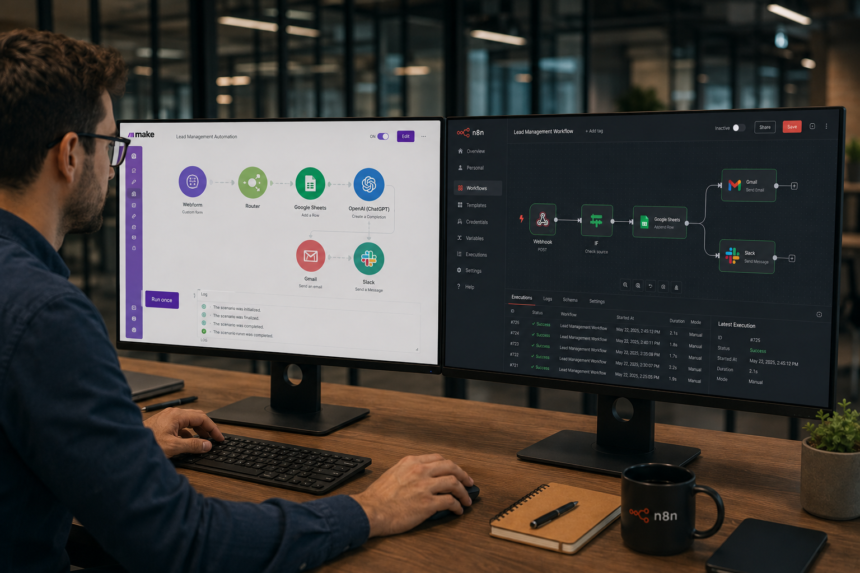


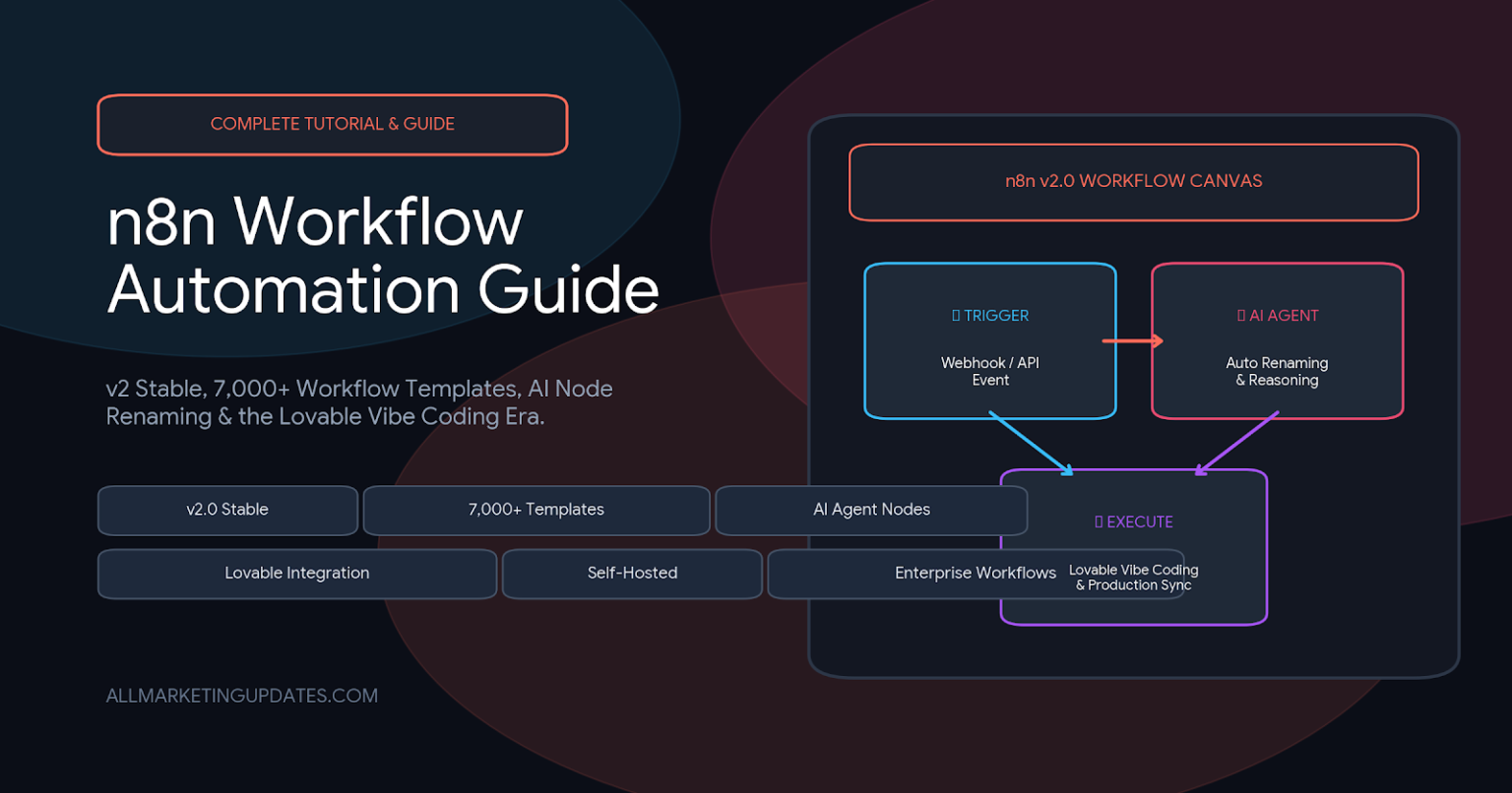
n8n workflow automation is a visual, source-available platform that lets teams build multi-step automations across APIs, AI models, SaaS tools and internal systems — without full-blown engineering cycles. Since its Berlin-based origins, n8n has grown into one of the most widely adopted open-core alternatives to Zapier and Make. This guide consolidates every major 2025–26 n8n release, community and ecosystem milestone into one authoritative resource so engineering, growth, and operations teams can decide whether n8n now meets production-grade standards for 2026.
What n8n Is in 2026 (and Why This Guide Exists)
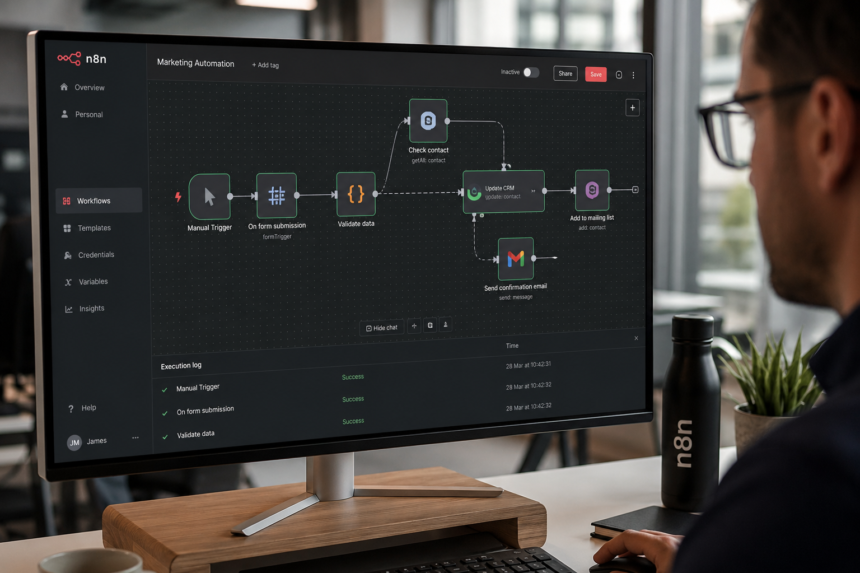
n8n is, structurally, a node-graph workflow engine. Each node wraps a service (Slack, OpenAI, HubSpot, Airtable, PostgreSQL, custom HTTP, etc.) and connects to other nodes through triggers, actions and conditional logic. The visual canvas was once the headline feature; in 2026, the platform’s real differentiation sits underneath it — in production-stable runtime behavior, an aggressive ecosystem cadence, AI-native editing improvements, and a “shared knowledge” template library large enough to compete with closed competitors.
This guide consolidates seven verified 2025–26 milestones — every figure, version number, and date below is drawn directly from official allmarketingupdates.com coverage of n8n news and was re-verified by retrieval this turn. Keep it current; bookmark for updates as the 2026 release calendar evolves.
1. n8n v2.0 Launch — From Experimentation to Essential Infrastructure
The n8n Version 2.0 announcement frames v2** as one of the biggest upgrades in the platform’s history, explicitly repositioning n8n from a flexible builder to a production-grade system that teams can confidently scale. The release focuses on three areas few headline screenshots show — but where enterprise teams actually lose time.
Redesigned workflow canvas — built for complex multi-node graphs, not single-screen automations:
- Faster rendering, even for workflows with dozens to hundreds of nodes
- Smoother navigation between nodes, branches and loops
- Reduced lag during edits, reconnections and large-graph operations
- Refreshed sidebar and layout for clearer organization at scale
Backend overhaul that doesn’t abandon n8n’s open, transparent philosophy:
- Modernised configuration management
- Improved environment variable handling
- Stronger permissions and access controls
- Higher long-term runtime stability
Migration tooling treated as a product feature:
- Pre-migration reports
- Clear identification of potential breaking changes
- Migration guidance rolled out before teams upgrade
Why this matters operationally: when automation becomes critical infrastructure — CRM routing, revenue ops, AI content pipelines, internal reporting — the failure modes are not about “did it connect” but about “did the underlying system stay healthy at three in the morning.” v2’s center of gravity is exactly those migration-to-month-three failure modes.
2. n8n v2 Stable Release — Security, Stability, and Speed First
Less than two weeks after v2’s initial beta, n8n v2 moved to its first stable release, a deliberate signal that the platform has entered its “production-ready” phase. The source article explicitly states the stable-channel criteria n8n targeted:
- Enhanced security foundations (the language the source uses verbatim)
- Improved System Reliability for Production Loads (the source’s verbatim framing — capital “S” in “System” preserved as published)
- Large and complex workflows: performance optimization
Crucially, n8n confirmed ongoing v1.x support for the next three months following the stable v2 promotion — an explicit no-pressure migration window for teams whose businesses enter critical seasons (the source flags this as particularly thoughtful for holiday-heavy businesses prioritizing stability over experimentation). The stable release is “not a hype release but a necessary one.”
Distinction English matters here: “v2 launched” and “v2 went stable” are two milestones. v2’s headline features shipped with the announcement covered in section 1; v2 stable is what the source calls “for production.” Treat the two as separate events when comparing dates or feature lists elsewhere.
3. Over 7,000 Workflow Automation Templates — A New Benchmark for No-Code
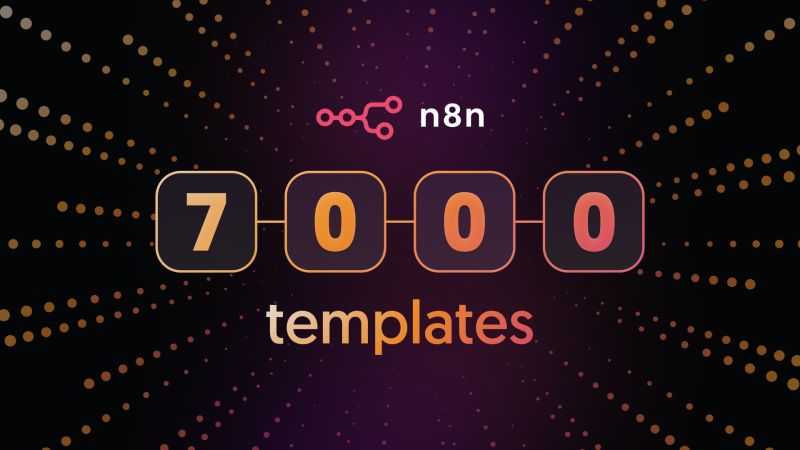
The crossing of 7,000+ workflow automation templates on n8n is, in the source’s framing, “not just a sign of platform growth — it’s evidence of a maturing category.” The article lists what this scale unlocks:
- Skip blank-canvas paralysis: start with a working example
- Learn automation logic by reverse-engineering proven flows
- Adapt, deduplicate, and re-share workflows between projects
- Move from idea to execution faster than closed-platform competitors
Most of these templates are community-contributed, not vendor-built — marketers, developers, operators and founders publish workflows they themselves rely on daily. The source frames this as “open-source learning, even for non-technical teams”: a build → share → refine → reuse loop that closed, top-down platforms find very hard to replicate.
The source additionally links this template milestone to v2.0 explicitly: “Templates lower the barrier to entry. Version 2.0 raises the ceiling. Together, they create a powerful combination.”
Why this matters strategically: in 2026, no-code platform reviews increasingly ask “what can I copy-paste to get value today?” rather than “how many integrations do you list?” — and the 7,000-template mark is the first time that’s been answered at this scale in the no-code category.
4. Daily Node Drops — Expanding the Integration Library
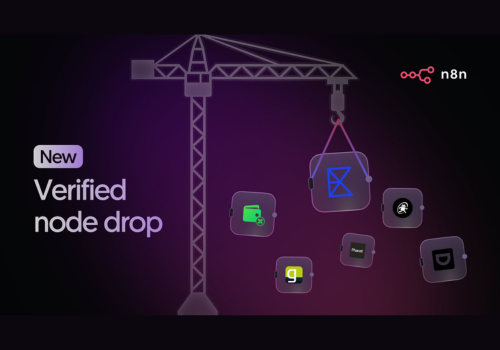
The n8n daily node drops launched from Berlin, late 2025 as a multi-week acceleration of the partner + community node pipeline. The first drop introduced the following integrations, listed by n8n and reproduced here verbatim from the source:
- AnchorBrowser
- CloudswayAI
- Crossmint
- DeepTagger
- Droid Run
- DumplingAI
- Everapi (Screenshotbase and Email Validation)
- geoCapture GmbH
- nele.ai
- Phacetlabs
- Reachkit
- TRIGGERcmd
The source added that three more node drops were scheduled to land before the week ended of the announcement, with all new integrations going live in the n8n integrations directory.
Why this matters operationally: the integration list above is described by n8n as covering “browser automation and AI-powered tagging to payments, validation, and system-level triggers” — meaning it accelerated coverage in three of 2026’s fastest-growing workflow verticals (AI agents, RPA-style browser ops, and validator/crossmint payment rails).
5. AI-Assisted Node Renaming for Cleaner Workflows
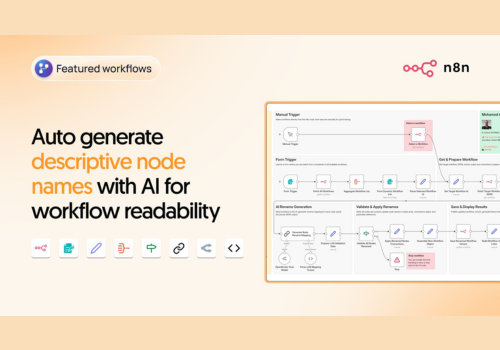
The AI-oriented node renaming update introduces an AI feature that “automatically helps rename nodes depending on their node type, configuration, and connections, thus eliminating manual cleanup tasks.” The source’s stated advantages, preserved verbatim:
- Automatic, context-aware naming of nodes based on what the actual task is that the node is responsible for performing
- Reduces refactoring time when revisiting older workflows
- Cleaner workflows during duplication and reuse across projects
- Better collaboration between team members reviewing one another’s flows
Why this matters practically: in the same canvas-redesign era (section 1 above), this AI feature removes one of the most-cited everyday headaches — “what does this stale node actually do?” — at scale. The source explicitly positions this as production-readiness work: “fewer dirty canvases, clearer logic, and easier construction of automations.”
6. The Lovable × n8n Case Study — Vibe Coding for Enterprise Product Teams
A case study published in December 2025 by Mohammad Owais describes how n8n’s own product and design org uses Lovable — an emerging “vibe coding” platform that lets teams build full-stack apps at unprecedented speed — to prototype features, build internal tools, and shorten the loop between user feedback and shipped product.
The source’s featured voice is Niklas (Nik) Hatje, Group Product Manager at n8n. Three of his quotes stand out and are reproduced here because they are quoted directly in the source:
- “We default to building and shipping quite a lot. Lovable helps us refine product taste and sense while still moving quickly.”
- “Where you would normally turn to another vendor, you can now build exactly what you need. Without Lovable, this tool either wouldn’t exist or would have been built on a suboptimal platform.”
- “I’m a builder at heart. Lovable lets me build again without diving into low-level details.”
The source article attributes three adoption advantages to Lovable, listed here as they are in the source:
- End-to-end capabilities — UI, backend, database, and deployment in a single tool.
- High-quality code export — engineers can use Lovable prototypes directly, reducing “rebuild” rework.
- Speed for non-engineers — product managers and designers can validate ideas visually, not in static documents.
Nik describes Lovable like this in the source: “Sometimes a visual helps you explore the idea better than writing it down. Lovable acts as a thought partner.”
Why this matters for n8n users: the case study is significant because the platform vendor — n8n — uses an AI coding platform (Lovable) for its own internal tooling. That phrasing matters: n8n is not pitching vibe coding as an external n8n feature. It’s documenting how an enterprise product team in the workflow-automation category lives the paradigm. The headline shipping conclusion: it’s a case study in modern, AI-assisted, low-friction product development, not a feature add.
7. Community Livestream and Awards with Jan Oberhauser

The n8n Community Livestream and Community Awards was scheduled to take place one day after the source article was published. Two headline elements stand out:
- A 2025 recap led by Jan Oberhauser (described in the source as both founder and CEO of n8n), reviewing growth milestones across the past year.
- A Community Awards ceremony with 21 nominees across seven different categories, including (per the source, verbatim):
- Contributions to GitHub repositories
- YouTube Education and Content
- Workflow templates
- Nodes constructed by the community
- And other key areas that support and expand n8n platform
Why this matters for the platform adoption curve: the source explicitly notes that this is not just a year-end retrospective — it’s the strategic moment where n8n reiterates that its positioning is “a builders’ platform,” built around community contribution rather than top-down roadmap pushes. For adoption decisions, this is a signal: the ecosystem contribution loop (templates → nodes → answer content → bug-fix credits) is being formalized, not improvised.
How These 7 Milestones Fit Together (The 2026 Pattern)
Read individually, each of these releases is a tactical update. Read together, they describe a coordinated platform shift:
| Milestone | Year of release | What it solved |
|---|---|---|
| Daily node drops | Berlin, late 2025 | Coverage gap in AI, browser-automation, payment, validation categories |
| v2.0 launch | Late 2025 | Canvas and backend readiness for large / complex workflows |
| AI node renaming | Late 2025 | Workflow hygiene at scale and across teams |
| v2 stable channel | Late 2025 (within a week of v2 beta) | Production-grade trust signal + a three-month v1.x support window |
| 7,000+ templates | Verified 2025–2026 | Knowledge loop, ecosystem signal, category maturity |
| Lovable × n8n case study | December 2025 | How an n8n product team uses vibe coding internally |
| Community livestream & awards | Late 2025 | Formalization of the community builder culture |
The thesis is clear: n8n is positioning itself as the production-grade, open-core alternative for the AI-driven automation era, combining enterprise readiness (v2 stable, security, migration tooling), ecosystem depth (7,000 templates, daily node drops), collaborative tooling (AI node renaming), and validated builder culture (Lovable × n8n, community awards). Individual updates reinforce one direction; together, they close a story.
n8n Workflow Automation FAQ
What is n8n used for?
n8n is a visual, source-available workflow automation platform used to connect APIs, AI models, SaaS apps, and internal systems into reusable multi-step pipelines. Common uses include CRM and lead routing, content workflows, AI-agent orchestration, internal reporting, and event-driven system triggers. It is widely adopted as an open-core alternative to Zapier and Make.
Is n8n free to use?
n8n offers a sustainable-use community edition (self-hosted, source-available) and a paid hosted cloud plan. Self-hosted users pay only for their own infrastructure; pricing for the hosted product varies with execution volume. Always verify current pricing on n8n’s official site — figures can change between 2025 and 2026.
How is n8n different from Zapier and Make?
Three structural differences matter most in 2026: (1) source-available, so the platform’s logic is inspectable but commercial use cases still work; (2) a much larger community template library — the 7,000+ milestone referenced in this guide is materially larger than either competitor’s verified community template counts at the time of this writing (per the source article, “a new benchmark for no-code platforms”); and (3) higher ceiling on complexity — customizable code nodes, self-hosting, and conditional flow control that give business users and developers more room to grow into the platform rather than outgrow it.
Is n8n 2.0 stable yet?
Yes. After v2’s initial release, n8n shipped a stable-channel version focused on security, runtime reliability, and performance for large workflows — and committed to continuing v1.x support for the next three months to give teams enough runway to plan their migrations. Always check the official release notes for the most current status.
What new integrations were added in the daily node drop?
The first daily drop included AnchorBrowser, CloudswayAI, Crossmint, DeepTagger, Droid Run, DumplingAI, Everapi (Screenshotbase and Email Validation), geoCapture GmbH, nele.ai, Phacetlabs, Reachkit, and TRIGGERcmd. Three further drops were scheduled within the same week by n8n’s announcement cadence.
What does the AI node renaming feature do?
It auto-rewrites node names in a workflow based on each node’s type, configuration, and connections, so messy or stale nodes become self-describing. It’s a hygiene, collaboration and reuse feature — particularly useful for large automation libraries and agencies running multiple client projects.
Who is n8n’s founder?
n8n’s founder and CEO is Jan Oberhauser, who led the 2025 community recap livestream and the Community Awards. He founded and continues to lead the platform headquartered in Berlin.
Can non-developers use n8n?
Increasingly yes — the 7,000+ templates library is the biggest single reason. A non-developer can install a community template, swap API keys, and run a workflow end-to-end. v2’s canvas and AI node renaming also lower friction for newcomers. For highly custom flows, the platform still benefits from someone on the team who can read documentation and write or adapt code nodes, but full engineering cycles are no longer a prerequisite for everyday automation work.