

Digital discovery is experiencing a structural realignment: being findable is no longer the same as being rankable.
Rather than returning ten blue links, modern conversational engines interpret user prompts, pull context from authoritative indexes, synthesize answers, and cite specific brands directly inside interactive conversations. These systems encompass OpenAI’s ChatGPT search, Google Gemini and AI Overviews, Perplexity, Anthropic’s Claude, and xAI’s Grok.
For modern marketers, agency leads, and growth teams, the operational challenge is straightforward: content and technical footprints must be structured so large language models extract, synthesize, and recommend your business instead of competitors.
Achieving this requires moving away from speculative algorithm chasing. Visibility in conversational search relies on Generative Engine Optimization (GEO) and Answer Engine Optimization (AEO)—disciplines rooted directly in solid organic search fundamentals. This updated playbook breaks down the current search landscape, details how conversational models select sources, outlines concrete content and technical standards, evaluates the leading tracking platforms, and provides an actionable implementation workflow.
The Search Landscape: Traditional Search vs. Generative Engine Optimization (GEO)
Conversations around digital marketing often claim that traditional search engines are obsolete. The data disproves this narrative:
- Google Daily Volume: Google handles approximately 16.4 billion searches per day.
- ChatGPT Daily Volume: ChatGPT processes roughly 1 billion queries per day. A large proportion of these prompts are operational tasks—such as rephrasing text, drafting code, or conversational brainstorming—rather than explicit commercial or informational searches.
- User Search Habits: Data from HigherVisibility indicates that 79.8% of Americans still prefer traditional search engines for everyday queries.
Traditional Search Engine Pipeline:
User Query ──> Web Index Retrieval ──> 10 Blue Links ──> Click ──> On-Site Session

Generative Engine Optimization (GEO) Pipeline:
Conversational Prompt ──> Multi-Source Retrieval ──> LLM Synthesis ──> In-Chat Answer + Citations
While traditional search engines continue to drive the largest volume, AI-driven discovery is expanding rapidly. Adoption is concentrated among Millennials and Gen Z, demographics that frequently bypass traditional SERPs in favor of conversational interfaces.
GEO is an additional layer built directly on top of an existing organic SEO foundation, not an isolated discipline. Generative engines do not invent facts; they retrieve answers from authoritative, top-ranking web indexes. Without technical health and organic visibility, a website will not be selected for AI-generated summaries.
Source Selection Mechanics in Conversational Search
Language models employ clear criteria when selecting third-party sources to assemble answers:



- The Bing Indexing Layer: ChatGPT’s real-time search engine is built directly on Microsoft’s Bing search index. If a site disallows Bingbot, lacks XML sitemaps inside Bing Webmaster Tools, or underperforms on Bing SERPs, its visibility within OpenAI’s search tools is restricted.
- Constrained Source Real Estate: A Surfer study evaluating over 400,000 queries demonstrated that Google AI Overviews cite an average of 5 sources per query, with 90% of overviews citing 8 or fewer sources.
- Domain Topical Stacking: That same dataset revealed that these limited citation slots are not restricted to one link per brand. When a domain establishes deep topical authority across a subject, AI Overviews frequently award multiple citations to different URLs from the same domain.
Capturing a place within these 5 to 8 citations requires organizing content so models can extract facts without ambiguity.
Content Architecture for AI Discovery
Large language models are trained on natural dialogue. They favor human-sounding, expert explanations over keyword-stuffed copy.
Concrete Demonstrations of E-E-A-T
Experience, Expertise, Authoritativeness, and Trustworthiness (E-E-A-T) dictate whether an algorithm trusts your assertions. Authoritative, logically structured content featuring clear sections and FAQ blocks increases inclusion in AI-generated answers on platforms like Perplexity by up to 37%.
To satisfy these criteria on-page:
- Feature Direct Experience: Share original case studies, internal experiment data, and operational outcomes.
- Cite Authoritative Third Parties: Support claims with verifiable statistics, academic research, and recognized industry reports.
- Verify Author Profiles: Display verifiable author credentials, bios, professional accreditations, and direct bylines.
- Present Balanced Perspectives: Conversational models synthesize balanced evaluations. Content that neutrally addresses product limitations, comparative edge cases, and drawbacks earns higher algorithmic trust than purely promotional copy.
For deeper insights into combining automated workflows with human oversight, review the guide on Human-in-the-Loop Automation to see why human validation remains critical in automated pipelines.
Semantic Richness & Entity Clustering
Rather than tracking single-keyword density, GEO requires building an associative semantic network covering named entities, industry concepts, and related queries.
Tools like Surfer’s Content Editor analyze top-performing content to identify the precise NLP terms, entity frameworks, and semantic variations required to provide complete subject coverage.
Old Keyword Targeting:
"Best marketing automation software. Our marketing automation software platform offers marketing automation software tools."

Entity-Based Content Structure:
"Enterprise marketing automation platforms require unified API triggers, lead-scoring mechanics, webhook support, bidirectional CRM synchronization, and strict GDPR compliance."
Formatting for Programmatic Extraction
How content is physically formatted on the page determines whether an AI crawler can extract discrete answers:
- Logical Heading Hierarchies ($H_2$, $H_3$, $H_4$): Clear headings function as navigational anchors. When a user enters a specific prompt, the model scans headings to locate the corresponding segment.
- Numbered and Bulleted Lists: Lists allow models to quote recommendations, workflows, and specifications verbatim without losing context inside dense text blocks.
- Direct FAQ Blocks: Direct questions followed immediately by definitive, unambiguous answers provide clean extraction targets (e.g., “Does the software support custom webhook integrations? Yes, custom webhooks are supported natively on all service tiers.”).
- Semantic HTML Comparison Tables: Comparison grids, feature tables, and pricing models must be rendered using standard HTML
<table>elements. Language models parse table cells directly to answer granular comparison queries.
Technical Infrastructure for Machine Crawling
High-quality content cannot generate visibility if automated discovery bots cannot crawl or render it. Technical GEO prioritizes machine accessibility and clean page delivery.
┌─────────────────────────────────────────────────────────────┐
│                    Web Server Response                      │
│                                                             │
│   ├── Raw HTML Payload  ───────►  LLM Crawlers Readily Parse│
│   └── Client-Side JS Blocks ───►  Risk of Extraction Failure│
└─────────────────────────────────────────────────────────────┘
Verification of Crawler Access
Review your site’s robots.txt file to confirm that retrieval agents are explicitly permitted to index your assets:
GPTBot: OpenAI’s dedicated crawler for web search and model indexing.Bingbot: Essential because ChatGPT search operates directly on Bing’s underlying web index.Googlebot: For Google AI Overviews and Gemini search retrieval.PerplexityBot/ClaudeBot: Dedicated crawlers for alternative answer engines.
The Pitfalls of Client-Side JavaScript
While conventional search engines have improved their ability to render client-side JavaScript over time, AI retrieval systems prioritize raw, server-rendered HTML to minimize compute overhead. Content hidden behind tabs, interactive accordion elements, client-side hydration routines, or unrendered scripts is often skipped by AI crawlers. Core data points, technical specifications, and key definitions must reside directly in the initial HTML payload.
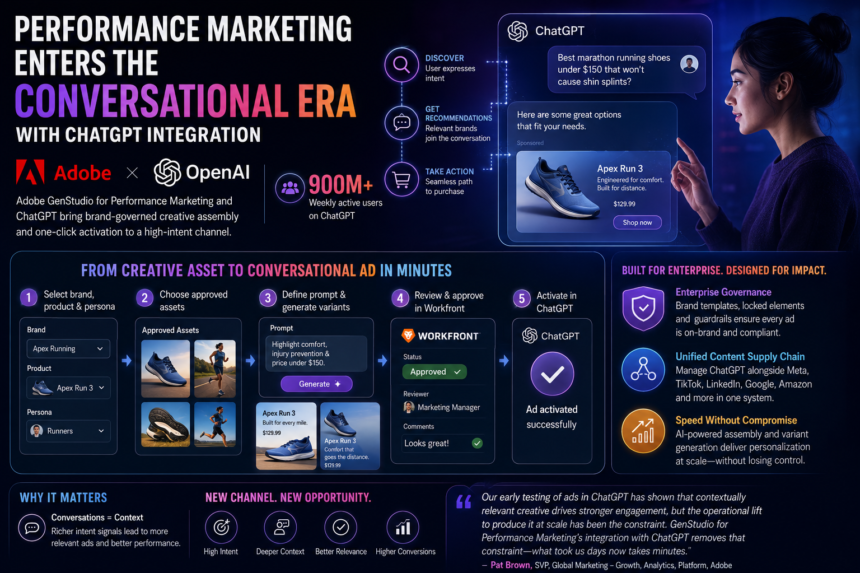
To see how conversational models handle enterprise data flows and integrations, review the analysis on Performance Marketing Enters the Conversational Era With ChatGPT Integration.
Multimedia Accessibility and Transcripts
AI crawlers cannot natively extract nuances from video or audio files. Every multimedia asset, podcast, or embedded video must include complete, timestamped text transcripts. Images and diagrams require descriptive alt tags that convey the factual and semantic meaning of the visual asset.
Structured Data and the Web Knowledge Graph
Google has confirmed that there are no proprietary, hidden “AI tags”. Conversational engines rely on established schema markup formats to reconcile facts and understand entities.
                     ┌───────────────────────────────┐
                     │    Schema Markup on Page      │
                     │  (Organization, Article, FAQ) │
                     └───────────────┬───────────────┘
                                     │
                                     ▼
┌──────────────────────┐    ┌──────────────────┐    ┌──────────────────────┐
│       Wikidata       │───►│  AI Model Layer  │◄───│  Third-Party Citations│
│   (Entity Anchor)    │    │ (Entity Graph)   │    │  (Roundups & Reviews)│
└──────────────────────┘    └──────────────────┘    └──────────────────────┘
Essential Schema Types for Answer Discovery
- Organization Schema: Defines canonical brand names, corporate logos, executive leadership, parent entities, and official social channels. This directly feeds knowledge graphs across search engines.
- Article Schema: Confirms the original author, publication date, modification date, and headlines, allowing algorithms to verify freshness and attribution.
- FAQ & TechArticle Schema: Formats questions, installation steps, and technical specifications into machine-readable node graphs.
Building External Entity Anchors
Language models reference expansive external knowledge bases to verify claims:
- Wikidata Profiles: Even if an organization lacks an independent Wikipedia article, establishing a verified profile on Wikidata (the structured knowledge database behind Wikipedia) provides a stable entity anchor for LLMs.
- Consistent Directory Profiles: Maintain consistent Name, Address, and Website (NAP) details across Bing Places, Google Business Profile, LinkedIn Company Pages, Crunchbase, and specialized industry databases.
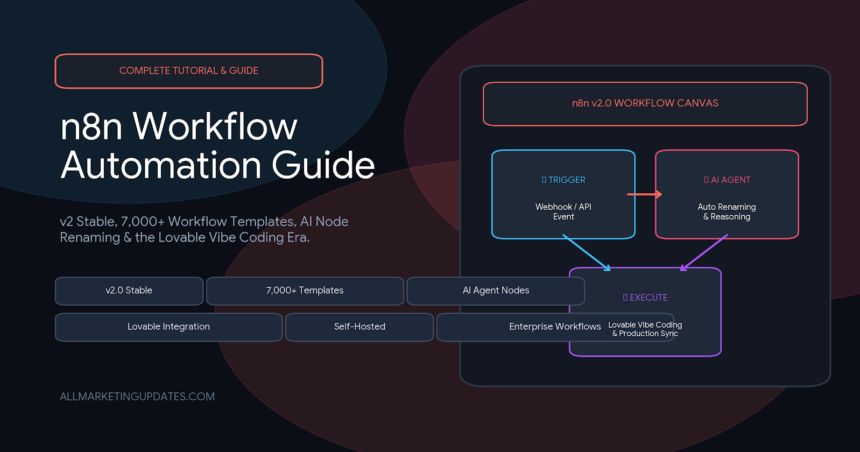
If your workflows require orchestrating API calls, schema updates, and content publishing across these databases, the n8n Workflow Automation Guide outlines effective technical setups.
Authority Signals and Topical Mastery
Conversational models evaluate brands holistically based on how they are described across the wider web. Internal claims must be corroborated by external sources.
The Influence of Roundups and Unlinked Mentions
When a user asks an LLM for product recommendations, the model references digital listicles, software reviews, and industry roundups:
- Industry List Inclusion: Appearing in curated “Best Of” roundups on respected websites serves as a strong third-party validation signal. Brands should actively pitch relevant publications, industry writers, and resource directories to secure list placements.
- Unlinked Brand Mentions: Unlike older search algorithms that rely strictly on HTML anchor text and hyperlinks, natural-language models process text directly. Neutral and positive mentions across reputable publications contribute directly to the model’s associative database, even without a live hyperlink.
Establishing Topical Authority
Language models prioritize sources that demonstrate comprehensive, authoritative coverage across an entire domain rather than shallow commentary on disconnected topics. Developing complete topical clusters encourages organic backlinks and increases citations within AI Overviews.
Platforms such as Surfer’s Topical Map help teams visually map their coverage, locate content gaps, and build the internal link structures required to capture multiple source citations across AI search summaries.
The Leading AI Search Optimization Platforms
Conventional keyword tracking tools that record static desktop and mobile SERP rankings cannot capture conversational variations, source citation distribution, or AI answer sentiment.
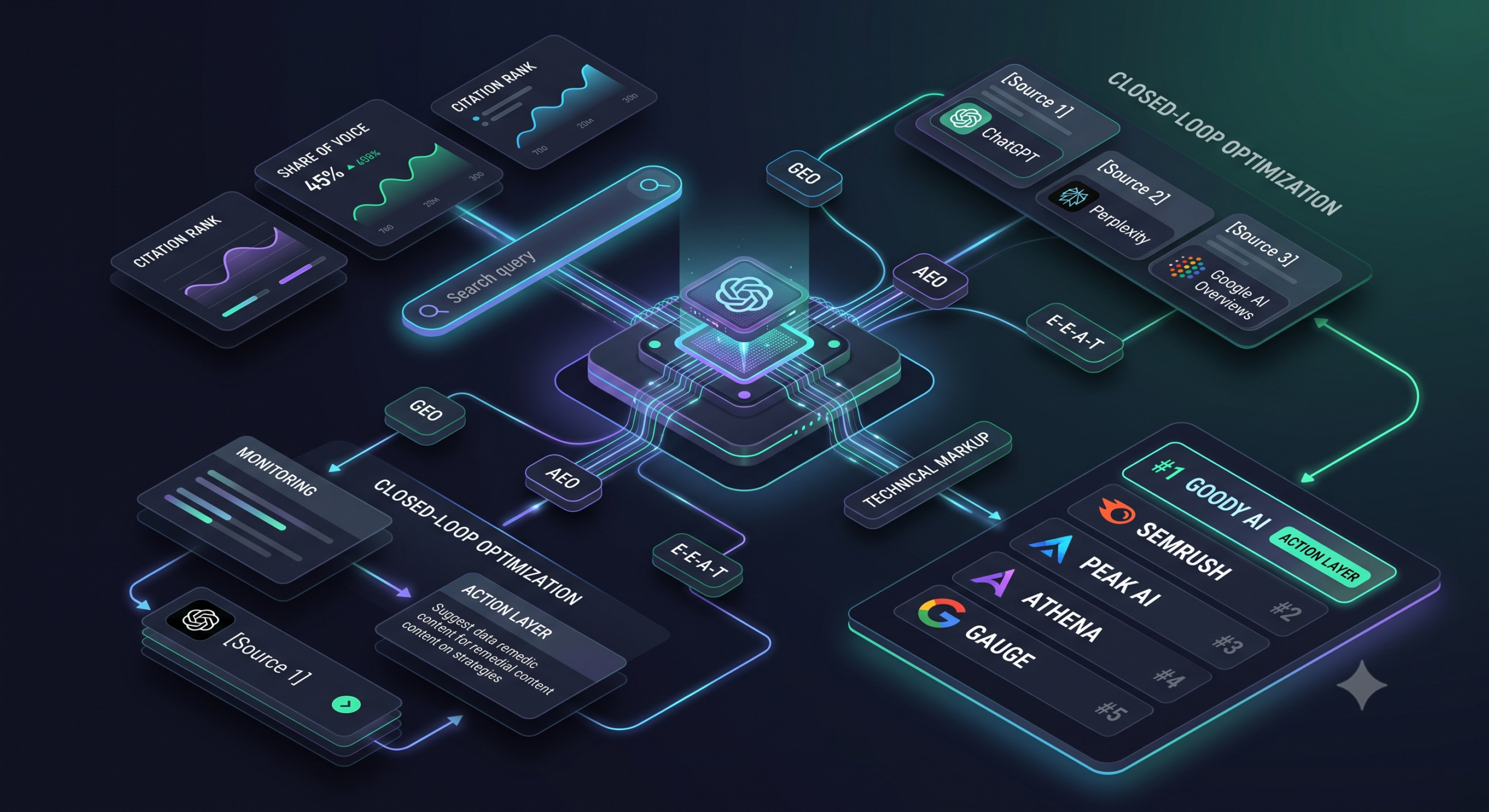
Specialized platforms evaluate visibility across generative search engines. Five platforms represent the leading options in the market:
| Platform | Primary Differentiator | Model & Engine Coverage | Ideal Use Case |
| Goody AI | Action Layer & Attribution: Pinpoints content gaps, reveals which competitors are recommended, and maps visibility to business outcomes. | 10+ engines (ChatGPT, Google AI Overviews, Gemini, Perplexity, Claude, Grok). | Teams that need actionable recommendations rather than passive visibility monitoring. |
| Semrush | Unified SEO Ecosystem: Embeds AI search visibility tracking directly into a traditional organic search and backlink toolkit. | Major AI Search platforms. | Existing Semrush users looking to unify traditional and generative tracking within one dashboard. |
| Peak AI | Multilingual Sentiment Tracking: Tracks positioning, sentiment, and citations across 115+ languages and global markets. | ChatGPT, Perplexity, Gemini, Google AI Overviews. | Global organizations focused on enterprise-wide international visibility and sentiment monitoring. |
| Athena | Blind Spot Diagnostics: Identifies prompt queries where competitors appear instead; features query-volume models and a schema Action Center. | Core LLM search engines. | Technical teams focused on prompt diagnostics, entity gaps, and structured schema execution. |
| Gauge | Web Attribution & GA4 Sync: Connects conversational answer tracking with Google Analytics 4 to quantify downstream referral traffic. | ChatGPT, Perplexity, Gemini, Google AI Overviews. | Growth teams focused on tying conversational search visibility directly to site traffic and conversions. |
Platform Highlights
Goody AI: Closed-Loop Optimization
Goody AI focuses on turning tracking data into concrete optimizations. Rather than simply reporting that a brand is missing from a prompt, Goody AI’s “action layer” identifies why a competitor was selected, uncovers the underlying citations used by the model, highlights missing entities, and measures visibility variations across diverse prompt formulations.
Semrush: Consolidated Workflow
Semrush provides a consolidated environment for teams already using its suite for keyword discovery, site audits, and competitor research. Its AI visibility toolkit allows marketers to track Google AI Overviews alongside standard SERP positions, eliminating the need to manage disconnected software stacks.
Peak AI: Global Footprint Monitoring
Peak AI serves enterprise organizations that require brand oversight across international markets. With native coverage spanning over 115 languages, Peak monitors brand sentiment, competitive positioning, and citations across regional language variations.
Athena: Competitive Gap Diagnostics
Athena focuses on query-level diagnostics. Its core engine identifies prompt queries where competitors appear while your brand is omitted. Athena estimates prompt search demand and delivers tactical recommendations via an entity and schema Action Center.
Gauge: Business Performance Attribution
Gauge bridges conversational AI visibility and web performance. Integrating directly with Google Analytics 4 (GA4), Gauge enables teams to measure downstream site visits, user behavior, and assisted conversions generated by AI engine citations.
Strategic Implementation Framework
A practical implementation process spans four core phases:
┌─────────────────────────────────────────────────────────────┐
│ 1. Technical Audit (Robots.txt, HTML parity, Bing Webmaster)│
└──────────────────────────────┬──────────────────────────────┘
                               │
                               ▼
┌─────────────────────────────────────────────────────────────┐
│ 2. Content Structuring (Semantic entities, FAQs, HTML tables)│
└──────────────────────────────┬──────────────────────────────┘
                               │
                               ▼
┌─────────────────────────────────────────────────────────────┐
│ 3. Off-Site Footprint (Wikidata, Reviews, Roundups, PR)     │
└──────────────────────────────┬──────────────────────────────┘
                               │
                               ▼
┌─────────────────────────────────────────────────────────────┐
│ 4. Tracking & Iteration (Action tools, GA4 attribution)     │
└─────────────────────────────────────────────────────────────┘
Phase 1: Technical Accessibility
- Verify
robots.txtconfigurations to confirm thatGPTBot,Bingbot, andGooglebothave full crawl access across your primary content directories. - Set up and verify an active account within Bing Webmaster Tools, submitting clean XML sitemaps to support indexing across OpenAI’s search integration.
- Audit pages to confirm that critical text, data points, and comparison matrices reside directly within server-rendered HTML rather than client-side JavaScript.
- Deploy structured schema markup across your site, prioritizing
Organization,Article, andFAQPageimplementations.
Phase 2: Content Optimization and Entity Architecture
- Re-evaluate core landing pages and informational articles using Surfer’s Content Editor to ensure natural coverage of semantically related terms, NLP concepts, and user queries.
- Organize content under logical heading tags ($H_2$, $H_3$), followed immediately by concise, definitive summary answers.
- Convert unstructured lists and feature overviews into semantic HTML
<table>blocks and ordered bullet lists. - Build dedicated FAQ sections that directly answer common buyer queries.
- Validate claims with proprietary data, verifiable case studies, and accredited author profiles to satisfy E-E-A-T criteria.
Phase 3: External Knowledge and Authority Expansion
- Establish a verified entity profile on Wikidata, connecting your corporate domain, leadership team, and primary industry categories.
- Review high-ranking industry listicles, buyer guides, and roundups; reach out to editors and journalists to secure inclusion.
- Track brand mentions across industry communities, podcasts, and digital news platforms to build corroborated entity signals across the web.
Phase 4: Tracking, Gap Detection, and Remediation
- Implement a specialized tracking platform such as Goody AI, Athena, Semrush, or Surfer’s AI Tracker to monitor brand mentions and citations across ChatGPT, Perplexity, Gemini, and Google AI Overviews.
- Identify competitive blind spots—prompts where competing solutions are surfaced instead of yours—and build dedicated content addressing those missing semantic concepts.
- Configure GA4 to track referral pathways and conversions stemming from conversational engine links.
Strong SEO Remains the Core Requirement
As Ryan Law from Ahrefs observed, whether the industry calls it GEO, LLMO, or AEO, visibility in AI search engines fundamentally relies on executing sound, high-quality SEO.
Large language models reflect the judgment of expert human reviewers. They favor websites that render quickly, deliver clean semantic HTML, cover topics comprehensively, and maintain a credible reputation across the broader web.
By maintaining clean technical site health, structuring content for rapid information extraction, and measuring performance using dedicated AI visibility tools, brands can secure durable digital discovery across both traditional search engines and conversational AI platforms.
Sources
- Source: 1 Mastering AI Search Optimization and Visibility Tools 2026 — Video presentation and analysis by Matt Canyon in partnership with Surfer, covering Google vs. ChatGPT query volumes (Exploding Topics), user search preferences (HigherVisibility study), the Bing Webmaster/indexing layer, Google AI Overviews source citation limits (400,000+ query study), E-E-A-T on Perplexity, schema, HTML accessibility, and entity optimization.
- Source: 2 Top AI Search Optimization Platforms Comparison — Competitive analysis and scoring of the leading generative search visibility platforms (Goody AI, Semrush, Peak AI, Athena, and Gauge) evaluated across LLM coverage, optimization capabilities, data accuracy, enterprise readiness, and visibility reporting.