





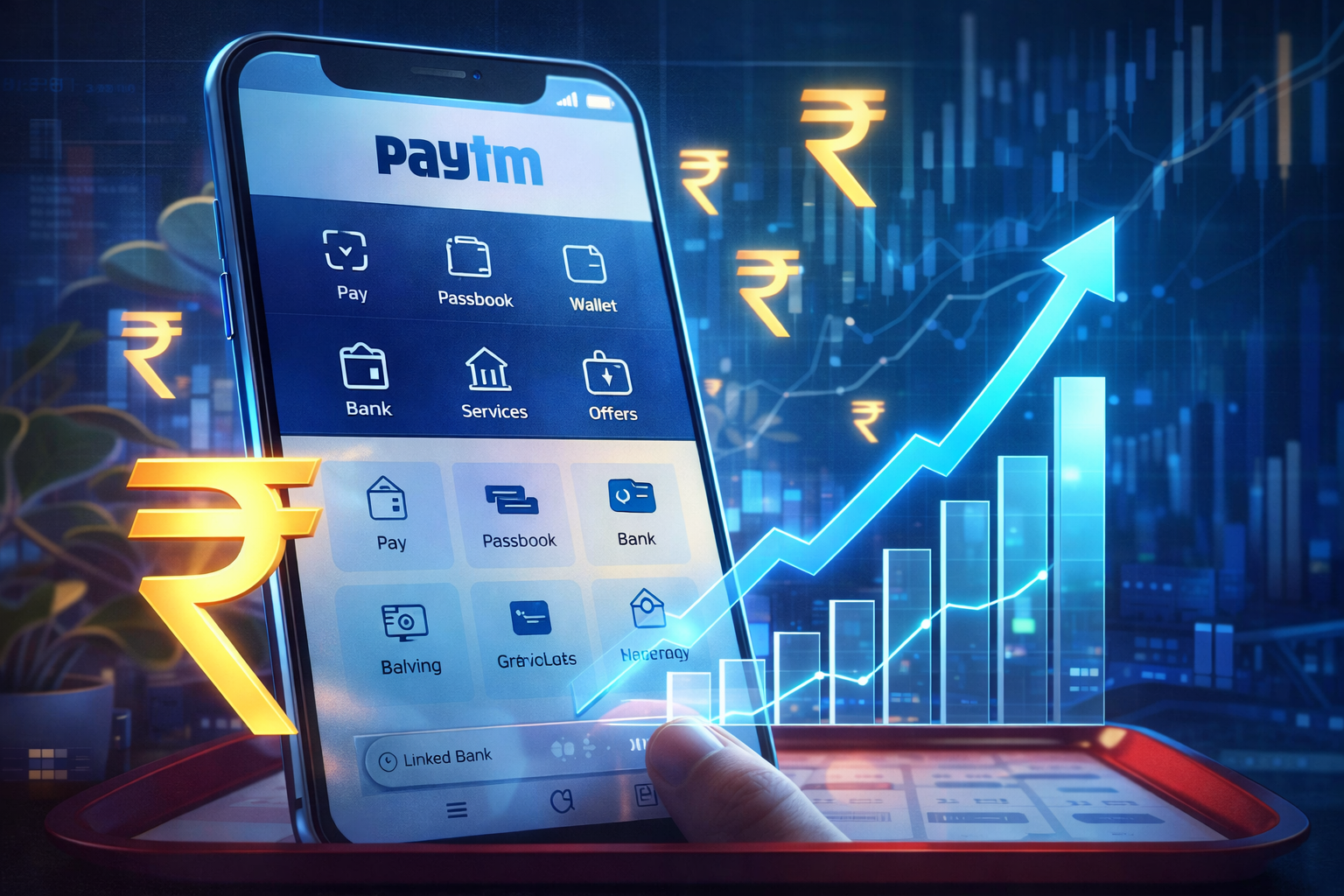

In a significant structural shift that reflects both market confidence and evolving investor dynamics, One97 Communications—the operator of Paytm—has officially become a majority Indian-owned and controlled company. As of March-end 2026, domestic investors now hold 50.3% of the company, marking a notable transition in ownership composition.
- Domestic Ownership Surge: A Turning Point
- Mutual Funds and Insurance Players Lead the Charge
- Improving Financial Performance Strengthens Investor Confidence
- Merchant Business: The Core Growth Engine
- Broker Confidence and Market Outlook
- Digital Strategy and Growth Execution
- A Broader Shift in India’s Fintech Landscape
- Challenges Ahead
- FAQs
- Conclusion
This development is not merely symbolic; it represents a deeper shift in how Indian institutional capital is increasingly backing homegrown technology companies, particularly those that have demonstrated resilience and improving financial performance.
Domestic Ownership Surge: A Turning Point
The rise in domestic shareholding has been gradual but consistent, culminating in a record 50.3% stake. Domestic institutional investors alone increased their holdings to 23.1% in the March quarter, reflecting a steady upward trend both sequentially and year-on-year.
This shift indicates growing confidence among Indian investors, who are now playing a more active role in shaping the ownership structure of major fintech companies. It also highlights a broader trend where domestic capital is stepping in to support long-term growth in the technology sector.
Mutual Funds and Insurance Players Lead the Charge
A closer look at the composition of domestic ownership reveals that mutual funds have been at the forefront of this increase. Their collective stake rose to 16.6%, supported by a growing number of participating funds, including prominent players such as Motilal Oswal Mutual Fund, Mirae Asset, and Bandhan Mutual Fund.
Insurance companies have also strengthened their positions, raising their combined stake to 5.1%. This participation from long-term institutional investors suggests a strong belief in Paytm’s future prospects, particularly as the company continues to refine its business model and improve profitability.
Improving Financial Performance Strengthens Investor Confidence
The increase in domestic ownership has coincided with a notable improvement in Paytm’s financial performance. The company reported its third consecutive profitable quarter, posting a net profit of ₹225 crore in the December quarter, alongside a 20% year-on-year increase in revenue to ₹2,194 crore.
EBITDA stood at ₹156 crore with margins of 7%, indicating that the company is not only growing but also becoming more operationally efficient. Such improvements play a crucial role in attracting institutional investors, who typically prioritize sustainable profitability over rapid but unstable growth.



Merchant Business: The Core Growth Engine
One of the key drivers behind Paytm’s improving fundamentals is its strong performance in the merchant segment. The company’s subscription merchant base has crossed 1.44 crore, reflecting a 24% year-on-year increase.
This growth highlights Paytm’s success in building a robust ecosystem around merchant payments and financial services, positioning itself as a key player in India’s digital economy. The ability to monetize these services effectively has become a critical differentiator in the competitive fintech landscape.
To manage such large-scale merchant ecosystems and customer interactions, companies often rely on CRM and marketing automation platforms to streamline operations, improve retention, and optimize engagement strategies.
Broker Confidence and Market Outlook
The improving fundamentals have not gone unnoticed by global brokerages. Bank of America has upgraded the stock, citing Paytm’s leadership in higher-monetization segments and its advancing profitability trajectory. The brokerage emphasized the company’s strength in B2B services and its diversified business model, maintaining a positive outlook with a ‘Buy’ rating.
Similarly, Bernstein has highlighted Paytm’s revenue advantage in the merchant business, noting that it generates nearly twice the revenue of its closest competitor despite similar payment volumes. This indicates a stronger monetization strategy and a more mature revenue model.
Digital Strategy and Growth Execution
Beyond financial metrics, Paytm’s continued growth also reflects its ability to adapt to evolving digital ecosystems. From payments to lending and financial services, the company has built an integrated platform that caters to both consumers and businesses.
To sustain this growth and enhance customer engagement, fintech companies increasingly rely on AI-powered tools for social media marketing to drive awareness, personalize communication, and optimize user acquisition strategies.
A Broader Shift in India’s Fintech Landscape
Paytm’s transition to majority Indian ownership is part of a larger trend in the Indian fintech ecosystem, where domestic capital is playing an increasingly significant role. As regulatory frameworks evolve and local investors gain confidence, more companies are likely to see similar shifts in ownership structures.
This trend not only strengthens the domestic financial ecosystem but also reduces reliance on foreign capital, creating a more balanced and resilient market environment.
Challenges Ahead
While the outlook appears positive, Paytm will need to maintain its growth momentum and continue improving profitability to justify investor confidence. Competition in the fintech space remains intense, with multiple players vying for market share across payments, lending, and financial services.
Sustaining innovation while managing costs and regulatory requirements will be key to long-term success.
FAQs
What does majority Indian-owned mean for Paytm?
It means domestic investors now hold more than 50% of the company’s shares.
Why is this shift important?
It reflects growing confidence from Indian institutional investors and strengthens domestic control.
Is Paytm profitable now?
Yes, the company has reported multiple consecutive profitable quarters.
Conclusion
Paytm’s transition to a majority Indian-owned company marks a significant milestone in its journey, reflecting both improved financial performance and rising confidence among domestic investors. As the company continues to strengthen its business model and expand its merchant ecosystem, it is well-positioned to play a central role in India’s evolving fintech landscape.
This shift also signals a broader transformation in how Indian capital is supporting homegrown technology companies, paving the way for a more self-reliant and robust digital economy.