





India’s creator economy is no longer just about influencers posting videos or brands collaborating with creators for one-off campaigns. A much bigger transition appears to be taking shape — creators are increasingly becoming part of formal organisational structures.
- Creator Hiring Has Moved From Side Hustles To Structured Careers
- Companies Are Building Creator Teams, Not Just Hiring Creators
- Why Brands Want Creators In-House
- The Talent Gap Is Becoming A Bigger Problem
- India’s Creator Economy Is Becoming Institutionalised
- Performance Is Becoming The New Creator Metric
- Related Reads
- What This Means For The Future Of Marketing
- Conclusion
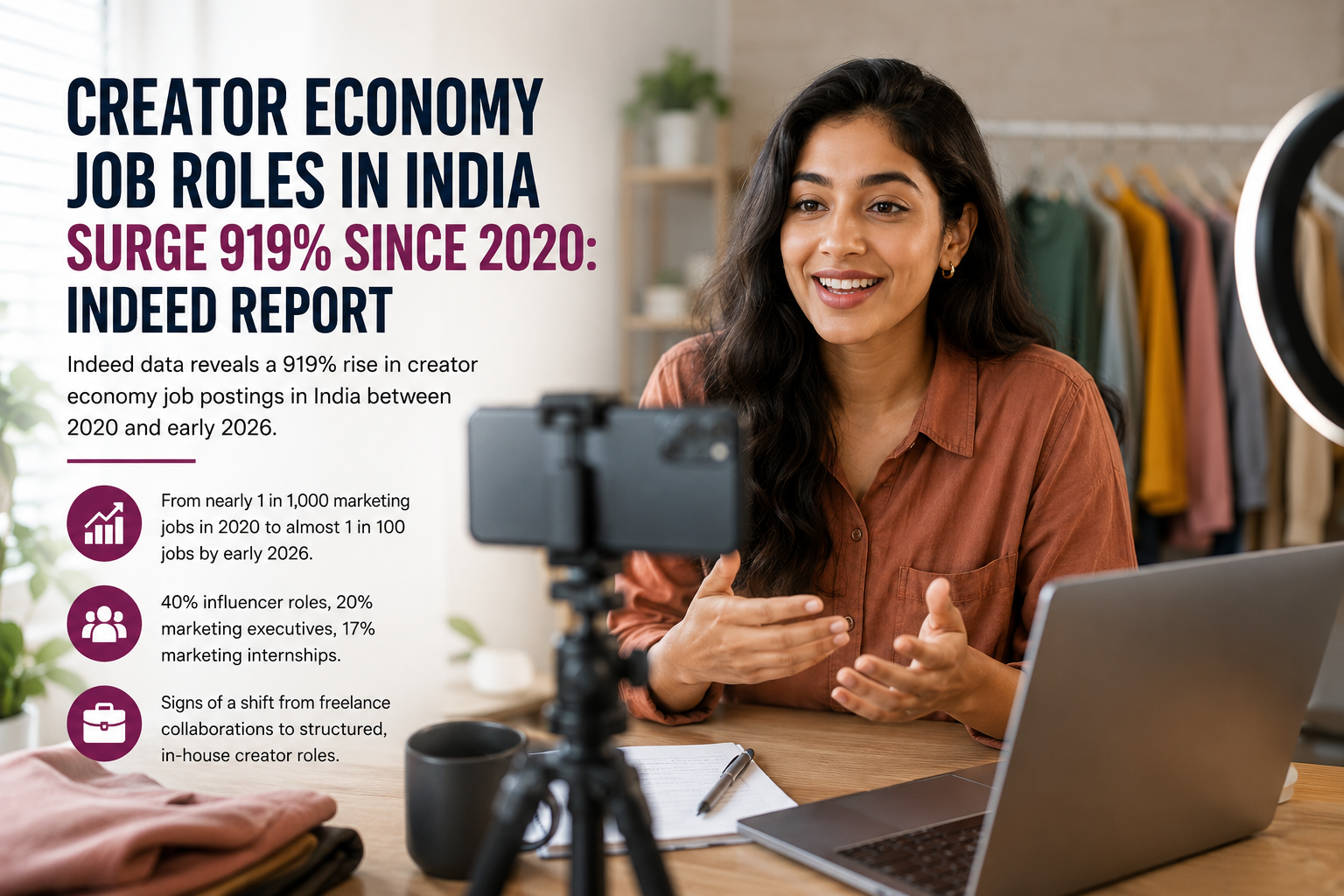
According to new data released by Indeed, India has witnessed a 919% increase in job postings requiring creator-focused skills between 2020 and early 2026. The numbers point toward a major shift in how companies view creators — from external collaborators to strategic in-house talent.
The report suggests that brands and agencies are no longer hiring creators simply for reach or visibility. Increasingly, they are building structured content ecosystems around them.
Creator Hiring Has Moved From Side Hustles To Structured Careers
Just a few years ago, creator-related work largely revolved around:
- freelance collaborations
- sponsorship deals
- campaign-based influencer partnerships
- independent content creation
But the latest data shows the ecosystem maturing rapidly.
According to Indeed:
- Creator-focused roles represented nearly 1 in every 1,000 marketing jobs in 2020
- By early 2026, that number had increased to almost 1 in every 100 marketing jobs
That shift signals something significant:
Content creation is gradually becoming an integrated business function rather than a peripheral marketing activity.

Companies Are Building Creator Teams, Not Just Hiring Creators
The report also highlights that creator hiring has become increasingly multidisciplinary.
Between March 2025 and February 2026:
Job role distribution included:
- 40% influencer-related roles
- 20% marketing executive positions
- 17% marketing internships
The remaining demand was spread across:
- video production
- content operations
- social media management
- community building
- engagement teams
This indicates that businesses are no longer relying solely on individual creators.
Instead, they are creating entire internal ecosystems around content production and audience engagement
Why Brands Want Creators In-House
For years, brands largely depended on external influencers for campaigns and audience access.
But as creator-led marketing budgets increased, businesses also discovered challenges around:
- accountability
- consistency
- brand safety
- performance measurement
- long-term audience relationships
As Saumitra R Chand noted:
“Employers aren’t just looking for reach anymore; they’re looking for accountability.”
That statement reflects a broader industry shift.
Today, creators are increasingly expected to operate like business functions rather than independent promotional channels.
The Talent Gap Is Becoming A Bigger Problem
While demand for creators is accelerating, supply appears to be struggling to keep pace.
The report highlights a growing imbalance between:
Employer demand
vs
qualified creator talent availability
This creates several challenges:
- brands competing for experienced creators
- rising compensation expectations
- increased focus on creator upskilling
- stronger emphasis on measurable outcomes
As more companies enter the space, attracting skilled creator talent could become increasingly competitive.
India’s Creator Economy Is Becoming Institutionalised
The growth also comes alongside broader policy recognition around India’s creator ecosystem.
Over the past few years, creators have evolved from being viewed largely as social media personalities into participants in a formal digital economy.
Increasing institutional support creates:
- greater career clarity
- stronger legitimacy
- improved long-term planning
- more predictable growth opportunities
Eshaanya Maheshwari highlighted this shift:
Performance Is Becoming The New Creator Metric
The creator economy historically rewarded:
- followers
- views
- engagement
- virality
But increasingly, organisations appear to be evaluating creators through business metrics.
Rohan Sylvester noted that creator expectations are now moving toward measurable outcomes such as:
- audience engagement
- conversions
- brand consistency
- performance metrics
This suggests creators may increasingly operate similarly to:
- marketing teams
- sales teams
- growth teams
- customer acquisition teams
Related Reads
As creator ecosystems and digital marketing continue evolving, you may also like:
- https://allmarketingupdates.com/fortnightly-social-media-roundup-ai-safety-content-discovery/
- https://allmarketingupdates.com/performance-marketing-enters-the-conversational-era-with-chatgpt-integration/
- https://allmarketingupdates.com/best-ai-tools-for-social-media-marketing/
- https://allmarketingupdates.com/top-crm-with-marketing-automation-tools/
What This Means For The Future Of Marketing
The creator economy is increasingly moving beyond influencer marketing.
Brands are now investing in:
- creator-led storytelling
- in-house content systems
- community-first growth
- performance-driven content teams
- AI-powered content workflows
This could reshape how companies build marketing organisations over the next decade.
The distinction between “creator” and “marketer” may gradually become less defined.
Conclusion
The 919% increase in creator-related job roles signals something much larger than a hiring trend.
It represents the formalisation of an industry that was once considered informal and experimental.
Creators are increasingly becoming integrated into how brands communicate, engage, and grow.
For India’s creator economy, the next phase may not simply be about building audiences.
It may be about building careers, systems, and long-term business functions around content itself.