

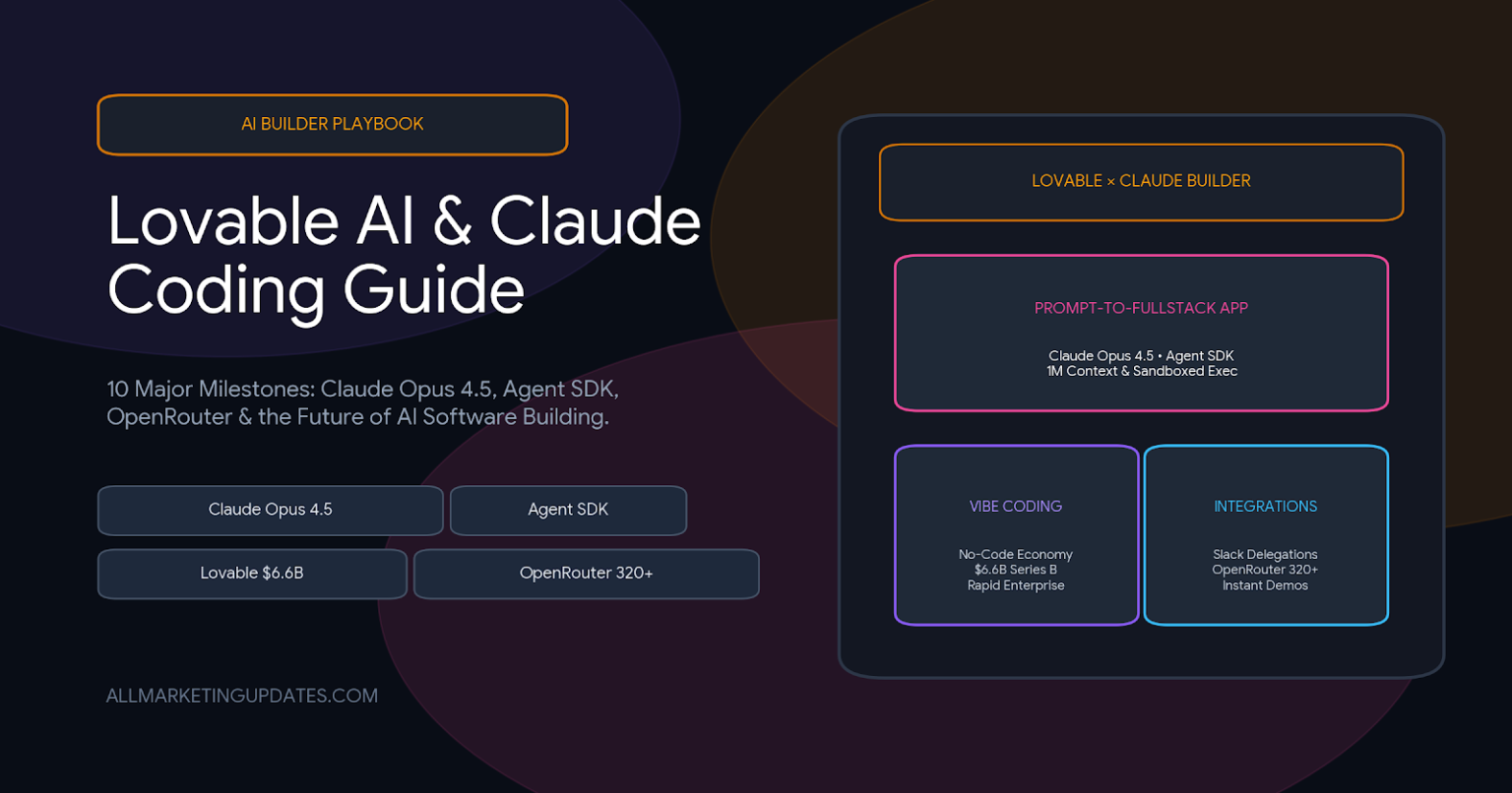
Lovable AI is the AI-powered vibe-coding platform that lets non-coders and product teams build full-stack web apps from prompts, while Claude Code and the Claude Agent SDK are Anthropic’s developer-first AI tooling for code generation, agentic workflows, and large-context automation. The 2026 “Lovable AI and Claude coding” story isn’t two parallel tracks — it’s the convergence of who builds (Lovable’s vibe-coding democratisation) and with what intelligence (Claude Code, Claude Opus 4.5 inside Lovable, and the new 1M-context Claude Agent SDK). This guide consolidates ten verified 2025–26 milestones so builders, product managers, and engineering leads can see the whole stack at once.
Lovable and Claude Coding in 2026, at a Glance
Two companies, one builder economy:
| Vendor | What it does | Why it matters in 2026 |
|---|---|---|
| Lovable | Prompt-to-app, full-stack vibe-coding platform | $330M Series B at $6.6B valuation; Claude Opus 4.5 integration; enterprise-wide sales engineering adoption |
| Anthropic (Claude Code + Agent SDK) | CLI, IDE and SDK for AI-assisted coding and agents | Slack delegation, Android app, 320-model OpenRouter access, 1M-token context, sandboxed agent execution |
The two are increasingly integrated — Lovable now runs on Claude Opus 4.5 for its core generation — and the rest of this article walks through each of the ten verified milestones that bring us here.
Lovable: 5 Milestones That Define the Platform in 2026
1. Lovable’s $330M Series B Reaches $6.6B Valuation
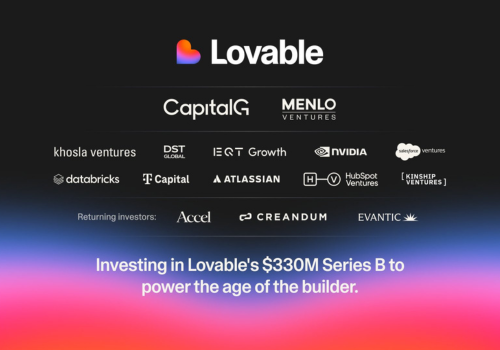
The Lovable Series B announcement describes a $330 million raise at a $6.6 billion valuation — among the largest in the no-code / AI-powered product building space.
What the article named verbatim:
- Lead investors: CapitalG and Menlo Ventures Anthology Fund
- Strategic venture arms participating: NVentures (Nvidia), Salesforce Ventures, Databricks Ventures, T. Capital (Deutsche Telekom), Atlassian Ventures, HubSpot Ventures
- Other participating firms: Khosla Ventures, DST Global, EQT Growth, Kinship Ventures
- Returning investors: Accel, Creandum, Evantic
Lovable’s official framing of the raise: “Empower the 99% — people with ideas who don’t code.” The platform positions itself as turning founders, teachers, artists, and enterprise teams from “people with ideas” into “people with shipped products.”
The source’s investor thesis: “Now everyone is a builder.”
Implications for builders and product teams:
- Platform capabilities for non-coders will accelerate
- Enterprise adoption is now a fundable, board-supported strategy
- AI-assisted building workflows expand (model integrations, deeper design intelligence)
- Cross-platform integrations with investor ecosystems (Salesforce, HubSpot, Atlassian, Databricks, Nvidia) move from roadmap to strategy
2. Lovable Integrates Claude Opus 4.5: 15% Fewer Mistakes, 5% Higher Success
The Opus 4.5 integration announcement names three measurable improvements from integrating Anthropic’s Claude Opus 4.5 as one of Lovable’s core models:
- 15% fewer AI-generated mistakes
- 5% increase in overall project success rates
- Clear improvements in visual design, layout consistency, and UX alignment
Critically, the source flags: “Notably, these enhancements come without any extra cost for the already existing Lovable users.” The improvement journey is:
Old model build (with retries) → Opus 4.5 build (fewer cleanups, more first-time-correct) → faster iteration cycles for the same subscriber
For a builder, this translates directly into: fewer dead-end generations, less manual clean-up, smoother upgrade paths from concept to shippable interface.
3. Lovable Enterprise Case Studies: Delivery Hero and ElevenLabs
Two enterprise case studies make Lovable’s ROI concrete in 2026:
Delivery Hero
Delivery Hero’s product team uses Lovable to short-circuit weeks-long alignment loops:
- Built a functional prototype just one hour before a customer meeting — stakeholders clicked through, gave concrete feedback, aligned on direction in real time
- What would normally take around three weeks of revisions after discussion was completed in just one week
- Result: “Showing, not telling” replaced deck-meeting-and-revise loops; opinions became specifics; product organisations ship faster
ElevenLabs
The ElevenLabs × Lovable build (January 2026, by Mohammad Owais) is the highest-leverage enterprise use case published to date. Named individual: Gabo Lopez, GTM Lead at ElevenLabs.
- One team member built a working demo during a six-minute taxi ride on the way to a customer meeting
- ElevenLabs produces three to four demos in the time it used to take to deliver one
- Reported ~50% reduction in demo creation time
Two named example demos the source quotes from ElevenLabs:
- A fictional movie launch for a media company prospect, where fans interact with AI-powered characters via combined voice agents and music generation, with the narrative mystery preserved
- A CPG brand demo featuring a detergent brand with its own AI personality, demonstrating voice-first product support as an engaging brand channel
Two quotes from Gabo Lopez (verbatim from the source):
“Time is super precious. Every interaction with a customer needs to count.”
“You have an idea and with Lovable, you make it happen.”
The source’s enterprise pattern: inspiration drives adoption; experience beats documentation; speed enables personalization; personalization accelerates trust.
4. Lovable Free for Teachers and Students Until Year-End
The Lovable education initiative (announced 9 December 2025, by Mohammad Owais) opens free Lovable access for teachers and students in classrooms through end of year, in collaboration with Hour of AI, Imagi, and OpenAI.
What classrooms get:
- Project-based lessons where students build simple apps and tools with Lovable
- A visual introduction to software design, UX, and AI-assisted development
- Hour-of-AI-style workshops where students explore how AI helps them build usable products
- Hands-on creativity without advanced coding skills
What the partnership covers:
- Curriculum and classroom structure — Hour of AI
- Creative coding for kids and teens — Imagi
- World-class AI models and capabilities — OpenAI
- Vibe coding and end-to-end app building — Lovable
Why this matters beyond classrooms: it builds a generation of builders comfortable with vibe coding before they graduate, and it establishes teacher-network distribution channels for the platform.
5. Lovable Holiday Gift Cards: “Gift Someone the Ability to Create”
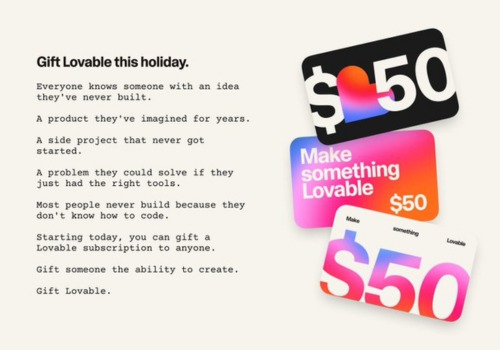
Lovable’s holiday campaign reframes the platform as an emotional enabler via digital gift cards and a giveaway:
- Holiday message: “Gift someone the ability to create” — positions a subscription as a creative unlock, not a software licence
- Giveaway: $100 Lovable subscriptions to 10 randomly selected participants — community-first engagement during the festive season
- Core copy angle: “Most people never build because they don’t know how to code.”
- Campaign takeaway (verbatim source phrasing): “Lovable isn’t selling software. It’s selling the courage to start.”
Why this matters strategically: creative-gifting positioning differentiates Lovable from the sea of discount-led holiday campaigns.
Claude Code & the Claude Agent SDK: 4 Milestones That Power the Underlying Intelligence
6. Claude Code Slack Integration — Delegate Coding from a Channel
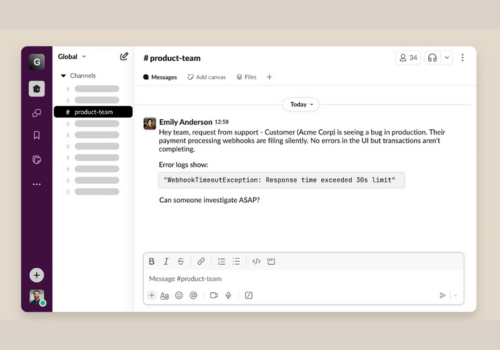
Anthropic’s Claude Code × Slack integration makes Claude a first-class collaborator inside existing engineering workflows:
- Users type
@Claudeinside any Slack channel or thread - Claude determines whether the message is a coding or technical request
- The task is automatically forwarded to Claude Code
- A new browser-window session opens with Slack context carried over
The source’s named why: “This deeper integration of Claude into the daily workflow of engineering, product, and operations teams reduces friction between discussions and execution.”
Use cases the article explicitly calls out:
- Engineering teams collaborating on tickets and bugs
- Product teams refining specs and asking for quick prototypes
- Ops teams automating workflows
- Anyone needing instant code generation without leaving Slack
The source’s framing: brainstorm code, auto-generate scripts, analyze errors, refactor large codebases, build tools — without slowing down team communication.
7. Claude Code Android App + Hotkey Model Switcher + Context Visibility
Anthropic rolled three Claude Code updates in a single developer-productivity push:
- Claude Code on Android — write, review, iterate on code from mobile; on-the-go debugging, quick edits, idea validation
- Hotkey-based model switcher — switch between models mid-session, reducing friction in workflows where different models suit different tasks
- Context window usage directly in the status line — real-time visibility into how much context is consumed; manage long sessions, avoid unexpected context limits
What stays consistent across these three updates: the centre of gravity is developer productivity and control — mobile access expands flexibility, hotkeys speed up experimentation, and context visibility improves trust and predictability during longer interactions.
8. Claude Code × OpenRouter: 320 Models
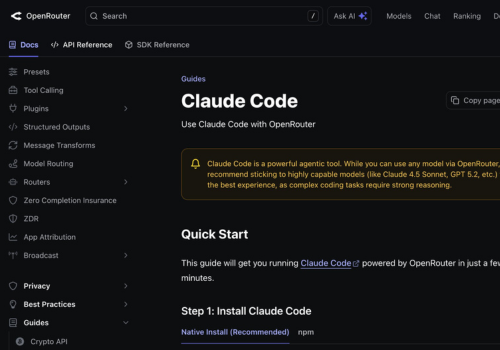
The Claude Code × OpenRouter integration unlocks the OpenRouter model catalogue:
- More than 320 large language models accessible
- 39 free models included
- Developers can plug in any OpenRouter-supported model while keeping the shape and types of the Anthropic API — meaning no code rewrites against the current Claude model
- A centralised model-usage monitor (helps with cost, performance and experimentation)
What this means operatively: the toolkit stays constant, but the model underneath can be swapped — Claude Code as interface, OpenRouter as the model switchboard.
9. Claude Agent SDK: 1M Context, Sandboxing, Simpler TypeScript
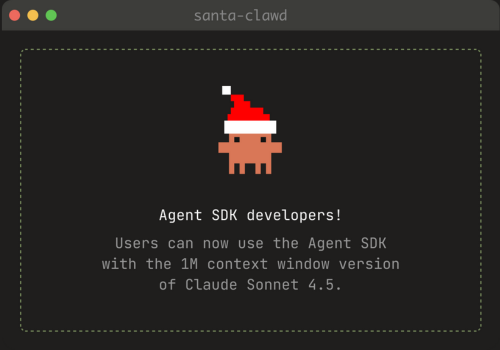
The Claude Agent SDK upgrade bundles three substantive developer-experience improvements for production-grade agent building:
- 1M-token context window — agents can support long multi-step workflows, large documents and datasets, and complex reasoning across extensive inputs. New use cases the source names verbatim: research, enterprise knowledge bases, sophisticated automation
- Built-in sandboxing — agent actions execute safely with strengthened security, reliability, and guardrails for autonomous AI behavior. Agents can experiment and iterate in a controlled environment before going to production
- Lightweight TypeScript SDK v2 — replaces the old async generator mental model with a clean “send — receive — done” pattern. Single-call
send()for multiturn conversations; less boilerplate; clearer flow; easier debugging
Why this matters strategically: Anthropic is positioning Claude as a go-to platform for AI workflows, autonomous agents, complex orchestration, and enterprise-grade LLM applications — the message is power + safety + cleaner DX, without added complexity.
The Pattern Behind the 10 Milestones
Read individually, ten updates. Read together, one structural story:
| Milestone | What shifted in 2026 |
|---|---|
| Lovable $330M / $6.6B Series B | Capital concentration on who builds — the no-code / vibe-coding category becomes an investable thesis at scale |
| Opus 4.5 inside Lovable | Capital-grade AI inference lands inside vibe coding at no extra cost to users |
| Delivery Hero + ElevenLabs enterprise rollouts | Lovable becomes a measurable workflow tool, not a “weekend toy” — sales-engineering and product alignment systems built on it |
| Free Lovable for teachers / students | Distribution through classrooms — building the next generation of vibe coders while they’re still in school |
| Holiday gift cards | Lovable sells courage, not a licence; emotional-positioning category entry |
| Claude Code Slack integration | Claude transitions from command-line tool to in-chat collaborator, embedded in the existing workflow layer |
| Claude Code Android + hotkeys + context visibility | Claude Code becomes a multi-device, multi-model, context-transparent IDE |
| Claude Code × OpenRouter (320 models) | Claude Code is now a shell above a model-agnostic backbone — model selection is no longer a Claude Code vs. competitor decision |
| Claude Agent SDK 1M + sandbox + TypeScript v2 | Anthropic is positioning for production-grade agents in enterprise — long context, safe execution, easy build |
The 2026 thesis is clear: Lovable + Claude is moving from “anyone with an idea builds” to “anyone with an idea + a team ships production.” Money, models, enterprise use cases, in-workflow integrations, and developer-grade controls all push in one direction. Loosely put: the 10 milestones close the gap between vibe coding and enterprise-grade software.
FAQ
What is Lovable?
Lovable is the prompt-to-app, AI-powered vibe-coding platform that lets non-coders, founders, teachers and enterprise teams build full-stack web apps by describing what they want. As of the start of 2026, Lovable is a confirmed $6.6-billion-valuation company following a $330M Series B, with Claude Opus 4.5 integrated as one of its core models for design accuracy and reliability.
What is Claude Code?
Claude Code is Anthropic’s developer-first AI coding assistant — a CLI and web environment where developers write, review, and iterate on code. In 2026, Claude Code runs on Android, supports hotkey model switching, exports real-time context usage in its status line, integrates with Slack via @Claude mentions, and connects to OpenRouter’s catalogue of 320+ models.
What is the Claude Agent SDK?
The Claude Agent SDK is Anthropic’s framework for building production-ready AI agents. The 2026 release added a 1-million-token context window, built-in sandboxing for safe agent execution, and TypeScript SDK v2 with a send — receive — done pattern that cuts the lines of code needed to wire agents.
Is Lovable free?
Yes for specific audiences: Lovable is free for teachers and students in classrooms through end of year 2025, in partnership with Hour of AI, Imagi and OpenAI. Outside of that, Lovable offers subscription tiers for individual users, with higher capabilities folded into enterprise plans. Verify current pricing on the official Lovable site — pricing can change.
Why did Lovable raise $330M?
The raise, led by CapitalG and the Menlo Ventures Anthology Fund and participated by NVentures (Nvidia), Salesforce Ventures, Databricks Ventures, T. Capital (Deutsche Telekom), Atlassian Ventures, and HubSpot Ventures (plus Khosla, DST Global, EQT Growth, Kinship, and returning Accel/Creandum/Evantic), is meant to accelerate Lovable’s enterprise adoption, AI-assisted building workflows, and platform capabilities for non-coders.
Can Claude Code replace a developer environment?
For routine workflows Claude Code sits inside a developer’s existing environment; for AI-augmented teammates it has become a coordinating surface across Slack, Android and CLI/IDE. The OpenRouter integration means Claude Code is increasingly model-agnostic, so developers can choose underlying models without changing the developer-facing toolkit.
How does Claude Code integrate with Slack?
By mentioning @Claude in any channel or thread, Claude determines whether the message is a coding task, forwards it to Claude Code’s web environment, and opens a coding session with the Slack context carried over — no tab switching, no message copying.
Can Lovable build production-grade apps?
Yes — and increasingly so. ElevenLabs reports a ~50% reduction in demo creation time using Lovable for enterprise sales demos; Delivery Hero cut three weeks of revisions into one using Lovable prototypes inside alignment meetings; in both cases, Lovable is being used for board-meeting-ready customer assets, not hobby projects.
Does Opus 4.5 cost extra inside Lovable?
No. Per the source, Opus 4.5 inside Lovable delivers the gains (15% fewer AI-generated mistakes, 5% higher project success rates) without any extra cost for already-existing Lovable users. That is the core customer-experience promise of the integration announcement.
Is the Claude Agent SDK safe?
The new release adds built-in sandboxing with strengthened security, reliability, and guardrails for autonomous AI behaviour — agents can try out, experiment, and test iteratively in a controlled environment before going into production. Production safety is one of the three named pillars of the upgrade.