

Executive Summary
Honasa Consumer Limited—the parent company that originally pioneered the Indian beauty and personal care (BPC) direct-to-consumer (D2C) ecosystem through Mamaearth—has undergone a structural transformation. Following an initial public offering (IPO) marked by elevated valuation multiples, single-brand dependency, and channel bottlenecks, the company faced significant market skepticism.
                                Honasa Operational Platform
                [ Shared R&D | Central Supply Chain | Data & Media Scale ]
                                              │
    ┌─────────────────────────┬───────────────┴───────────────┬────────────────────────┐
    ▼                         ▼                               ▼                        ▼
Mamaearth                The Derma Co.                   Aqualogica               Dr. Sheth's & BBLUNT
Flagship Anchor          Science / Active Actives        Gen Z Hydration          Targeted Serums / Hair
(₹1,000 Cr+ ARR Base)    (₹1,000 Cr+ ARR Engine)        (₹200 Cr ARR Scaling)    (Specialized Niches)
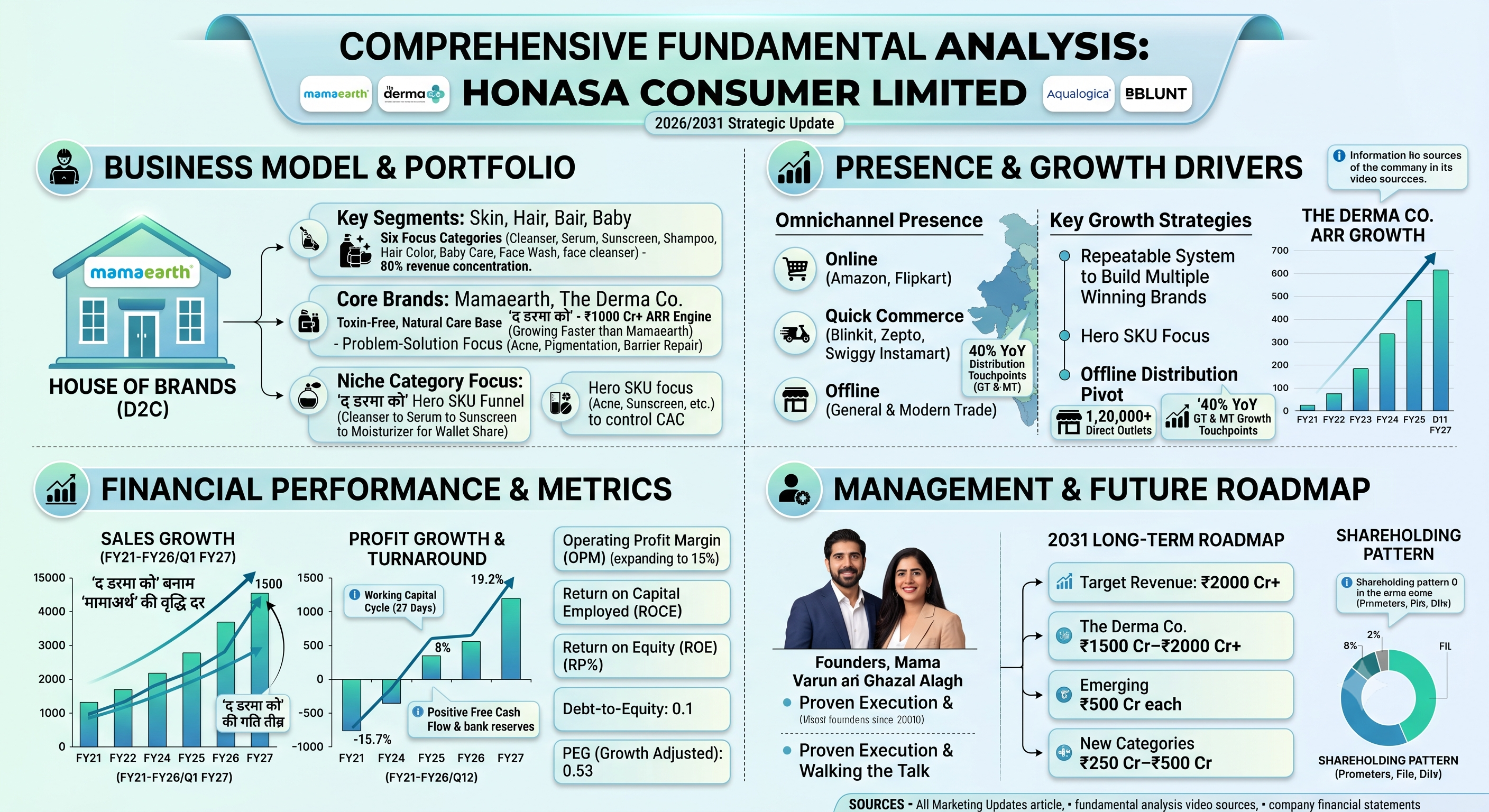
Between FY25 and FY27, management executed a turnaround by pivoting from a single-brand hero model to an integrated House of Brands platform. By systematically scaling secondary and acquired labels—led by The Derma Co.—restructuring distribution from intermediary-heavy layers to direct retail, and driving operating margins from 5% to 15%, Honasa has established a repeatable brand incubation and scaling platform.
Financial Turnaround & Operating Benchmark
The financial trajectory of Honasa highlights a successful corporate restructuring from an unprofitable digital seller to a compounding consumer goods enterprise.
| Operating Metric | Historical Baseline (FY21) | Transition Phase (FY25–FY26) | Recent Quarter (Q1 FY27) | Long-Term Vision (2031 Targets) |
| Annualized Net Revenue | ₹460 Crore | ~₹2,400 Cr – ₹2,500 Crore | ₹756 Crore (+27% YoY) | ₹5,500 Crore (~18% CAGR) |
| Operating Profit Margin (OPM) | Sub-5% (Depressed) | 9% – 11% | 15% (Up ~300 bps normalized) | ~15%+ Sustainable Consolidated |
| Quarterly Net Profit (PAT) | Net Loss (~₹1,300 Cr in FY21) | ₹25 Cr – ₹50 Cr quarterly range | ₹90 Crore (+100%+ YoY) | EBITDA Compounding at ~28% CAGR |
| Mamaearth Scale (ARR) | Core revenue contributor | ₹1,000 Cr+ ARR (Growth in teens) | Teens growth trajectory | ₹2,000 Crore+ ARR |
| The Derma Co. Scale (ARR) | Incubation stage (Launched 2020) | ₹1,000 Cr+ ARR (Mid-20s growth) | Primary margin & volume driver | ₹1,500 Cr – ₹2,000 Crore ARR |
| Young Portfolio Run-Rate | N/A (Pre-acquisition) | ₹50 Cr – ₹200 Cr ARR per brand | Accelerating in mid-twenties | 3 brands scaling to ₹500 Cr each |
| Retail Touchpoints | Online-dominated | 2,70,000+ FMCG outlets | 1,20,000 direct-billed stores | Omnichannel penetration across pin codes |
| Balance Sheet Leverage | Highly leveraged/Burn phase | Debt-to-Equity: 0.1 | Positive Free Cash Flow; Reserves ~₹1,100 Cr | Zero-debt organic/M&A reinvestment |
The Strategic Bottleneck: Deconstructing the “Single-Brand D2C Trap”
Honasa’s founding phase (2016–2021) relied entirely on Mamaearth’s rapid emergence as India’s first D2C unicorn. By leveraging outsourced third-party contract manufacturing, digital performance marketing (Meta, Google, YouTube, and influencer networks), and a “toxin-free” natural positioning, Mamaearth disrupted legacy personal care incumbents.
┌─────────────────────────────────────────────────────────────────────────┐
│                      THE D2C SCALING BOTTLENECK                         │
├──────────────────────────┬──────────────────────────────────────────────┤
│ 1. Flagship Fatigue      │ Natural baby/skincare category reached       │
│                          │ local penetration ceilings (growth in teens) │
├──────────────────────────┼──────────────────────────────────────────────┤
│ 2. Digital Inflation     │ Ad spending consumed 26–27% of revenues;     │
│                          │ rising Customer Acquisition Costs (CAC)      │
├──────────────────────────┼──────────────────────────────────────────────┤
│ 3. Intermediary Drag     │ Multi-layered super-stockists squeezed gross │
│                          │ margins and obscured real-time retail demand │
└──────────────────────────┴──────────────────────────────────────────────┘
(Source: Market Analysis & Financial Filings)
By 2024–2025, three structural constraints threatened Honasa’s long-term terminal value:
- Category Maturation of the Flagship: The natural and organic personal care narrative matured. Mamaearth’s top-line revenue decelerated to the mid-to-high teens, exposing the vulnerability of relying on a single brand for company-wide valuation support.
- Rising Digital Acquisition Costs: As performance marketing channels became saturated, spending 26% to 27% of revenues on digital marketing and advertising ceased to deliver exponential customer lifetime value (LTV).
- Inefficient Distribution Networks: Relying heavily on traditional super-stockist distribution networks added margin friction and separated the brand from inventory dynamics at the retail counter.
Architectural Pivot: Engineering a Multi-Brand Platform
To avoid the limits of single-brand maturation, Honasa repositioned its corporate identity to mirror institutional consumer conglomerates like Unilever, L’Oréal, and Procter & Gamble. The company stopped treating new product launches as simple brand extensions under Mamaearth; instead, it built distinct brand equity for targeted consumer demographics.
                     Honasa Platform Infrastructure
      [ Formulations | Regulatory | Shared Media Sourcing | Logistics ]
                                     │
   ┌───────────────────┬─────────────┴───────┬───────────────────┐
   ▼                   ▼                     ▼                   ▼
Mass Natural      Active Science         Hydration          Salon-Grade
Mamaearth         The Derma Co.          Aqualogica         BBLUNT / Men's
Target: Family    Target: Problem-Skin   Target: Gen Z      Target: Specialized
(Toxin-Free)      (Active Actives)       (Light Textures)   (Color & Styling)
1. Brand Segmentation Strategy
Honasa segmented its brand portfolio across specialized consumer cohorts, reducing brand cannibalization and establishing targeted pricing power:
More Read

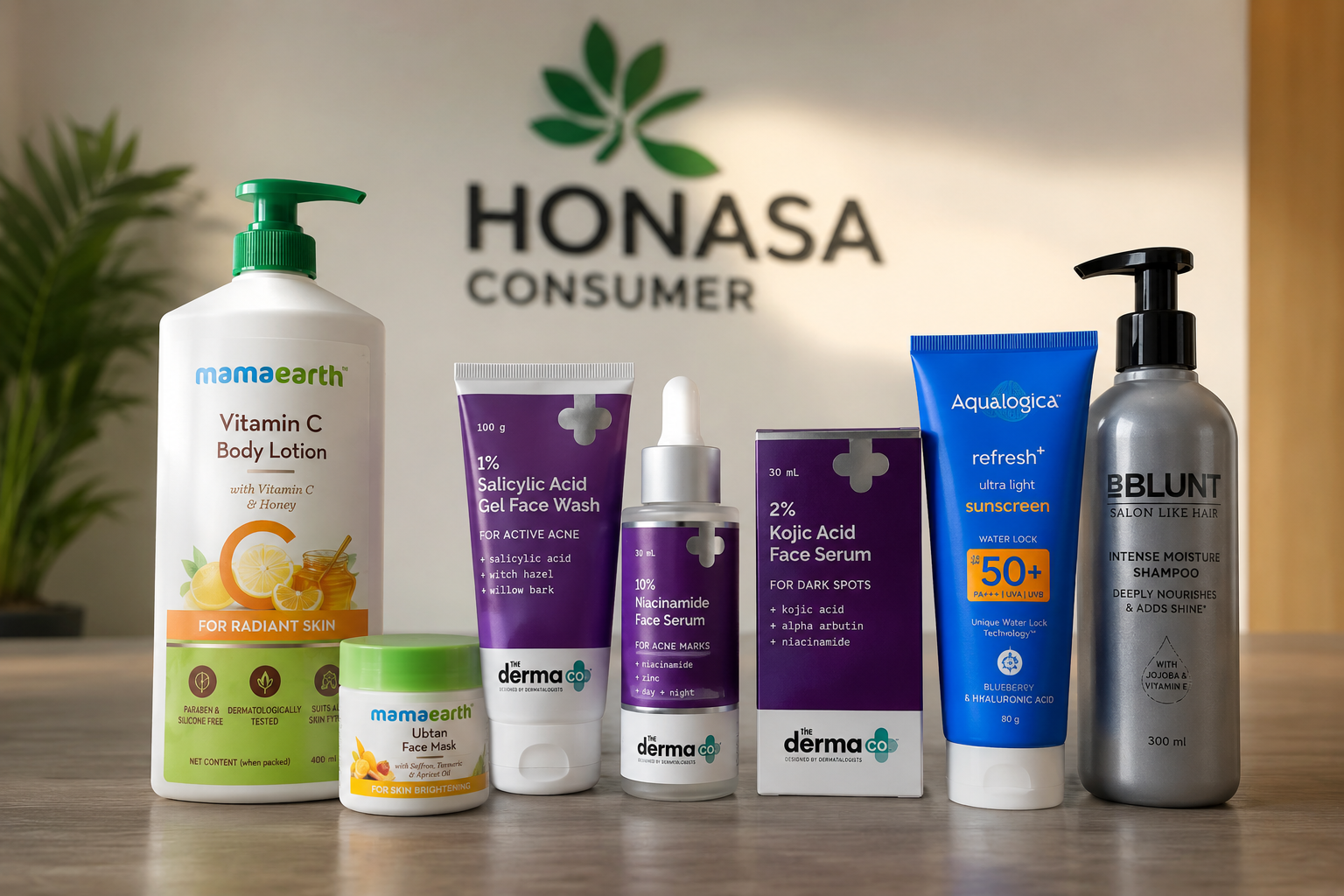
- Mamaearth (The Cash Cow / Anchor): Mass natural formulations, baby care, and daily personal care. Provides baseline cash generation and offline retail distribution scale.
- The Derma Co. (The Growth Engine): Science-backed, active-ingredient skincare (Niacinamide, Salicylic Acid, Hyaluronic Acid) serving urban, ingredient-conscious consumers.
- Aqualogica (Gen-Z Trend Capture): Lightweight, hydration-focused skincare targeting young digital shoppers.
- Dr. Sheth’s (Specialized Treatment): Premium, targeted face serums and clinical formulations designed for specific skin types.
- BBLUNT & Men’s Care (Specialty Niches): Acquired in 2022, focusing on salon-grade hair color, hair styling, and men’s grooming regimens (such as the acquired Reginald label, which doubled post-acquisition to ~₹110 Cr–₹150 Cr ARR).
- Incubation Segments: Early-stage entries into Oral Care, Nutraceuticals, and the fast-growing Indian Fragrance market (a ₹7,000 Cr+ TAM growing at 15% CAGR).
2. Category Concentration and the “Hero SKU” Funnel
Rather than diversifying into hundreds of unrelated product lines, Honasa concentrates ~80% of its total revenue across 6 to 7 core personal care categories: face cleansers, face serums, moisturizers, sunscreens, shampoos, hair color, and baby care.
[ Top of Funnel: Hero SKU Campaign ]
  (Targeted Digital Ad on 1 Key Innovation: e.g., Derma Co. 1% Salicylic Acid Face Wash)
                   │
                   ▼
[ Consumer Trial & Conversion ]
  (High Satisfaction on Targeted Skin Problem)
                   │
                   ▼
[ In-Brand Cross-Selling ]
  (Consumer Adopts Cleanser ──► Serum ──► Sunscreen ──► Moisturizer)
                   │
                   ▼
[ Wallet-Share Expansion ]
  (High Retention, Lower Subsequent CAC, Improved Margins)
The operational advantage of this architecture lies in backend standardization:
- Backend Synergies: Formulations, supply chain sourcing, packaging procurement, and quality testing are shared across the platform.
- Frontend Segmentation: Each brand presents unique pricing, packaging, and marketing narratives.
- Hero SKU Acquisition: Marketing spend is focused on 1 or 2 breakout “Hero SKUs” per brand (such as a specific active-ingredient serum or sunscreen) to acquire customers efficiently, subsequently cross-selling full skincare regimens to capture wallet share without broad SKU bloat.
The Derma Co.: Anatomy of an Outperforming Growth Engine
The inflection point in Honasa’s quarterly performance is the scaling of The Derma Co., which matched Mamaearth’s milestone by reaching a ₹1,000 Crore ARR in a shorter timeframe (launched in 2020 vs. Mamaearth in 2016).
┌─────────────────────────────────────────────────────────────────────────┐
│              THE DERMA CO. COMPETITIVE ADVANTAGE PLAYBOOK               │
├──────────────────────────┬──────────────────────────────────────────────┤
│ 1. Science-Led Shift     │ Capitalized on consumer migration from broad │
│                          │ "natural" claims to active ingredient doses  │
├──────────────────────────┼──────────────────────────────────────────────┤
│ 2. Superior Unit Pricing │ Clinical problem-solving claims enabled      │
│                          │ higher retail price points vs. mass brands   │
├──────────────────────────┼──────────────────────────────────────────────┤
│ 3. Margin Accretion      │ Operating leverage expanded segment margins  │
│                          │ into double digits and mid-teens             │
└──────────────────────────┴──────────────────────────────────────────────┘
(Source: Comparative Analysis of Honasa Portfolios)
Strategic Growth Drivers of the Derma Segment
- Ingredient-First Consumer Demand: Indian skincare consumers have become increasingly ingredient-literate, searching specifically for active compounds to treat acne, pigmentation, and skin-barrier damage rather than buying generic beauty creams.
- Pricing Elasticity: Because The Derma Co. positions its catalog around clinical solutions, products command premium price realization and higher gross margins than legacy mass-market personal care lines.
- Operating Margin Accretion: As brand equity matured, promotional discounting and exploratory marketing costs dropped, moving The Derma Co.’s operating margins into double digits and mid-teens, making it Honasa’s primary driver of consolidated bottom-line expansion.
Omnichannel Channel Restructuring
A central driver of Honasa’s operating turnaround has been the reorganization of its distribution architecture from pure-play digital to a direct omnichannel network.
                             Honasa Distribution Strategy
                                           │
         ┌─────────────────────────────────┴─────────────────────────────────┐
         ▼                                                                   ▼
  Online Engine (~70%)                                                Offline Channels (~30%)
  ├── Quick Commerce: 10% (Blinkit, Zepto, Instamart)     ├── General Trade: 2,70,000+ FMCG Stores
  ├── E-Commerce: 30–40% (Amazon, Flipkart, Nykaa, Myntra)├── Direct Distributors: 1,20,000+ Outlets
  └── Owned D2C: 15–20% (Direct Apps & Brand Portals)        └── Modern Trade: Reliance, DMart (+40% YoY)
Channel Breakdown & Optimization Strategies
- Quick Commerce (Q-Commerce): Scaled to contribute ~10% of revenue through platforms like Blinkit, Zepto, and Instamart, capturing high-intent, immediate-need skincare purchases.
- E-Commerce & Digital Marketplaces: Accounts for 30% to 40% of revenues across Amazon, Flipkart, Nykaa, and Myntra, supported by owned D2C web platforms contributing 15% to 20%.
- Disintermediation of Offline Distribution: Historically, products moved through a multi-tiered super-stockist network that eroded margins. Honasa transitioned to a direct-to-distributor distribution structure:
- Scale: Expanded presence across 2,70,000+ FMCG retail touchpoints spanning over 10,000+ pin codes.
- Direct Control: Scaled direct billing to over 1,20,000 outlets, capturing distributor margin upside and optimizing supply chain turnaround.
- Growth Velocity: Offline modern trade (DMart, Reliance Retail) and neighborhood general trade outlets grew at 40% YoY, outpacing pure-play digital sales.
Financial Architecture & Margin Expansion Mechanics
Honasa’s financial trajectory reflects an operational turnaround, moving from an FY21 net loss of ~₹1,300 Crore to generating ~₹250 Crore in annual net profits and reaching ₹90 Crore in PAT in Q1 FY27.
[ Revenue Growth: ~18% CAGR ] ──┐
[ Gross Margin Optimization ]   ├─► [ Operating Leverage ] ──► [ Projected EBITDA Growth: ~28% CAGR ]
[ Ad Spend Rationalization ]    │   (OPM Expanding from 10% to 15%+)
[ Direct Retail Distribution ]  ──┘
                          MARGIN EXPANSION LEVERS

   Ad Spend Normalization        Scale Efficiencies         Distribution Yield
  ┌───────────────────────┐   ┌───────────────────────┐   ┌───────────────────────┐
  │ Marketing spend       │   │ Fixed overheads, R&D, │   │ Disintermediating     │
  │ rationalizing down    │ + │ and employee costs    │ + │ super-stockists lifts │
  │ from 26-27% of sales  │   │ dilute as young brands│   │ realized channel      │
  │ as brands mature      │   │ scale up to ₹500 Cr   │   │ gross margins         │
  └───────────────────────┘   └───────────────────────┘   └───────────────────────┘
(Source: Financial Modeling based on Management Guidance)
1. The Core Margin Levers
- Ad Spend Normalization: As secondary brands (The Derma Co., Aqualogica, BBLUNT) build organic brand equity and repeat-order velocity, marketing spend as a percentage of revenue is gradually rationalizing from historical highs of 26% to 27%.
- Fixed Cost Dilution: Centralized product formulations, shared administrative overhead, and unified warehouse logistics create economies of scale as sub-brands grow from ₹100 Cr to ₹500 Cr ARR.
- Distribution Realization: Removing intermediate super-stockist fees directly improves wholesale gross margins across general trade touchpoints.
2. Working Capital & Cash Flow Profile
- Cash Conversion Cycle: Operates with a negative cash conversion cycle common to FMCG companies, supported by cash-in-advance digital sales and short retailer collection cycles.
- Working Capital Days: Maintained at a healthy 27 days, well below the retail sector threshold of 50 days.
- Capital Return Ratios: Return on Capital Employed (ROCE) increased from 8% to 19.2%, while Return on Equity (ROE) reached 15.7% as profitability compounded[cite: 2].
- Institutional Capital Accumulation: Institutional investment patterns show Domestic Institutional Investors (DIIs like ICICI Prudential, Bandhan, and Mirae Asset) expanding holdings from 15% to 21.5%, with Foreign Institutional Investors (FIIs) expanding stakes to ~14%[cite: 2].
2031 Long-Term Strategic Roadmap
Management has outlined a strategic roadmap targeting ₹5,500 Crore in consolidated revenue by 2031 (up from ~₹2,400 Cr in 2026, representing an 18% CAGR) with sustained operating margins of 15%+.
                     2031 Projected Revenue Composition (₹5,500 Cr Target)
                                             │
    ┌─────────────────────────┬──────────────┴──────────────┬────────────────────────┐
    ▼                         ▼                             ▼                        ▼
Mamaearth                The Derma Co.                 Young Core Brands        New Incubations
₹2,000 Cr+ Target        ₹1,500 Cr – ₹2,000 Cr Target  ₹1,500 Cr Target         ₹250 Cr – ₹500 Cr Target
(14–15% Steady CAGR)     (Active Ingredient Engine)    (3 Brands @ ₹500 Cr each) (Fragrance, Oral, Nutra)
Strategic Allocation Breakdown
- Mamaearth Expansion (~₹2,000 Cr Contribution): Expected to compound steadily at 14% to 15% CAGR by deepening Tier-2/Tier-3 offline penetration and maintaining its core baby and personal care market share.
- The Derma Co. Scale (~₹1,500 Cr–₹2,000 Cr Contribution): Positioned to match or potentially exceed Mamaearth’s top-line by capturing urban demand for functional skincare.
- Emerging Brands Maturation (~₹1,500 Cr Contribution): Management intends to scale three sub-brands—Aqualogica, Dr. Sheth’s, and BBLUNT—into independent ₹500 Crore ARR businesses.
- New Category Incubations (~₹250 Cr–₹500 Cr Contribution): Inorganic bolt-on acquisitions and greenfield launches into premium Fragrances, Oral Care, and Nutraceuticals.
Valuation Multiples & Strategic Risks
While Honasa’s execution has delivered operational improvements, the business model carries specific valuation considerations and operating risks.
┌─────────────────────────────────────────────────────────────────────────┐
│                     RISK AND VALUATION PROFILE                          │
├──────────────────────────┬──────────────────────────────────────────────┤
│ 1. Premium Valuation     │ Trades at 61x–75x P/E; elevated PEG ratio    │
│                          │ leaves limited cushion for quarterly misses  │
├──────────────────────────┼──────────────────────────────────────────────┤
│ 2. Low Switching Costs   │ BPC consumers have minimal brand loyalty;    │
│                          │ low barrier to entry for competing D2C lines │
├──────────────────────────┼──────────────────────────────────────────────┤
│ 3. FMCG Incumbent Scale  │ Legacy players (HUL, Marico, L'Oréal) possess│
│                          │ superior capital depth and distribution reach│
└──────────────────────────┴──────────────────────────────────────────────┘
(Source: Comparative Capital Markets Data)
1. Valuation Dynamics
- Elevated P/E Multiples: Trading at 61x to 75x P/E, Honasa commands a significant premium over legacy FMCG peers (Hindustan Unilever trades around 40x–45x; Marico and Colgate trade around 25x–35x).
- Growth Expectations: While its 27% top-line growth outpaces traditional FMCG peers, an elevated Price/Earnings-to-Growth (PEG) profile leaves the stock sensitive to quarterly earnings volatility.
2. Strategic Operating Risks
- Low Economic Moats in Beauty: Consumer switching costs in skincare and haircare remain low. Consumer loyalty is transient, requiring continuous product innovation, high marketing visibility, and constant trend tracking.
- Execution Vulnerability: Unlike traditional utility or infrastructure businesses with structural entry barriers, Honasa’s House of Brands model requires consistent operational execution across inventory management, creative marketing, and product launches.
- Incumbent & Neo-D2C Competition: Legacy FMCG platforms are introducing active-ingredient lines, while agile digital-native competitors enter specialized niches, creating persistent competition for ad inventory and offline shelf space.
Strategic Takeaways
The transformation of Honasa Consumer Limited provides several core lessons for digital-native brands and modern consumer businesses:
- The Second Brand Validates Platform Architecture: A company’s initial breakout product proves consumer product-market fit; engineering a second ₹1,000 Crore brand (The Derma Co.) proves the underlying operating and distribution platform.
- Category Concentration with Hero SKUs Controls Operational Complexity: Focusing ~80% of revenue on 6 to 7 personal care categories while marketing distinct consumer-facing brands enables backend supply chain efficiency while preserving focused frontend positioning[cite: 1, 2].
- True Omnichannel Disintermediation Drives Operating Leverage: Sustainable FMCG scale cannot rely entirely on performance marketing or traditional multi-tiered wholesalers[cite: 1]. Direct distribution networks, combined with e-commerce and quick commerce, create the operating leverage needed to expand operating margins toward 15%+[cite: 1, 2].
Honasa’s evolution marks a shift from a single-product D2C brand into a diversified House of Brands platform, built to sustain long-term compounding across the Indian beauty and personal care market[cite: 1, 2].
Sources & References
- Source 1: YouTube Business & Financial Analysis – Honasa Consumer Limited (Mamaearth) Turnaround, House of Brands Strategy & 2031 Vision Breakdown by Chirag.
- Source 1: Fundamental Equity & Financial Statement Analysis – Honasa Consumer Limited Q1 FY27 Results, Balance Sheet & Distribution Metrics[cite: 3].