
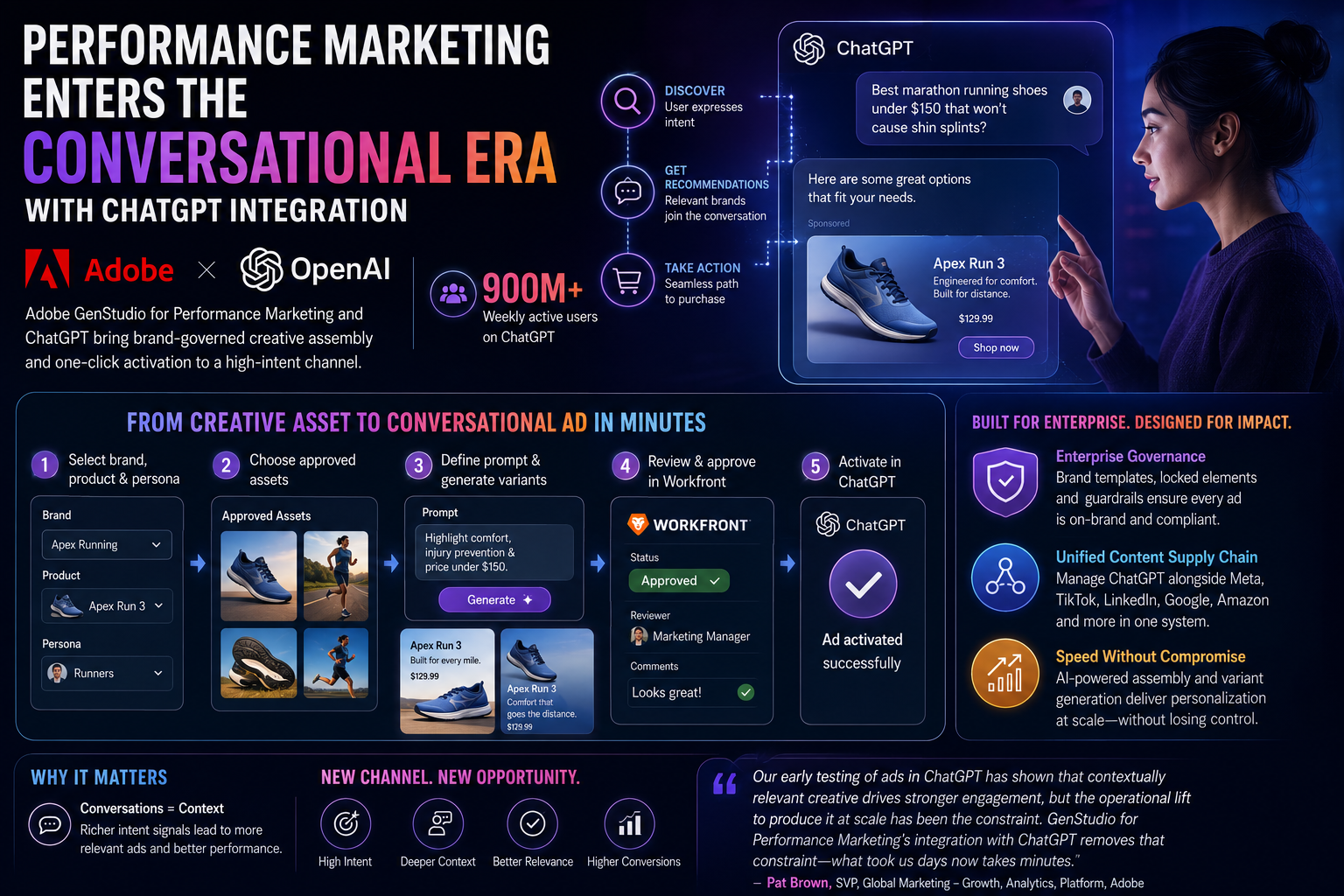

Performance marketing is undergoing one of its biggest transformations since the rise of search advertising and social media targeting. For years, marketers optimized campaigns around clicks, impressions, keywords, and segmented audience behavior. But conversational AI is now introducing an entirely different dynamic—one where user intent is expressed naturally, contextually, and often with remarkable specificity.
- Why Conversational AI Changes Performance Marketing
- ChatGPT as a New Performance Channel
- The Adobe and OpenAI Integration Explained
- Why Governance Matters in AI Advertising
That shift is pushing the advertising industry into a new era, where conversations themselves are becoming the next high-intent digital channel.
Recognizing this transition, Adobe and OpenAI have announced a major integration between Adobe GenStudio for Performance Marketing and ChatGPT. The partnership aims to help enterprise marketers create, govern, and activate conversational ads directly within ChatGPT—effectively positioning AI conversations as a new performance marketing ecosystem.
Why Conversational AI Changes Performance Marketing
Traditional digital advertising has largely revolved around fragmented user signals. Search engines interpret keywords. Social media platforms rely on behavioral targeting. Display advertising depends on browsing activity and audience segmentation.
Conversational AI fundamentally changes this model because users communicate differently in chat interfaces. Instead of typing fragmented search terms, people explain needs in complete thoughts filled with context, constraints, preferences, and purchase intent.
For example, a query like:
“Best marathon running shoes under $150 that won’t cause shin splints”
contains significantly richer intent than a standard keyword search like “running shoes.”
This deeper level of context creates a more intelligent advertising environment—one where recommendations can feel integrated into the user’s journey rather than interruptive.



ChatGPT as a New Performance Channel
The scale of this opportunity is difficult to ignore. According to OpenAI, ChatGPT has now surpassed 900 million weekly active users globally.
That audience behavior is especially important because conversational AI usage tends to happen during high-intent moments:
- researching products
- comparing options
- solving problems
- planning purchases
- making decisions
In other words, ChatGPT is increasingly becoming a discovery engine—not just an assistant.
For marketers, this creates a channel unlike anything that came before it. The objective is no longer just visibility. It is relevance within the flow of a conversation.
The Adobe and OpenAI Integration Explained
The integration between Adobe GenStudio for Performance Marketing and ChatGPT enables brands to create and activate ads directly into conversational experiences while maintaining enterprise-grade governance.
Inside Adobe’s ecosystem, marketing teams can:
- choose approved brand assets
- select target personas
- generate ad variations
- customize prompts
- review creatives within approval workflows
- activate campaigns into ChatGPT directly
The process is tightly integrated with Adobe Experience Manager Assets, Adobe Express, and Adobe Workfront, ensuring that campaigns remain compliant with brand standards while still adapting dynamically to user intent.
Why Governance Matters in AI Advertising
One of the biggest concerns around AI-generated marketing content is brand inconsistency. Generative systems can create endless variations, but enterprises still require strict governance around tone, visuals, compliance, and legal approvals.
Adobe’s approach attempts to solve this balance by separating:
What must remain fixed:
- brand templates
- compliance rules
- approved design systems
- review workflows
What can adapt:
- messaging
- imagery
- conversational context
- audience-specific variations
This combination allows companies to scale personalization without sacrificing control—a challenge that many AI marketing tools still struggle to solve effectively.
Conversational Ads Are Different From Traditional Ads
The most important shift here is philosophical. Traditional ads interrupt. Conversational ads participate.
That difference changes everything.
Instead of forcing attention, conversational advertising attempts to insert value into an existing exchange. When executed properly, the ad becomes part of the solution rather than an external promotion.
This also explains why performance marketing teams are now focusing heavily on:
- contextual creativity
- AI-driven personalization
- conversational UX
- dynamic asset assembly
Many businesses are already adopting AI-powered tools for social media marketing to improve personalization and campaign automation across channels.
Unified Marketing Ecosystems Are Becoming Critical
One major advantage of Adobe’s system is that ChatGPT ads are not isolated from the broader marketing ecosystem. Campaigns can operate alongside platforms such as:
- Meta
- TikTok
- Amazon
within a unified performance workflow.
This reflects a broader industry trend where marketers increasingly rely on integrated CRM and marketing automation systems to manage omnichannel customer journeys efficiently.
The future of performance marketing will likely belong to platforms capable of orchestrating campaigns seamlessly across multiple environments rather than optimizing each channel independently.
Adobe’s Internal Testing Signals the Direction
Adobe itself has already begun testing conversational advertising workflows internally. According to Pat Brown, Senior Vice President of Global Marketing at Adobe, the operational burden of producing highly contextual creative at scale had previously been a major limitation.
The integration reportedly reduces campaign production timelines from days to minutes—highlighting how AI is not only transforming customer-facing experiences but also internal marketing operations.
The Bigger Industry Shift
This partnership signals something much larger than a single product integration.
It suggests that conversational AI is evolving into a foundational digital infrastructure layer for:
- advertising
- ecommerce
- discovery
- customer service
- search
- content creation
As users increasingly move from traditional search interfaces into AI-driven conversations, marketers will need to rethink how visibility, intent, and conversion operate in this environment.
The future performance marketer may spend less time optimizing keywords and more time optimizing conversational experiences.
Related Industry Developments
The rise of conversational AI marketing is happening alongside broader platform transformations:
- https://allmarketingupdates.com/fortnightly-social-media-roundup-ai-platform-updates/
- https://allmarketingupdates.com/x-chat-app-launch-encryption-security-analysis/
- https://allmarketingupdates.com/instagram-comment-editing-feature-15-minute-limit/
Conclusion
Performance marketing is no longer confined to search results, social feeds, or banner placements. It is moving into conversations—spaces where users naturally express intent, preferences, and purchasing decisions in real time.
The Adobe and OpenAI partnership represents one of the clearest signs yet that conversational interfaces are emerging as a fully-fledged marketing channel. And unlike previous channels, this one is built around context rather than interruption.
For marketers, the implications are enormous. The future of digital advertising may no longer depend on who captures clicks first.
It may depend on who becomes most useful within the conversation itself.