

The social media industry is entering a new phase—one no longer defined simply by engagement metrics or content formats, but by who can control the entire digital journey from discovery to creation to conversion. Platforms are no longer competing just for attention; they are competing to become fully integrated ecosystems where users create, consume, communicate, shop, and interact without ever needing to leave the platform.
- Meta: Building an AI-Led Advertising Ecosystem
- WhatsApp and the Push Beyond Advertising
- Instagram’s Evolution Into a Creation Engine
- Threads: Chasing Real-Time Relevance
- LinkedIn’s Shift Toward AI and Professional Trust
- X: Rebuilding Through Messaging and AI
- Snapchat’s Local Engagement Strategy
- YouTube’s Creator-First AI Expansion
- OpenAI and the Growing AI Ecosystem
- The Bigger Trend: Ownership of the Entire User Journey
- Conclusion
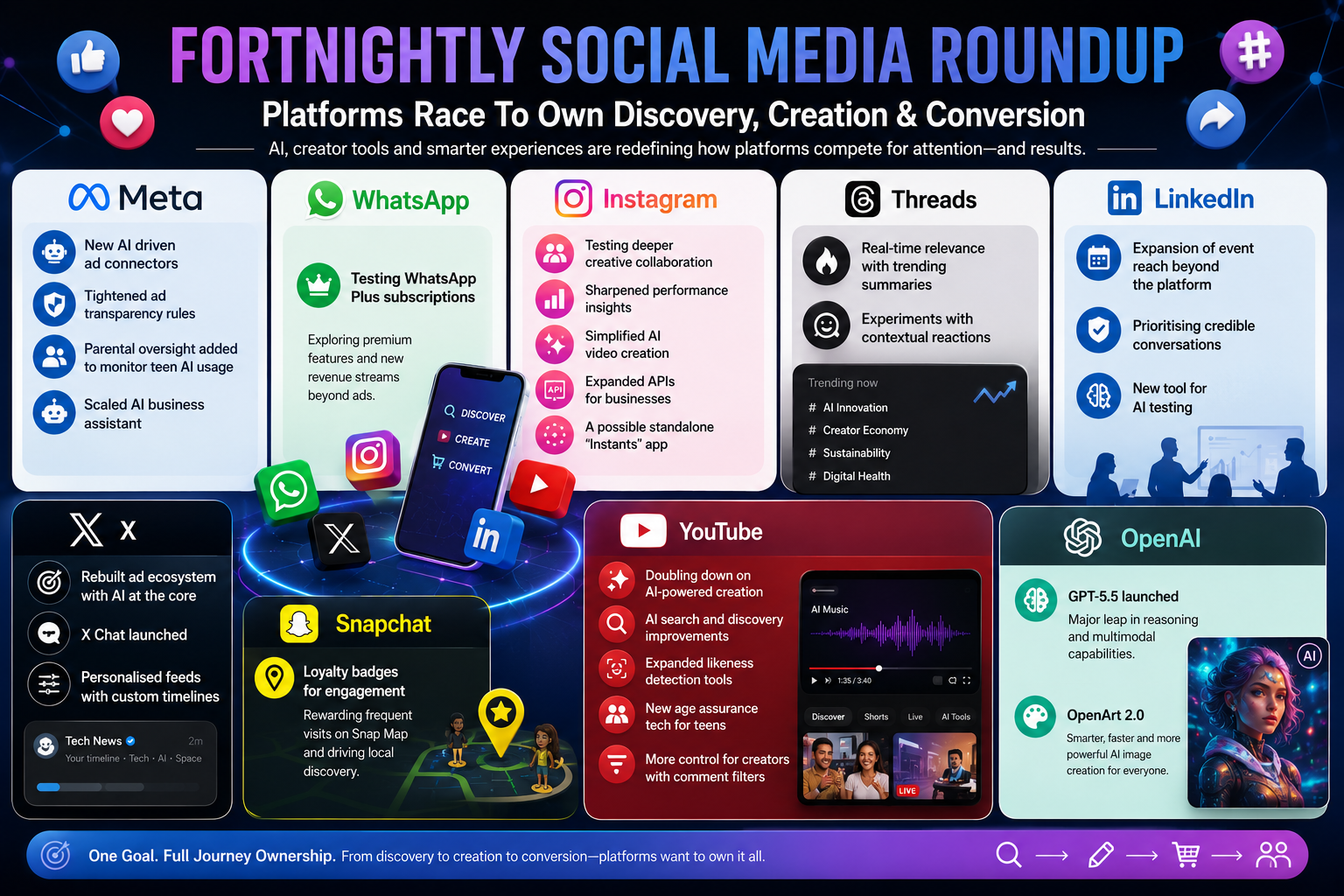
Over the last fortnight, major players including Meta, YouTube, LinkedIn, X, and OpenAI have accelerated this race through aggressive AI integrations, creator-focused tools, deeper personalization, and tighter platform governance.
The result is a rapidly evolving digital landscape where automation, personalization, and AI-assisted experiences are becoming central to how platforms retain users and generate revenue.
Meta: Building an AI-Led Advertising Ecosystem
Meta’s recent updates clearly show that the company is moving toward a future where advertising becomes increasingly conversational and automated. One of the most significant developments is the introduction of AI-driven ad connectors, which allow brands to integrate ads directly with third-party chatbots.
This fundamentally changes how digital advertising works. Instead of sending users to static landing pages, ads can now initiate real-time conversations, shortening the path from awareness to action. In practical terms, Meta is trying to transform ads from interruptions into interactive service experiences.
The company has also tightened ad transparency rules for third-party ad platforms, reflecting growing regulatory pressure and increasing consumer concerns around data usage and targeting practices. As AI-generated advertising becomes more sophisticated, transparency is becoming just as important as performance.
Another notable update is Meta’s expanded parental oversight feature, allowing parents to view their teens’ AI queries. This signals the platform’s attempt to balance rapid AI adoption with growing concerns around digital safety and accountability.
WhatsApp and the Push Beyond Advertising
WhatsApp’s testing of a premium “WhatsApp Plus” subscription model marks an important shift in platform monetization strategy. Messaging platforms have historically resisted heavy advertising integration, but the growing pressure to diversify revenue streams is changing that equation.



Rather than relying entirely on ads, WhatsApp appears to be exploring a hybrid model where users pay for premium functionality and enhanced experiences. This reflects a broader industry trend where platforms are increasingly experimenting with subscription-based monetization.
Instagram’s Evolution Into a Creation Engine
Instagram’s latest experiments indicate that the platform is aggressively positioning itself as an all-in-one creator ecosystem. By enabling users to edit text within others’ Reels, Instagram is pushing deeper into collaborative storytelling and remix culture.
This move extends content lifecycles while encouraging participation rather than passive consumption. It also strengthens community-driven creation, which is increasingly becoming the dominant engagement model on short-form video platforms.
At the same time, Instagram has introduced redesigned Insights dashboards and easier AI-powered editing tools. The strategy is obvious: reduce friction in content creation while giving creators more actionable performance data.
This aligns with broader industry demand for AI-powered tools for social media marketing, where automation and analytics are becoming essential for scaling content operations efficiently.
Threads: Chasing Real-Time Relevance
Threads continues to evolve beyond being simply a Twitter alternative. The platform’s expansion of trending topic summaries suggests Meta wants Threads to become a real-time information and conversation network.
By making trends easier to understand quickly, Threads is optimizing for contextual relevance rather than just chronological updates. Experiments with contextual emoji reactions also point toward richer, more nuanced engagement mechanics.
LinkedIn’s Shift Toward AI and Professional Trust
LinkedIn’s recent updates reveal a clear focus on professional credibility and AI experimentation. The platform’s new verified-replies filter is designed to prioritize trustworthy conversations and reduce noise—an especially important move in professional communities where information quality matters significantly.
The company has also launched tools for comparing outputs from different AI models, positioning itself not just as a networking platform but as a workspace for AI experimentation and productivity enhancement.
X: Rebuilding Through Messaging and AI
Under Elon Musk, X continues its transformation into an “everything app.” The launch of X Chat represents another step in strengthening private interactions and encrypted communication.
At the same time, X has rebuilt large portions of its advertising infrastructure around AI-driven optimization, aiming to improve targeting efficiency and restore advertiser confidence.
Snapchat’s Local Engagement Strategy
Snapchat’s introduction of loyalty badges for Snap Map locations highlights an interesting shift toward blending digital behavior with physical movement. By rewarding users for repeated visits to locations, Snapchat is exploring new models for local discovery and engagement.
This could eventually open new opportunities for local businesses and location-based advertising ecosystems.
YouTube’s Creator-First AI Expansion
YouTube remains heavily focused on empowering creators while improving content discovery through AI. The platform is testing AI music generation, moderation tools, multiview experiences, and AI-driven search capabilities—all designed to reduce friction in both content creation and consumption.
One particularly important development is the expansion of AI likeness detection tools, helping creators identify unauthorized use of their image or voice. As generative AI becomes more advanced, creator protection is emerging as one of the platform’s biggest priorities.
OpenAI and the Growing AI Ecosystem
The launch of GPT-5.5 signals another major leap in reasoning and multimodal AI capabilities. Beyond just technological advancement, it highlights how rapidly AI is becoming integrated into mainstream creative and marketing workflows.
This is also fueling the rise of AI-assisted creative ecosystems where platforms like OpenArt are making advanced image generation accessible to broader audiences.
The Bigger Trend: Ownership of the Entire User Journey
Across all these updates, one pattern is becoming impossible to ignore:
- Platforms no longer want to own just content.
- They want to own discovery, interaction, creation, monetization, and retention simultaneously.
This is why CRM systems, AI automation, creator tools, payments, and personalized feeds are increasingly merging into unified ecosystems. Platforms are becoming operating systems for digital behavior itself.
Businesses adapting to this environment are increasingly relying on advanced CRM and marketing automation platforms to manage multi-platform engagement and customer journeys effectively.
Conclusion
The latest wave of platform updates makes one thing very clear: social media is no longer just about social interaction. It is evolving into a fully AI-assisted infrastructure layer for communication, commerce, entertainment, and business.
Meta is pushing deeper into conversational commerce. YouTube is investing heavily in creator empowerment. LinkedIn is blending AI with professional credibility. X is rebuilding around messaging and personalization.
And beneath all of it lies the same objective:
own the user journey from start to finish.
The platforms that succeed won’t simply be the ones with the biggest audiences. They will be the ones that make discovery, creation, and conversion feel seamless, personalized, and impossible to leave.