

For decades, India’s technology workforce operated with a fairly predictable career aspiration. Landing a job at large IT giants such as TCS, Infosys, or HCL was considered a symbol of professional stability, social prestige, and long-term career success. These companies shaped the image of what a “dream employer” looked like for an entire generation of Indian professionals.
- Flipkart Leads India’s Preferred Employer Rankings
- Why Product Companies Are Becoming More Attractive
- Toxic Work Culture Remains the Biggest Concern
- India’s Startup Ecosystem Faces a Reputation Challenge
- Employees Are Becoming More Vocal
- Even Global Tech Employees Are Looking at Indian Firms
- Employer Branding Is Entering a New Era
- The Next Battle in Indian Tech
- Conclusion
But that perception appears to be changing.
A new survey by anonymous workplace community platform Blind suggests that India’s newer internet-first and product-driven companies are increasingly becoming more desirable workplaces than traditional outsourcing giants. The findings show Flipkart emerging as the most preferred Indian homegrown employer among respondents, ranking significantly ahead of long-established IT services firms.
Yet beneath this growing ambition around Indian startups and product companies lies a much deeper issue that continues to shadow the country’s technology ecosystem:
toxic work culture.
The survey suggests that for modern professionals, employer branding is no longer defined purely by company scale, salary packages, or market reputation. Increasingly, it is about trust, sustainability, and quality of work life.
Flipkart Leads India’s Preferred Employer Rankings
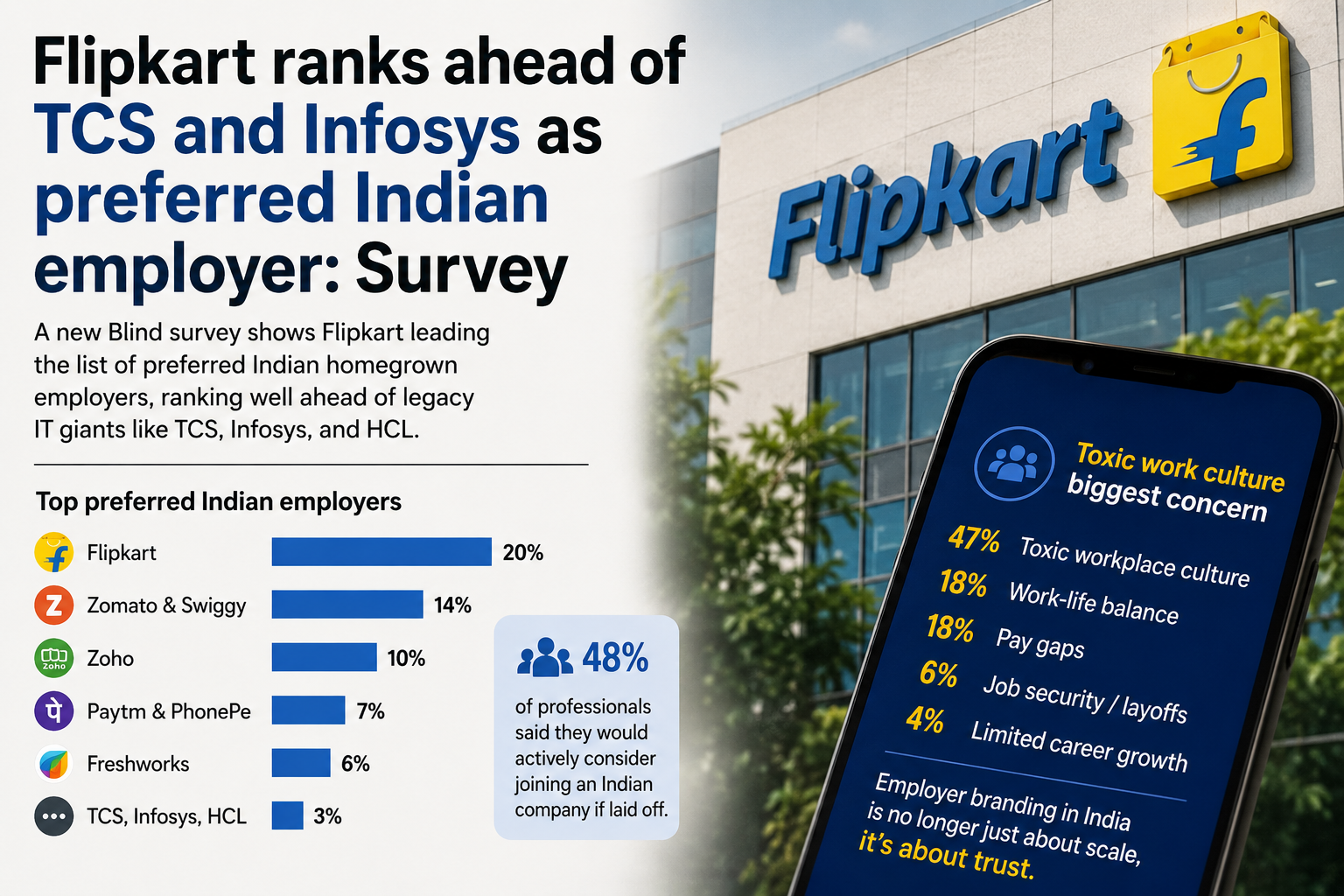
According to Blind’s survey of 1,205 India-based professionals, Flipkart secured the top spot among Indian homegrown employers respondents would most likely join if they were laid off tomorrow.
The ranking reflects how product-led and internet-first businesses are reshaping professional aspirations across India’s technology industry.
Other highly preferred companies included:



- Zomato and Swiggy at 14%
- Zoho at 10%
- Paytm and PhonePe at 7%
- Freshworks at 6%
Meanwhile, legacy IT services companies including TCS, Infosys, and HCL collectively attracted only 3% of responses despite remaining among India’s largest employers.
Perhaps the most revealing statistic, however, was that 40% of respondents selected “none of the above,” indicating widespread skepticism toward Indian workplace environments overall.
Why Product Companies Are Becoming More Attractive
The findings point toward a broader shift in how Indian professionals now evaluate career opportunities. Traditional IT services firms historically built their appeal around:
- job stability
- structured growth
- predictable career ladders
- large-scale hiring
But newer product-driven companies are increasingly attracting talent through:
- faster innovation cycles
- global product exposure
- stronger ownership culture
- startup-driven growth opportunities
- more modern workplace branding
Companies like Flipkart, Swiggy, and Zoho represent a different type of professional aspiration compared to the outsourcing-focused identity traditionally associated with Indian IT services firms.
Toxic Work Culture Remains the Biggest Concern
Despite growing interest in Indian companies, the survey also revealed a major challenge that continues to affect the sector:
workplace culture.
According to Blind’s findings:
- 47% of respondents cited toxic workplace culture as their biggest hesitation
- 18% pointed to poor work-life balance
- 18% identified pay gaps as a key issue
- 6% worried about layoffs and job security
- 4% cited limited career growth opportunities
Combined, culture and work-life concerns accounted for nearly 65% of all responses.
This suggests that professionals increasingly prioritize psychological wellbeing and workplace quality alongside compensation.
India’s Startup Ecosystem Faces a Reputation Challenge
Over the past several years, India’s technology and startup ecosystem has grown rapidly, but that growth has also triggered increasing scrutiny around:
- burnout culture
- extreme work expectations
- leadership behavior
- unrealistic productivity standards
Blind referenced earlier internal research showing that:
- 83% of Indian IT professionals report burnout
- 25% say they work over 70 hours per week
These numbers reflect a growing tension inside India’s tech sector. While companies aggressively compete for innovation and market share, employees are increasingly questioning whether the cost to personal wellbeing is becoming too high.
Employees Are Becoming More Vocal
One major reason these concerns are becoming harder to ignore is the rise of anonymous workplace platforms such as Blind, where verified employees openly discuss company culture and management practices.
The survey highlighted comments from employees across several firms. One Flipkart employee reportedly wrote:
“You will feel at home if you have no life outside of work.”
Meanwhile, employees at other companies raised concerns about:
- limited remote flexibility
- unpaid overtime
- weekend work expectations
- pressure-driven environments
This reflects a larger global trend where professionals increasingly value sustainable work environments over purely financial rewards.
Even Global Tech Employees Are Looking at Indian Firms
Interestingly, Blind’s data also showed growing interest in Indian companies among employees currently working at major global technology firms including:
- Microsoft
- Amazon
- Oracle
Microsoft employees accounted for 7.6% of respondents open to joining Indian firms, followed by Amazon employees at 6.8%.
This suggests India’s domestic technology ecosystem is no longer viewed merely as a local opportunity. Increasingly, it is becoming globally relevant talent infrastructure.
Employer Branding Is Entering a New Era
The findings highlight how employer branding itself is evolving. In the past, scale and salary were often enough to attract talent. Today, professionals increasingly evaluate companies based on:
- mental health culture
- leadership transparency
- flexibility
- trust
- sustainability
- career meaning
This shift mirrors broader changes happening across digital business ecosystems where trust and long-term relationship building are becoming central competitive advantages.
Many companies are now investing heavily in:
- AI-powered HR systems
- employee engagement automation
- internal communication platforms
- culture-focused employer branding
- https://allmarketingupdates.com/top-crm-with-marketing-automation-tools/
- https://allmarketingupdates.com/best-ai-tools-for-social-media-marketing/
The Next Battle in Indian Tech
India’s technology sector may now be entering a new phase where the biggest competition is no longer only for customers or funding—but for talent trust.
The companies that win over the next decade may not simply be those growing the fastest. They may be the ones capable of building:
- healthier workplaces
- sustainable cultures
- employee-focused leadership models
Because in a world where professionals have increasing options, reputation alone is no longer enough.
Conclusion
The Blind survey reflects a major psychological shift within India’s professional ecosystem. While traditional IT giants once defined career ambition for millions, newer product-led companies like Flipkart are increasingly shaping what modern professionals aspire toward.
But the survey also reveals a deeper truth:
India’s technology sector still faces a serious workplace culture challenge.
Professionals today are not only asking:
“How much will I earn?”
They are increasingly asking:
“How will this company make me feel?”
And in the future of employer branding, that second question may matter far more than the first.