

Executive Summary
The Wagh Bakri Tea Group is one of India’s most enduring fast-moving consumer goods (FMCG) businesses, backed by a heritage exceeding 133 years. Starting from a single retail outlet in Ahmedabad that sold handpicked loose leaf blends, the brand has scaled into a multi-format packaged powerhouse generating more than ₹2,000 crore in annual revenue.
Operating in an Indian packaged tea industry valued at roughly ₹30,000 crore, Wagh Bakri holds the #3 spot nationally with a low double-digit overall share (~10%)—placing it directly behind multinational leaders Tata Tea and Brooke Bond Red Label. In its home fortress of Gujarat and Ahmedabad, the brand commands an overwhelming 70% to 80% regional market share. For a deeper look at brand positioning across similar consumer verticals, explore our dedicated collection of FMCG Case Studies.
Its sustained success relies on a clear brand narrative centered on equality, meticulous regional blend engineering, early adoption of sealed packaging technology, and continuous adaptation into modern retail formats.
Founder Story & Historical Milestones (1892–Present)
[1892] Narandas Desai launches 500-acre estate in South Africa
  │
[Early 1900s] Racial apartheid barriers; Mahatma Gandhi advises return to India
  │
[1915–1919] Operations move to Ahmedabad; Gujarat Tea Depot established
  │
[1934] Launch of the "Wagh Bakri" brand identity
  │
[1980s–2000] Packaging automation; 4th generation takes helm
  │
[2000s–Present] Multi-state rollouts, Modern Tea Lounges, ₹2,000+ Cr revenue
The South African Foundation & Mahatma Gandhi’s Counsel
The entrepreneurial roots of the brand trace back to 1892, when founder Shri Narandas Desai traveled to South Africa and established a 500-acre tea estate. Despite building deep technical expertise in agricultural cultivation and leaf processing, escalating racial discrimination under colonial apartheid created severe roadblocks for Indian merchants.
During this period, Desai interacted closely with Mahatma Gandhi, who was leading civil rights efforts in South Africa. Gandhi sent Desai a personal letter—preserved in the company’s official corporate archives—advising him to return home to India, establish indigenous enterprises, and promote native manufacturing.
The Ahmedabad Textile Mill Connection (1915–1919)
Desai returned to India, gathered practical experience across regional plantations in Maharashtra, and moved with his sons to Gujarat in 1915. Ahmedabad was undergoing rapid industrial expansion, with cotton textile mills employing tens of thousands of factory workers. Desai capitalized on this local need by supplying robust, cost-effective “dust tea” directly to mill workers needing a strong morning stimulant.
In 1919, he formalized the business as Gujarat Tea Depot. The shop sold loose tea from large glass jars, allowing customers to curate personalized blends based on grain cut, infusion strength, and aroma. Blends like “Number 22” earned widespread word-of-mouth recall among early generations of consumers.
Formalizing “Wagh Bakri” (1934)
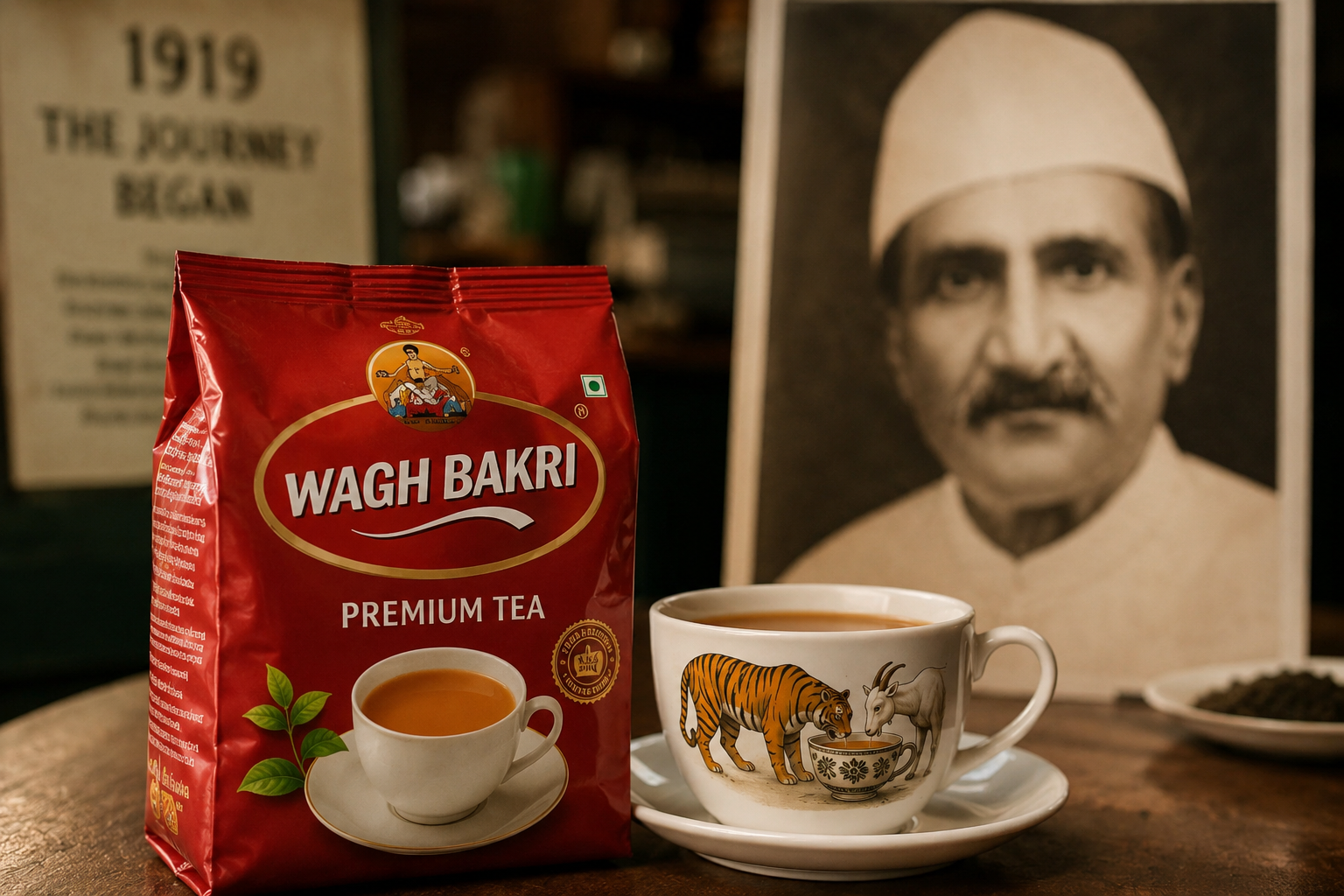
By 1934, Desai recognized that loose-commodity sales lacked enduring differentiation. He adopted the commercial brand name Wagh Bakri (Wagh = Tiger, Bakri = Goat) to communicate a unifying socio-cultural message alongside superior leaf quality.
Logo Meaning & Semiotic Deconstruction
| Visual Element | Direct Representation | Societal & Cultural Meaning | Commercial Function |
| Wagh (Tiger) | Apex predator; strength and nobility. | Upper class, social power, and might. | Communicates strong karak brew. |
| Bakri (Goat) | Humble domestic herbivore. | Common man, humility, universal access. | Signals everyday affordability and warmth. |
| Shared Tea Cup | Central cup shared by both animals. | Social harmony, equality, and unity. | Tea as the great Indian social equalizer. |
| The Pahelwan (Wrestler) | Muscular figure framing the emblem. | Physical vitality, energy, and strength. | Positions tea as a functional energy source. |
               [ The Pahelwan / Vitality & Stamina ]
                               │
       ┌───────────────────────┴───────────────────────┐
       ▼                                               ▼
 [ WAGH (Tiger) ]                                [ BAKRI (Goat) ]
 Upper Class / Power             Common Man / Humility
       │                                               │
       └────────────────► [ SHARED TEA CUP ] ◄─────────┘
                   "Social Equality & Togetherness"
Visual Semiotics in Low-Literacy India
When the visual trademark was formalized six decades ago, formal literacy across urban and rural India hovered around 50–60%. In an environment where printed text offered limited branding value, iconic visual markers were essential for shelf recall. The image of a tiger and a goat peacefully sharing tea gave everyday buyers an instantly recognizable visual cue.
Tea as the Social Equalizer
In India’s socially stratified landscape, tea serves as an everyday bridge. As noted by group leadership, “You have tea when you’re fighting with someone, when you’re making up with someone, when you’re alone, and when you’re in a group”. The emblem visualizes the philosophy that status differences fade when sharing a cup of tea. To understand how emotional narratives drive consumer connection, read our analysis on Emotional and Experiential Marketing.
Identity Refresh & Sonic Branding (Mogo)
To engage digital-first demographics without losing brand heritage, Wagh Bakri updated its packaging to bring the heritage emblem to the front-of-pack. Complementing the visual update, the group introduced a “Mogo” (Musical Logo) across its TV and digital campaigns, creating a recognizable audio signature.
Operational Shift: From Loose Leaf to Packaging Pioneer
Traditional Loose Leaf (Pre-1980s)
  │ (Customer touched, smelled, and inspected leaves in jars)
  ▼
Packaged Automation Disruption (1980s)
  │ (Imported machinery to seal freshness & eliminate adulteration)
  ▼
Standardized In-House Testing Laboratories
  │ (Rigorous batch checks across Assam, Bengal & South Indian leaves)
  ▼
Product Line Expansion
    • Flagship CTC Leaf & Dust
    • Wagh Bakri Milli & Navchetan
    • Instant 3-in-1 Premixes & Green/Iced Teas
Overcoming the Packaged Tea Resistance
For decades, unorganized loose leaf vendors dominated Indian tea retail. Consumers were accustomed to inspecting the dry leaf cut, testing aromas, and watching vendors blend grades on the spot. Sealed packaging initially ran into consumer skepticism because buyers could neither see nor smell the tea inside.
Investing in Packaging Technology
Wagh Bakri took a decisive leap by importing modern packaging machinery to seal in leaf freshness, standardize grain sizes, and protect products from contamination. This move established the group as an early pioneer of branded, sealed packaged tea in Western India.
Institutional Quality Control: Dedicated In-House Labs
To build long-term consumer trust, Wagh Bakri established one of the industry’s earliest dedicated private tea-testing laboratories. Shipments sourced from partner gardens across Assam, North Bengal, and South India were rigorously inspected for moisture, leaf grading, aroma, and infusion consistency before blending.
The Science of the Blend: Regional Customization
┌─────────────────────────────────────────────────────────────┐
│              REGIONAL BLEND ADAPTATION ENGINE               │
├─────────────────────────────────────────────────────────────┤
│                                                             │
│  [ Regional Field Sourcing ]                      │
│    • Water Quality Analysis (Hard vs. Soft Water Profiles)  │
│    • Dairy Profiling (Buffalo Milk vs. Cow Milk Fat)        │
│                                                             │
│                           ▼                                 │
│  [ Master Blenders in Ahmedabad ]                 │
│    • Tailoring CTC Granule Cuts and Leaf Ratios             │
│    • Testing Infusion Strengths and Extraction Rates        │
│                                                             │
│                           ▼                                 │
│  [ Standardized "Kaddak Meetha" Experience ]      │
│    • Consistent Taste, Color, and Finish Nationwide         │
│                                                             │
└─────────────────────────────────────────────────────────────┘
Because tea in India is typically boiled with milk and sugar, regional water minerals and dairy fat content significantly change the final taste.
- Water Hardness: Soft water extracts flavors quickly, while hard mineralized water slows extraction and can suppress subtle aromas.
- Milk Fat Profiles: Northern and Western households frequently boil high-fat buffalo milk (6%–8% fat), requiring a strong, pungent CTC grain cut. Southern states often use lower-fat cow milk (3.5%–4%), calling for a different leaf balance so the tea profile is not overwhelmed.
To ensure a consistent sensory profile nationwide, Wagh Bakri’s master blenders in Ahmedabad physically import water and milk samples from target expansion markets. They adjust leaf grain cuts and blend ratios to deliver the signature Kaddak Meetha profile in every market:
- Kaddak (Strength/Body): Delivers a rich brew, dark color, and satisfying astringency without turning bitter.
- Meetha (Lingering Sweet Aftertaste): Refers to the smooth mouthfeel that leaves a pleasant coating on the palate after drinking.
Financial Growth & Market Share Metrics
Under fourth- and fifth-generation family leadership, Wagh Bakri expanded beyond its home market to build a national distribution footprint.
Revenue Growth Trajectory (₹ in Crores)

  2024: ████████████████████████████████████████ ₹2,000+ Cr
  2023: ███████████████████████████████████ ₹1,740 Cr
  2021: ████████████████████████████████ ₹1,606 Cr
  2020: █████████████████████████ ₹1,282 Cr
  2000: ██ ₹100 Cr
Financial Trajectory
- c. 2000: Total annual revenue stood around ₹100 crore.
- FY 2019–20: Revenue reached ₹1,282 crore.
- FY 2020–21: Rose to ₹1,606 crore.
- FY 2022–23: Expanded to ₹1,740 crore.
- FY 2023–24: Surpassed ₹2,000 crore.
While overall volume growth across the mature Indian tea category averages 1% to 2% annually, Wagh Bakri has achieved volume growth of 5% to 7%.
Market Share Dynamics
- Organized Category Size: Valued at roughly ₹30,000 crore.
- Top 3 Concentration: The top three brands account for 40%–45% of the organized market.
- National Standing: Wagh Bakri is the #3 player nationwide, commanding a low double-digit share (~10%).
- Regional Strongholds: Holds a 70% to 80% market share in Gujarat and Ahmedabad, while generating 40% to 45% of total revenue from core Western states (Gujarat, Rajasthan, Maharashtra, and Madhya Pradesh).
Product Portfolio Architecture & Formats
                       WAGH BAKRI PRODUCT ARCHITECTURE
                                      │
   ┌──────────────────┬───────────────┴───────────────┬──────────────────┐
   ▼                  ▼                               ▼                  ▼
[ Mass-Market ]  [ Premium Core ]          [ Modern Convenience ] [ Experiential ]
 • Milli Tea        • Wagh Bakri Premium CTC    • Instant 3-in-1       • Tea Lounges
 • Navchetan          (Kaddak Meetha)             Premixes             • Bubble Teas
                                                • Green / Iced Teas    • "Chai-Coffee"
| Portfolio Tier | Product Variants | Target Segment & Occasion | Strategic Value |
| Mass-Market Regional | Wagh Bakri Milli, Navchetan Tea | Price-conscious rural and semi-urban households; high-volume daily consumption. | Defends against low-cost, unbranded loose tea vendors. |
| Core Flagship | Wagh Bakri Premium CTC Leaf & Dust | Everyday family breakfast staple and household pantry anchor. | Drives primary volume and revenue; delivers signature kaddak meetha profile. |
| Modern Convenience | 3-in-1 Instant Premixes (Masala, Ginger, Cardamom) | Working professionals, travelers, and offices needing quick boiled taste. | Taps into urban convenience trends. |
| Youth & Wellness | Green Teas, Iced Teas, Salted Caramel Infusions, CEO’s Assam Blends | Urban youth, health-focused consumers, specialty tea buyers. | Broadens appeal across modern lifestyle segments. |
| Experiential QSR | Tea Lounge Menus, RTD Bubble Teas, Chai-Coffee Fusions | Social outings, casual catch-ups, afternoon social hours. | Elevates chai culture into modern casual dining. |
Experiential Retail: Wagh Bakri Tea Lounges
              WAGH BAKRI TEA LOUNGE FOOTPRINT
                            │
       ┌────────────────────┼────────────────────┐
       ▼                    ▼                    ▼
[ Footprint Scale ]   [ Metro Distribution ] [ Extended Operations ]
 • 50+ Lounges         • 50% in Delhi-NCR     • Open Early Morning
 • Across 9 Metros     • Present in             to 1:00 AM
                         Bangalore & West     • Quick-Commerce Hubs
Elevating the Traditional Tapri
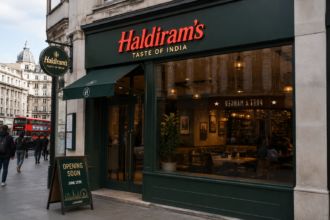
While international coffee chains popularized cafe culture in India, Wagh Bakri introduced dedicated Tea Lounges to give the country’s favorite beverage a premium, welcoming casual-dining setting. The chain has grown to over 50 lounges across 9 major cities, with roughly half located in Delhi-NCR, alongside locations in Bangalore and Western India.
Menu Innovation for Younger Demographics
The lounges double as real-world R&D centers, introducing modern beverage formats to engage younger consumers:
- Ready-to-Drink Bubble Teas: Launched to draw teenage and college-age crowds during summer months.
- Hybrid Innovations: Offerings like “Chai-Coffee”—a blend pairing the warmth of tea with the punch of coffee.
- Classic Regional Pairings: Traditional snacks like hot samosas and crispy pakoras celebrate monsoon snacking culture.
- Late-Night Quick-Commerce: High-density lounges stay open from early morning until 1:00 AM, serving both dine-in guests and late-night delivery orders.
Modern Distribution, Sampling & Marketing
┌─────────────────────────────────────────────────────────────┐
│                 GO-TO-MARKET DISTRIBUTION                   │
├─────────────────────────────────────────────────────────────┤
│                                                             │
│  [ Traditional Retail ][cite: 1, 2] [ Experiential Lounges ]│
│    • Kirana Store Coverage     • 50+ Outlets in 9 Metros    │
│    • Morning Park Wet Sampling • High-Street Flagships      │
│                                                             │
│  [ Quick & E-Commerce ]    [ Global Exports ][cite: 1, 2]   │
│    • Blinkit, Zepto, Swiggy    • 50 to 66 Countries         │
│    • Premium Instant Lines     • Focus on USA/UK Diaspora   │
│                                                             │
└─────────────────────────────────────────────────────────────┘
Quick-Commerce and Digital Retail Channels
Wagh Bakri’s market share on quick-commerce and e-commerce platforms runs 200 to 300 basis points higher than in traditional general trade. Digital platforms serve two primary purchase modes:
- Routine bulk pantry refills (1kg CTC packs).
- Fast convenience orders (3-in-1 instant tea sachets and late-night lounge delivery).
Wet-Sampling in Expansion Markets
Because daily tea habits are deeply ingrained, brand-switching rarely happens through broadcast ads alone. When expanding into competitive markets such as Delhi, Bangalore, and Haryana, Wagh Bakri runs morning wet-sampling activations at jogging parks and community hubs, letting consumers experience the taste firsthand. Discover more on-ground activation tactics in our guide on Guerrilla and Outdoor Advertising Examples.
Integrated Cultural Campaigns & Purpose Initiatives
- “Pyaar Wali Chai” Campaign: Storytelling centered on how sharing tea resolves disputes and brings families together.
- Monsoon Brand Partnerships: Retail and social collaborations with McCain Foods promoting hot masala chai alongside French fries.
- Tea Garden CSR Programs: Initiatives supporting women tea pluckers across Assam and South India with education, menstrual hygiene resources, and agricultural training. For comprehensive campaign breakdowns, explore our Advertising & Strategy Insights.
Global Expansion & International Footprint
                       GLOBAL EXPORT REACH[cite: 1, 2]
                                │
       ┌────────────────────────┼────────────────────────┐
       ▼                        ▼                        ▼
[ Scale & Scope ]       [ Core Export Markets ]   [ Distribution Channels ]
 • 50–66 Countries       • USA, Canada, UK,        • Indian/Pakistani Grocery
 • Diaspora-led            Australia, Middle East    Retailers
   Word-of-Mouth • Global Modern Trade   • Global E-Commerce
Leveraging India’s position as a major producer and exporter of black tea, Wagh Bakri built a worldwide export network:
- Global Footprint: Packaged exports reach 50 to 66 countries.
- Diaspora Retail Presence: Market leadership across Indian and Pakistani grocery networks in the US, Canada, UK, Australia, and the Middle East.
- Word-of-Mouth Adoption: Indian travelers and diaspora communities introduced the brand overseas, creating an international trial loop that reinforced domestic brand loyalty when families returned to India.
SWOT Analysis
                      SWOT MATRIX
  ┌─────────────────────────────────┬─────────────────────────────────┐
  │           STRENGTHS             │          WEAKNESSES             │
  │ • 133-year brand heritage       │ • Regional revenue dependence   │
  │ • 70-80% West market share      │   on Western India              │
  │ • Region-tailored blending      │ • High friction to induce habit │
  │ • 50+ modern Tea Lounges        │   switching in new regions      │
  ├─────────────────────────────────┼─────────────────────────────────┤
  │         OPPORTUNITIES           │            THREATS              │
  │ • 3-in-1 premix convenience     │ • Fragmented unorganized local  │
  │ • Quick-commerce channel lift   │   tea merchants                 │
  │ • Global diaspora expansion     │ • Raw tea price fluctuations    │
  │ • Youth-focused RTD beverages   │ • Shifting youth preferences    │
  └─────────────────────────────────┴─────────────────────────────────┘
Strengths
- High consumer trust and brand equity built over 133 years of continuous operation.
- Blending processes tailored to local water hardness and dairy fat differences across states.
- Strong visual recall from the historic “Tiger and Goat” equality emblem.
- Growing footprint of experiential Tea Lounges in prime urban locations.
Weaknesses
- A large share of overall sales remains concentrated in Western India (Gujarat, Rajasthan, Maharashtra, MP).
- High customer-acquisition costs and continuous wet-sampling needed to shift entrenched habits in Southern and Eastern markets.
Opportunities
- Growing adoption of 3-in-1 instant tea premixes for busy professionals and travelers.
- Rolling out tea lounges in airports, business parks, and international diaspora hubs.
- Leveraging higher margins from quick-commerce and specialty tea blends.
Threats
- Competition from unorganized, low-cost loose leaf sellers across regional districts.
- Raw leaf supply fluctuations and commodity price shifts across Assam and Bengal auctions.
- Changing urban youth habits toward specialty coffee, energy drinks, and RTD alternatives.
12. Key Strategic Takeaways for Marketers
┌─────────────────────────────────────────────────────────────┐
│                 CORE STRATEGIC TAKEAWAYS                    │
├─────────────────────────────────────────────────────────────┤
│                                                             │
│  1. Unbroken Consistency Drives Ritual Brands               │
│     In daily habit categories, consistent taste matters     │
│     more than promotional ad frequency.                     │
│                                                             │
│  2. Semiotic Storytelling Outlasts Short Campaigns          │
│     Symbols rooted in cultural values (equality, unity)     │
│     create intergenerational brand trust.                   │
│                                                             │
│  3. Product Chemistry as a Defensive Moat                   │
│     Formulating products for local conditions (water/milk)  │
│     creates a strong barrier against generic blends.        │
│                                                             │
│  4. Format Evolution Keeps Heritage Relevant                │
│     Expanding into modern channels (QSR lounges, instant    │
│     premixes, quick-commerce) attracts younger audiences.   │
│                                                             │
└─────────────────────────────────────────────────────────────┘
- Daily Rituals Require Consistent Taste: In habit-heavy categories like morning tea, consumers rarely switch brands through advertising alone. Long-term loyalty requires experiential sampling and consistent taste in every cup.
- Semiotic Foundations Build Enduring Equity: Wagh Bakri’s emblem—originally created during a period of lower literacy to represent social equality—remains a powerful differentiator in modern digital campaigns.
- Hyper-Local Adaptation Protects Market Share: Formulating blends around regional water chemistry and milk fat profiles creates a local moat that one-size-fits-all national competitors struggle to breach.
- Format Innovation Keeps Legacy Brands Fresh: Expanding into instant premixes, quick-commerce, and casual-dining lounges keeps the brand relevant to younger consumers while protecting its heritage core.
Wagh Bakri’s transformation from a local loose-leaf counter into a ₹2,000+ crore multi-format beverage brand shows how regional heritage, scientific product formulation, and channel adaptation can work together to build a lasting FMCG enterprise.
Sources & References
- Iconic Brand Stories Interview: Executive interview discussing Wagh Bakri’s 133-year legacy, Mahatma Gandhi’s archive letter, logo meaning, regional water and milk blending chemistry, modern Tea Lounge operations, and omni-channel retail dynamics.
- Industrial & Historical Retrospective: Comprehensive documentary coverage detailing Shri Narandas Desai’s South African tea garden (1892), the establishment of Gujarat Tea Depot (1919), transition to packaged tea automation, in-house laboratory testing, and revenue growth trajectory to ₹2,000+ crore.
- EQ Brand Stories: Brand analysis on the socio-cultural equality philosophy behind the Wagh (Tiger) and Bakri (Goat) naming and regional dominance in Western India.