






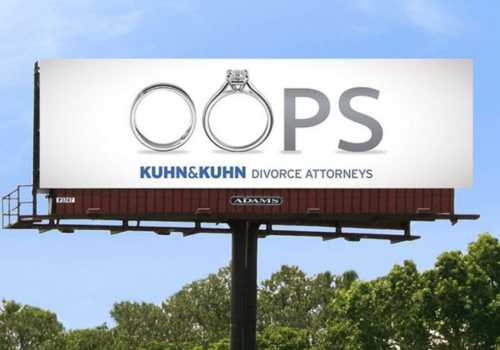

At first glance, it’s just two wedding rings and one word:
OOPS.
No phone number screaming at you.
No aggressive headline.
No legal credentials stacked in tiny fonts.
And yet — it works.
Because your brain finishes the ad.
You see the rings.
You read “OOPS.”
You connect the dots.
Marriage → Mistake → Divorce lawyer.
That split-second realization is the strategy.


The Power of the Micro “Aha” Moment
This billboard uses visual wordplay — and that matters for one key reason:
It forces light cognitive participation.
You’re not just looking at an ad.
You’re solving it.
Even a tiny moment of interpretation activates deeper processing in the brain. Instead of passively scanning, you engage.
And engagement improves recall.
When people participate in meaning-making, memory encoding strengthens. The brand becomes associated with a moment of cleverness — not interruption.
The joke lands.
And so does the message.
Why Humor Multiplies Memory
Humor isn’t just entertaining — it’s strategic.
Humorous ads are consistently shown to be:
- More distinctive
- More emotionally engaging
- More shareable
- Easier to remember
But here’s the subtle brilliance:
This humor is restrained.
There’s no over-the-top sarcasm.
No dramatic exaggeration.
No aggressive punchline.
Just implication.
That restraint makes the ad feel intelligent — not desperate for attention.
Minimalism as Competitive Advantage
Legal advertising is usually loud:
- “#1 Divorce Attorney”
- “Free Consultation”
- “We Fight For You”
- Credentials, awards, phone numbers
This billboard does the opposite.
It removes everything except the idea.
And in a cluttered outdoor environment, simplicity becomes contrast.
The human brain is drawn to what feels incomplete.
When something looks too clean, too spare — we pay attention.
The Gap Is the Hook
The real strength of this ad is the gap it creates.
It doesn’t explain the joke.
It doesn’t spell out the service.
It doesn’t over-clarify.
Instead, it trusts the audience.
Humans are wired to close gaps in information. When we do, the conclusion feels self-generated.
And self-generated conclusions are more powerful than delivered ones.
The moment you think,
“Oh. Divorce.”
The ad becomes yours.
What Marketers Should Take From This
This isn’t really about divorce law.
It’s about cognitive design.
If you want ads to stick:
- Don’t say everything — imply one sharp idea
- Let visuals carry the narrative
- Use humor with restraint
- Design for interpretation, not explanation
- Create a small gap the audience feels compelled to close
In a world where attention is shallow, participation is leverage.
When people figure something out themselves, they don’t just see the ad.
They experience it.
And experience will always outperform exposure.