
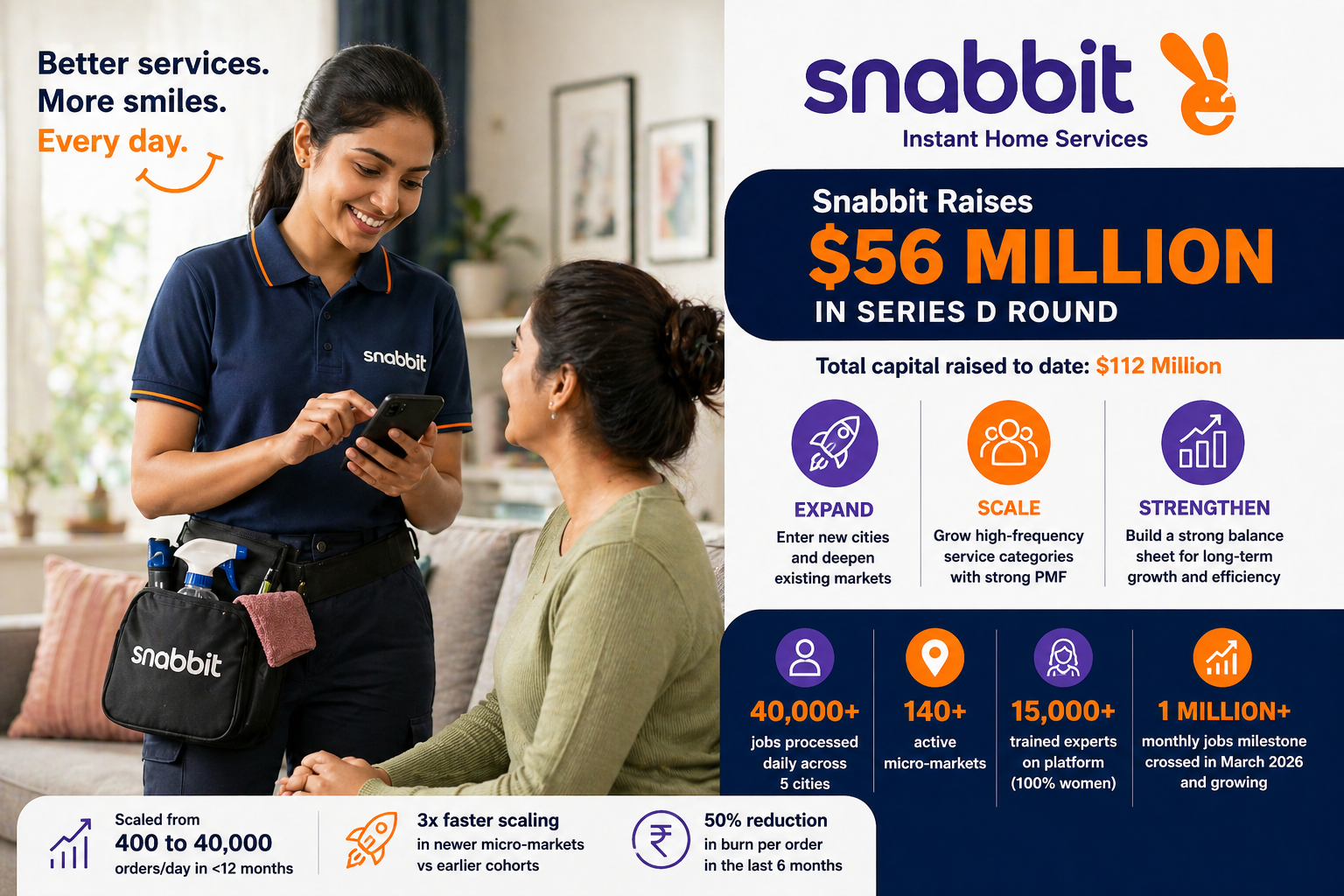

India’s home services market is entering a new phase of rapid transformation, driven by changing consumer behavior and increasing demand for convenience. At the center of this shift is Snabbit, a fast-growing home services platform that has raised $56 million in its Series D funding round.
- Funding Details and Strategic Intent
- From Category Creation to Market Dominance
- The Power of Hyperlocal Density
- A Women-Led Workforce Model
- Unit Economics: The Real Game-Changer
- Competition in the Home Services Market
- A $100 Billion Opportunity
- The Role of Technology and Automation
- External Perspective
- FAQs
- Conclusion
Co-led by Susquehanna Venture Capital, Mirae Asset Venture Investments, and Bertelsmann India Investments, the round signals strong investor confidence in Snabbit’s ability to not just participate in the market—but lead it.
Funding Details and Strategic Intent
The latest funding round comes just six months after Snabbit’s Series C, bringing its total capital raised to $112 million. This rapid fundraising cycle reflects both the scale of opportunity and the urgency of competition in the category.
The capital will be deployed across three core areas: expanding into new cities, deepening presence in existing markets, and improving unit economics. Rather than aggressive, unfocused expansion, the company is prioritizing disciplined growth—an approach that is increasingly becoming critical in the startup ecosystem.
From Category Creation to Market Dominance
Snabbit is no longer just building a category—it is now aiming to dominate it. The platform has scaled from fewer than 400 daily jobs to over 40,000 within a year, highlighting both strong demand and efficient execution.
This growth is not just about volume. It reflects deeper engagement, higher repeat usage, and stronger demand density across micro-markets. By focusing on hyperlocal clusters, the company is achieving better utilization of service providers and reducing customer acquisition costs.
The Power of Hyperlocal Density
One of Snabbit’s core strategic advantages lies in its focus on micro-market density. Instead of spreading resources thin across large geographies, the company is building depth within smaller, high-demand areas.
This approach creates a flywheel effect: higher order density leads to better service availability, which improves customer satisfaction, resulting in increased repeat usage. Over time, this strengthens unit economics and creates a more sustainable business model.


A Women-Led Workforce Model
A defining feature of Snabbit’s platform is its network of over 15,000 trained experts—all women. This not only addresses service quality and trust but also contributes to broader social impact by enabling financial inclusion and digital literacy.
The company has also implemented safety measures such as real-time tracking and emergency support through its ‘Snabbit Kavach’ system, enhancing both worker and customer confidence.
Unit Economics: The Real Game-Changer
While growth metrics often dominate headlines, the real story lies in Snabbit’s improving unit economics. The company has reduced burn per order by 50% over the past six months, a critical milestone in achieving long-term sustainability.
This focus on efficiency sets it apart in a market where many startups struggle to balance growth with profitability.
Competition in the Home Services Market
The race to dominate India’s home services sector is intensifying, with players like Urban Company and Pronto aggressively expanding their presence.
This competition is driving innovation and improving service standards across the industry. It also highlights the massive opportunity in a market that remains largely unorganized.
A $100 Billion Opportunity
India’s home services market is already valued at over $60 billion and is expected to approach $100 billion by 2030. Despite this scale, less than 5% of the market is currently penetrated by organized digital platforms.
This gap represents a significant opportunity for companies like Snabbit to formalize the sector and capture market share. Similar large-scale transformations can be seen across industries, where digital platforms are reshaping traditional categories.
- https://allmarketingupdates.com/chupps-ajinkya-rahane-investment-d2c-footwear/
- https://allmarketingupdates.com/paytm-majority-indian-owned-domestic-stake-growth/
The Role of Technology and Automation
Scaling a marketplace of this nature requires sophisticated technology infrastructure. Companies often rely on CRM and marketing automation platforms to manage demand-supply dynamics, optimize operations, and improve customer retention.
Additionally, driving user acquisition and engagement at scale requires leveraging AI-powered tools for social media marketing, enabling targeted campaigns and efficient growth strategies.
External Perspective
According to Invest India, India’s startup ecosystem continues to attract significant global investment, particularly in sectors driven by digital transformation and consumer demand.
FAQs
How much funding did Snabbit raise?
$56 million in Series D.
What does Snabbit do?
It provides instant home services through a marketplace platform.
Why is this funding important?
It supports expansion, improves unit economics, and strengthens operations.
Conclusion
Snabbit’s latest funding round marks a pivotal moment in its journey, signaling a transition from rapid growth to strategic consolidation. By focusing on unit economics, hyperlocal density, and operational excellence, the company is positioning itself as a leader in one of India’s most promising yet underpenetrated markets.
As the home services sector continues to evolve, the ability to balance scale with sustainability will determine which players emerge as long-term winners—and Snabbit is clearly building toward that future.