





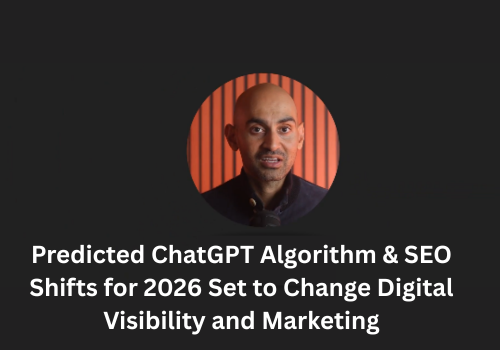

As AI-driven tools increasingly shape how people discover information, marketers are being forced to rethink what visibility really means. Recent commentary from Neil Patel reflects a wider industry shift — not toward panic about algorithms, but toward understanding how discovery itself is evolving.
- Authority Is Becoming Harder to Fake — and Easier to Lose
- Discovery Is Moving Beyond Keywords Toward Concepts
- Freshness and Momentum Are Becoming Real-Time Signals
- Reputation Is Becoming a Gatekeeper for Visibility
- Content Still Matters — but Structure Matters More Than Ever
- What Marketers Should Actually Focus On
- Why This Shift Feels Uncomfortable (But Necessary)
- Final Thought
The core insight is simple but uncomfortable: being findable is no longer the same as being rankable.
AI systems don’t just list links. They interpret, summarise, recommend, and sometimes decide for the user. That fundamentally changes which signals matter — and which old optimisation habits are quietly losing power.
Authority Is Becoming Harder to Fake — and Easier to Lose
One of the strongest patterns emerging across AI-powered discovery is the emphasis on real authority.
Unlike traditional search engines, which could sometimes be influenced by surface-level optimisation, AI systems are designed to minimise misinformation and hallucination. To do that, they rely heavily on trusted, validated sources.
For brands and publishers, this means visibility increasingly depends on:
- Credible third-party mentions
- Recognition by authoritative publications or platforms
- Demonstrated expertise within a specific niche
- Consistency across multiple trusted sources
In this environment, authority isn’t something you declare — it’s something that’s corroborated. AI systems look for confirmation signals, not self-promotion. Thin content, inflated claims, or isolated visibility no longer hold much weight.
Discovery Is Moving Beyond Keywords Toward Concepts
Traditional SEO trained marketers to think in terms of keywords. AI-driven discovery operates very differently.



Instead of waiting for exact queries, AI systems build associations between:
- Brands and problem spaces
- Topics and outcomes
- Products and use cases
- Experts and recurring themes
This shifts competition away from individual keywords and toward conceptual ownership.
Brands that succeed tend to:
- Cover topics deeply rather than broadly
- Maintain consistent positioning
- Revisit and expand core themes over time
On the flip side, brands that publish sporadically across unrelated topics struggle to build strong associations. Without coherence, AI systems find it harder to understand what you’re actually known for.
Freshness and Momentum Are Becoming Real-Time Signals
Another important shift is how recency is being weighted.
In fast-moving industries, AI systems often prioritise:
- Recent mentions
- Updated content
- Ongoing activity
- Current consensus
This doesn’t erase long-term authority, but it does change how relevance is judged. A brand that was credible three years ago but inactive today may be surfaced less often than a brand that is actively publishing, updating, and being discussed right now.
For marketers, this reinforces the importance of:
- Regular publishing cycles
- Updating existing content, not just creating new pages
- Staying present in current conversations
Visibility is increasingly tied to momentum, not just history.
Reputation Is Becoming a Gatekeeper for Visibility
One of the most under-discussed changes is how sentiment affects AI-driven discovery.
AI systems don’t just extract facts — they summarise opinions. Reviews, forums, customer feedback, and public discussions all influence how a brand is framed. In some cases, negative sentiment can reduce visibility altogether, not just conversion.
This means reputation management is no longer separate from search strategy.
For brands, this includes:
- Monitoring public feedback
- Addressing recurring complaints
- Ensuring customer experiences align with brand claims
- Managing narratives across platforms, not just websites
In an AI-mediated world, how people talk about you can matter as much as what you publish.
Content Still Matters — but Structure Matters More Than Ever
Despite frequent claims that “SEO content is dead,” structured content remains one of the most reliable ways for AI systems to understand information.
What’s changing is how content is evaluated.
AI systems favour content that is:
- Clearly structured
- Logically organised
- Easy to scan and summarise
- Explicit about definitions, relationships, and conclusions
This puts greater emphasis on:
- Clear headings and subheadings
- Concise summaries and explanations
- Well-defined sections
- Intent-aligned formatting
Content now serves two audiences simultaneously: humans and machines. Clarity isn’t just a UX improvement — it’s a visibility signal.
What Marketers Should Actually Focus On
Rather than trying to predict how any one AI system will behave, a more durable strategy is to align with the signals that consistently appear across platforms.
The signals gaining importance are:
- Credibility over clever optimisation
- Consistency over sporadic output
- Clarity over volume
- Reputation over reach
- Relevance sustained over time
These aren’t tricks or loopholes. They’re fundamentals — just evaluated more strictly than before.
Why This Shift Feels Uncomfortable (But Necessary)
AI-driven discovery removes many of the shortcuts marketers relied on:
- Over-optimised pages
- Thin content targeting narrow queries
- Tactical ranking hacks
What replaces them is harder work: building trust, earning recognition, and staying relevant continuously. But it also creates a fairer environment where usefulness compounds.
Brands that genuinely help their audience tend to benefit across every new discovery interface, whether it’s search engines, AI assistants, or future tools we haven’t seen yet.
Final Thought
AI search predictions aren’t really about technology — they’re about expectations.
Discovery is becoming less about who knows the rules and more about who deserves attention. SEO isn’t disappearing; it’s being elevated. Visibility now belongs to brands that are useful, trusted, consistent, and current.
For marketers, the future isn’t about chasing algorithms.
It’s about building signals that remain valuable no matter how discovery evolves.