





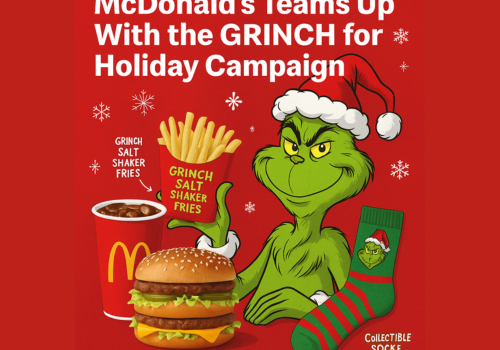

Holiday marketing has changed. What was once dominated by warm visuals, sentimental storytelling and limited-time menus has evolved into something far more cultural, participatory and multi-platform. McDonald’s’ latest holiday campaign is a clear example of that shift.
- Why the Grinch Is a Strategic Holiday Choice
- Turning a Meal Into a Multi-Platform Experience
- Why Gaming and Creator Tie-Ins Matter More Than Ever
- Controlled Chaos as a Creative Strategy
- Pop Culture as a Long-Term McDonald’s Playbook
- What Marketers Can Learn From This Campaign
- Why This Approach Fits the Moment
- Final Thought
By partnering with The Grinch, McDonald’s isn’t simply introducing a festive meal—it’s creating a pop-culture moment designed to live across TV screens, city streets, social feeds, and gaming platforms. The result is a campaign that feels less like a seasonal promotion and more like an entertainment rollout.
At its core, this campaign reflects how modern brands are adapting to fragmented attention and emotionally mixed holiday audiences.
Why the Grinch Is a Strategic Holiday Choice
Most holiday advertising leans into the same emotional playbook: joy, togetherness, nostalgia, and perfection. The Grinch disrupts that formula.
As a character, the Grinch represents resistance to forced festivity, exaggerated cheer, and unrealistic expectations. That makes him an unusually relevant figure in a season that many people experience as overwhelming rather than magical.
By choosing the Grinch, McDonald’s taps into controlled chaos:
- Acknowledging holiday stress instead of ignoring it
- Letting humour replace forced sentimentality
- Offering relief from overly polished seasonal messaging
This positioning gives audiences permission to engage with the holidays on their own terms. Instead of telling people how they should feel, the campaign meets them where they already are.
In a crowded seasonal landscape, that tonal difference becomes a competitive advantage.
More Read


Turning a Meal Into a Multi-Platform Experience
While the Grinch Meal is the physical product anchor, it’s only one layer of the campaign. What makes this launch notable is how McDonald’s builds an ecosystem around it.
The rollout spans:
- A Times Square takeover for mass visibility and spectacle
- National TV to establish broad awareness
- Social-first content driven by character-led storytelling
- A gaming activation that extends the campaign into creator communities
Each channel plays a different role. Times Square delivers cultural scale. TV provides legitimacy and reach. Social platforms extend narrative and humour. Gaming creates participation.
Rather than repeating the same message everywhere, McDonald’s uses each platform for what it does best.
Why Gaming and Creator Tie-Ins Matter More Than Ever
The gaming component is not an add-on—it’s central to the strategy.
By collaborating with Twitch creators and integrating livestreams, McDonald’s enters spaces where younger audiences already spend significant time. Importantly, the brand doesn’t force traditional advertising formats into gaming culture. Instead, it allows the Grinch persona to exist naturally within creator-led environments.
This reflects a broader shift in brand thinking:
- Gaming is no longer niche
- Creators are not just media channels, but cultural connectors
- Engagement now comes from participation, not interruption
In this context, gaming sits alongside TV, OOH, and social as a core pillar, not an experimental one.
Controlled Chaos as a Creative Strategy
What ties the campaign together is intentional unpredictability.
The Grinch’s personality allows McDonald’s to break from polished brand perfection without losing recognisability. Chaos is present—but it’s designed, branded, and controlled.
This approach:
- Keeps the campaign entertaining rather than chaotic
- Makes content feel more human and less corporate
- Encourages sharing because it feels unexpected
In a season saturated with sameness, unpredictability becomes memorable.
Pop Culture as a Long-Term McDonald’s Playbook
The Grinch collaboration isn’t a one-off. It fits into a larger McDonald’s strategy that leans heavily on pop culture, fandoms, and entertainment properties.
Across films, music, gaming, and now holiday characters, the brand consistently:
- Borrows existing cultural relevance
- Builds short-term excitement
- Reinforces long-term brand affinity
Rather than creating moments from scratch, McDonald’s inserts itself into conversations that already exist. This reduces creative friction and increases the chance of organic engagement.
What Marketers Can Learn From This Campaign
McDonald’s holiday push offers several practical lessons:
- Seasonal campaigns perform better when they reflect real emotional states, not idealised ones
- Pop culture partnerships can cut through clutter faster than original storytelling alone
- Gaming and creators are now mainstream media channels, not experiments
- Experiences and participation drive recall more effectively than products alone
- Cultural relevance often matters more than feature communication
The campaign shows how entertainment, not persuasion, increasingly leads modern marketing.
Why This Approach Fits the Moment
Holiday audiences today are overstimulated, time-poor, and emotionally mixed. Campaigns that demand attention or sentiment often struggle to land.
By embracing humour, chaos, and multi-platform storytelling, McDonald’s aligns with how people actually consume culture in 2025—across feeds, fandoms, and communities, not in linear silos.
The Grinch isn’t just a mascot here. He’s a mirror.
Final Thought
McDonald’s Grinch campaign illustrates how holiday marketing has evolved from festive visuals to cultural alignment. By combining food, entertainment, creators, gaming, and outdoor spectacle, the brand transforms a limited-time offer into a moment people want to talk about—and take part in.
In a season defined by noise and expectation, embracing a little controlled chaos might be one of the smartest strategies a brand can choose.