



During Basant, Lahore doesn’t simply host a festival — it transforms into one. Rooftops fill with kites, streets pulse with colour, and the skyline becomes kinetic with movement and sound.
This year, Coca-Cola didn’t advertise around the celebration.
It integrated into it.
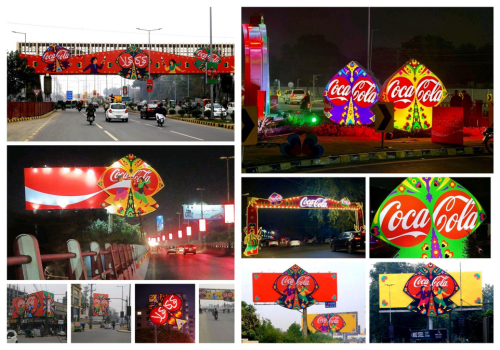
Working with Kinetic Pakistan, the brand transformed highways, roundabouts, flyovers, and nightscapes into a cohesive visual system built around Basant’s symbolism — creating what felt less like a campaign and more like a city-wide extension of the festival itself.
When a City Becomes the Canvas
Most outdoor campaigns are built to interrupt. They compete for attention with brightness, size, and contrast.
This one aligned instead of interrupted.
The creative language reflected Basant’s identity:
- Traditional yellow and red colour palettes associated with spring
- Kite-inspired illuminated installations integrated into urban structures
- Folk-influenced typography that echoed local aesthetics
- Carefully chosen placements along high-traffic arteries
Rather than competing with the festival’s energy, the brand extended it. The installations felt like part of the celebration’s choreography, not an overlay imposed on it.
The city became the canvas — and the brand became a visual rhythm within it.
Why This Activation Worked
Culture Led the Creative
The strongest festival campaigns begin with cultural literacy.
Instead of pushing product-forward messaging, Coca-Cola translated its brand identity into Basant’s vocabulary. The iconic red and dynamic visual energy naturally aligned with the festival’s colour and motion.
That shift — from selling to synchronising — transforms advertising into participation.
When brands respect cultural context, audiences perceive presence rather than intrusion.
Consistency Created Scale
Scale alone does not create impact. Cohesion does.
Across:
- Major highways
- Flyovers
- Roundabouts
- Night-lit skyline elements
the same visual logic was repeated. Colours, motifs, and typographic cues remained consistent.
This repetition builds memory structures. It reinforces recognition through rhythm rather than volume.
The campaign didn’t rely on a single iconic installation. It relied on cumulative presence.
The City Was Treated as a Media Ecosystem
Traditional out-of-home (OOH) buying is often transactional — one billboard equals one impression count.
This activation approached Lahore differently. It treated the city as a connected spatial environment.
Instead of scattered placements, it created narrative continuity. Each location felt like a chapter within a larger story.
That shift — from isolated impressions to spatial storytelling — reflects the evolution of experiential outdoor marketing.
As urban spaces become denser and attention becomes scarcer, campaigns that think in ecosystems outperform those that think in placements.
What Marketers Can Learn
This activation offers practical lessons for brands navigating crowded cultural moments:
- Align with existing cultural emotion rather than inventing new narratives
- Build visual cohesion across environments to strengthen recall
- Think ecosystem, not inventory
- Let recognition outperform persuasion
Festival marketing works best when brands amplify the moment instead of trying to dominate it.
The Bigger Strategic Implication
Audiences today are increasingly resistant to overt commercial messaging. But they remain receptive to brands that feel culturally fluent.
By embedding itself seamlessly into Basant’s visual and emotional landscape, Coca-Cola reinforced a long-standing positioning: celebration, togetherness, and shared joy.
It didn’t shout. It synchronized.
Final Takeaway
Coca-Cola’s Basant activation illustrates a broader shift in experiential OOH strategy.
When brands understand the rhythm of a place, visibility becomes belonging.
And belonging builds stronger equity than interruption ever could.