





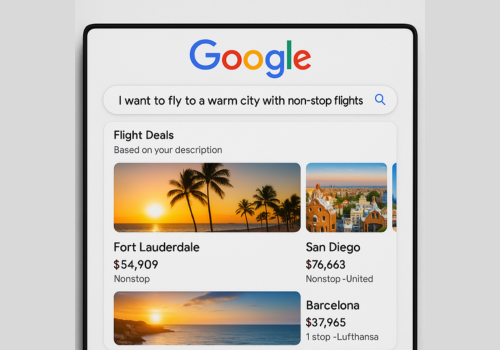

Google’s newly introduced Flight Deals feature isn’t really about finding the cheapest ticket—it’s about reflecting how travel planning has fundamentally changed. Instead of assuming users already know their destination, dates, and airline preferences, Google now allows people to begin where they actually start: with a feeling, a constraint, or a vague idea.
- From Rigid Planning to Intent-Based Discovery
- Why This Shift Matters for Travel Brands and Marketers
- A Natural Extension of Conversational and AI-Led Search
- How This Mirrors a Broader Pattern in Modern Marketing
- What Marketers Can Learn From Google’s Flight Deals Feature
- What This Means for Users
- Final Thought
This subtle shift—from rigid inputs to open-ended intent—signals a major evolution in search behaviour. It acknowledges that modern travellers don’t always plan trips like spreadsheets. They plan them like conversations.
Rather than typing exact routes and dates, users can now describe what they want:
- Warm weather
- Flexible dates
- Non-stop flights
- Budget limits
- Short getaways
Google then translates those signals into destination ideas and real-time flight prices directly inside Search. The tool feels less like a booking engine and more like a travel thought partner.
From Rigid Planning to Intent-Based Discovery
For years, travel search assumed certainty. You had to know:
- Where you were going
- When you were travelling
- How long you’d stay
But in reality, most people start with much looser thinking. They know they want a break, not necessarily Bangkok. They know they have ₹20,000, not a fixed date.
The Flight Deals feature mirrors this reality. Queries like:
- “Warm places under ₹20,000”
- “Non-stop flights next month”
- “Cheap weekend trips from Delhi”
aren’t edge cases anymore—they’re the norm.
More Read
By allowing these prompts, Google turns flight search into a discovery journey. Users explore possibilities before making decisions, rather than being forced to decide upfront. This reduces friction, lowers decision anxiety, and keeps people engaged longer within Search.
Why This Shift Matters for Travel Brands and Marketers
This change has far-reaching implications for travel marketing, airlines, OTAs, and content creators.
When users search by intent instead of destination, visibility moves away from rigid, city-specific keywords toward broader experience-based searches. That means:
- Inspiration becomes as valuable as pricing
- Content built around travel moods and use-cases gains importance
- Flexible fares and packages surface earlier in the funnel
- Brands that understand why people travel gain an edge over those that only sell where
Google is effectively reshaping the top of the travel funnel, capturing interest at a much earlier—and more emotional—stage.
A Natural Extension of Conversational and AI-Led Search
The Flight Deals feature fits neatly into Google’s larger shift toward conversational, AI-driven search experiences. Instead of filling out rigid forms, users now interact with Search the way they’d explain a plan to a friend:
“I want to go somewhere warm next month, but I don’t want to spend too much.”
As users refine their intent, results update dynamically. This encourages exploration rather than quick exits, increasing session depth while making the experience feel intuitive rather than transactional.
In short, Search is becoming less about answers and more about guided discovery.
How This Mirrors a Broader Pattern in Modern Marketing
What makes this update especially interesting is that the same behavioural insight is showing up well beyond search and travel. A strong parallel can be seen in how brands communicate offline as well.
For example, Blinkit’s sweater-themed winter billboard didn’t try to sell groceries aggressively. Instead, it tapped into a familiar seasonal routine—washing woollens and drying them in the sun—allowing people to recognise themselves in the message before noticing the brand. Just like Google’s Flight Deals, the campaign starts with human behaviour, not product features.
In both cases, the winning strategy is the same:
- Start with how people think
- Meet them before decisions are made
- Let relevance do the heavy lifting
This alignment between digital search behaviour and real-world brand communication highlights a larger truth: intent-first thinking is becoming the foundation of effective marketing everywhere.
What Marketers Can Learn From Google’s Flight Deals Feature
This update offers several clear lessons for marketers across industries—not just travel:
- Users increasingly begin journeys with intent, not specifics
- Conversational, flexible queries are now mainstream
- Inspiration-led discovery creates new visibility opportunities
- Brands that align with mindset outperform those that push products
- Early-funnel relevance builds long-term trust
If your content, ads, or experiences only speak to people who’ve already decided, you’re arriving too late.
What This Means for Users
For travellers, this shift is empowering. It reduces pressure, expands options, and makes planning feel lighter and more exploratory. Users no longer need to “know everything” before starting—they can figure it out along the way.
That’s not just convenient; it’s emotionally intelligent design.
Final Thought
Google’s Flight Deals feature isn’t just a product update—it’s a clear signal of where search is headed. By allowing people to describe what they want instead of what they already know, Google is adapting to a more human, intuitive way of discovering options.
For marketers, the takeaway is unmistakable: understanding intent is no longer optional. Whether you’re building search experiences, travel content, or even outdoor advertising, the brands that win will be the ones that meet people at the very beginning of their thought process—long before a final decision is made.