





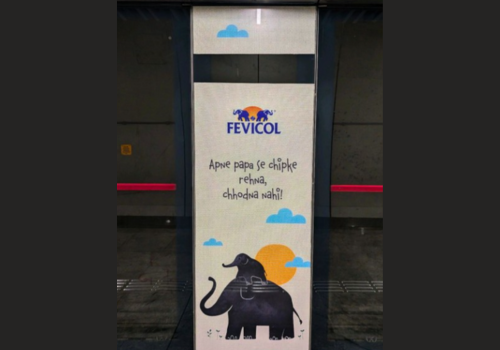

Fevicol’s latest metro station ads are a quiet yet powerful reminder that great advertising doesn’t always depend on scale, spectacle, or noise. At a time when most brands are fighting for attention with bold visuals, celebrity endorsements, and oversized claims, Fevicol has chosen restraint—and that’s precisely what makes this campaign stand out.
Instead of shouting for attention, the brand leans into a single line that feels deeply familiar to everyday commuters. One of the most talked-about lines reads:
“Apne papa se chhupke rehna, chhodna nahi.”
It’s not written like ad copy. It sounds like something overheard at home—half advice, half warning, delivered with humour and warmth. That’s the magic. The line doesn’t try to explain the product or its benefits. It trusts the audience to get it. And in doing so, it creates an emotional connection that far outlasts a transactional message.
Familiar Language as a Strategic Advantage
What Fevicol understands better than most brands is that memory lives in language people already know. This line taps into shared Indian experiences—childhood instructions, parental authority, and the small acts of secrecy that come with growing up.
By using conversational, almost affectionate language, the brand lowers the audience’s guard. Commuters don’t feel like they’re being advertised to; they feel like they’re being spoken with. In crowded urban spaces where attention is fragmented, this kind of familiarity becomes a strategic advantage.
Rather than forcing recall through repetition or exaggeration, Fevicol achieves it through recognition.
Using the Metro Environment as Part of the Idea
What truly elevates this campaign is how seamlessly it integrates with the metro environment itself. Instead of relying on traditional billboards alone, the brand uses escalator doors, station panels, and walkways—spaces where commuters naturally pause, wait, or slow down.
The escalator doors are particularly clever. As they open and close, the sentence visually breaks and reconnects, subtly reinforcing Fevicol’s core promise of strong bonding. There’s no need for explanation or demonstration. The environment completes the idea.


This is a textbook example of contextual OOH advertising, where placement isn’t just about visibility but meaning. The medium doesn’t carry the message—it is part of the message.
Why Commuters Actually Stop to Look
Metro stations are typically filled with noise—visual and otherwise. Screens flash, posters compete, announcements echo. Against this backdrop, Fevicol’s minimal approach feels refreshing.
There’s:
- No clutter
- No dramatic imagery
- No aggressive call-to-action
Just a line that feels oddly personal.
That’s why people stop, smile, reread, and even take photos. The ad doesn’t interrupt their commute; it fits into their mental rhythm. It rewards attention instead of demanding it, which is increasingly rare in public advertising.
A Brand Voice That’s Consistent Yet Still Fresh
Fevicol’s advertising legacy has always been rooted in everyday humour and human insight. From iconic TV commercials to print and outdoor, the brand has consistently avoided hard-selling in favour of storytelling.
This metro campaign continues that tradition while adapting it for a modern, high-footfall environment. The familiar yellow-and-blue palette ensures instant recognition, but the idea itself carries the weight. There’s confidence in that restraint—a belief that the brand doesn’t need to explain itself anymore.
Consistency, here, isn’t repetition. It’s evolution without dilution.
How This Campaign Connects to Modern Fearless Marketing
What makes Fevicol’s approach especially relevant today is how it contrasts—and yet aligns—with other standout campaigns driven by entirely different energies. A great example is how magicpin recently delivered a masterclass in instant, fearless marketing by reacting quickly, boldly, and unapologetically to spark online conversation.
While magicpin captured attention through speed and audacity, Fevicol does so through patience and subtlety. On the surface, the executions couldn’t be more different—but at their core, both campaigns succeed for the same reason: they understand human behaviour. One taps into internet culture and immediacy; the other into memory, language, and routine. Together, they prove that there’s no single formula for effective marketing—only a shared need for relevance, cultural awareness, and timing.
What Marketers Can Learn From This Campaign
Fevicol’s metro ads offer several practical lessons for brands and agencies:
- Simple language often travels further than clever copy
- Familiar behaviour creates instant emotional connection
- Outdoor advertising works best when it respects the space it occupies
- Contextual placement can amplify meaning without extra spend
- Brand voice consistency builds long-term recall and trust
In a world obsessed with novelty, Fevicol shows the power of staying recognisable.
Final Thought
Fevicol’s metro ads prove that when a brand truly understands its audience and environment, it doesn’t need to shout to be noticed. By turning everyday transit spaces into quiet moments of recognition, the campaign reminds us that subtlety—when rooted in insight—can be just as powerful as spectacle.