




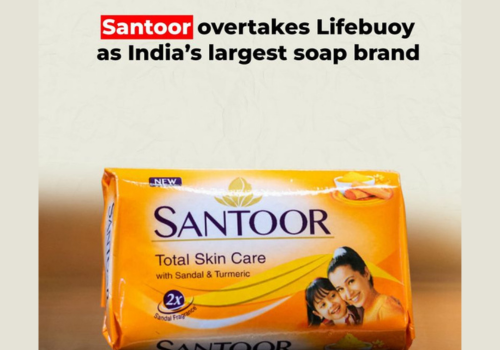

Santoor has become the biggest soap brand in India by displacing Lifebuoy by Hindustan Unilever to grab the pole position. Confirming the achievement, Wipro Consumer Care and Lighting called this a major development for one of India’s most fiercely fought FMCG categories.
In 2025, Santoor is expected to have raked in a revenue of ₹2,850 crore, propelled by its deep and sustained reach in the hinterland. While most brands were relentless in their pursuit of the urban repositioning and premiumisation, Santoor quietly got its act together where demand is loyal and volume-led.
What makes this significant is the scale of the achievement. Lifebuoy has been a household name in India for decades, near synonymous with mass hygiene. Santoor’s rise shows how strong distribution, regional relevance, and long-term consistency can outperform even legacy leadership.
The success of Santoor has been built on:
Deep rural penetration and affordability
Consistent product positioning around family and skin care.
Strong recall across generations
Wide availability rather than flashy reinvention



This is not a sudden victory, but the result of years of consistent implementation. In a market where growth is usually pursued by rapid rebranding or premium extensions, Santoor’s journey shows that scale is still an important factor, particularly in India.
For India’s FMCG landscape, this is a signal of one quiet but powerful truth: brands that grow with the masses, not just the metros, today can still lead the market.