





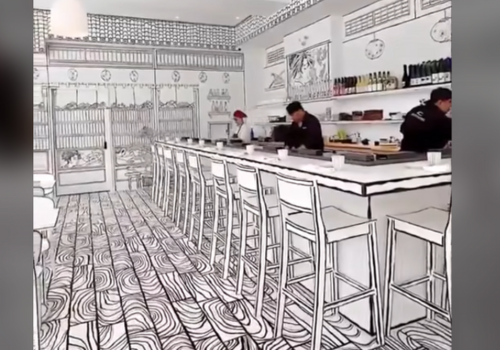

A restaurant in New York has done something most brands are terrified to try: it removed all color. And instead of turning people away, it’s stopping them in their tracks.
Shirokuro, a Japanese-inspired restaurant, has transformed its entire space into a hand-drawn, black-and-white world. Chairs, floors, walls, counters — everything looks like it’s been pulled straight out of a sketchbook. No paint. No polish. Just doodles.
At first glance, it feels strange. And that’s exactly the point.
While most restaurants compete on décor, lighting, and Instagram aesthetics, Shirokuro competes on attention. The space doesn’t let your eyes glide comfortably. It forces you to slow down and actually look.
There’s solid psychology behind why this works.
Researchers call it perceptual disfluency — a concept studied by Adam Alter and Daniel Oppenheimer. When something is slightly harder to process visually, your brain switches from autopilot to active thinking. Instead of skimming, you engage.
Your brain expects smooth textures, realism, and visual familiarity. Shirokuro gives you none of that. Hand-drawn lines break those expectations, making your mind work a little harder to understand what it’s seeing.
That effort creates focus.


In a 2011 study by Diemand-Yauman, Oppenheimer, and Vaughan, participants paid more attention and remembered information better when it was presented in a visually “imperfect” way. The same effect applies here — but in a physical environment.
In simple terms:
When your brain expects a photo and gets a sketch, it pauses.
That pause turns into curiosity.
Curiosity turns into memory.
Smooth, predictable spaces fade into the background. Irregular, hand-drawn ones demand exploration. And when your environment asks for attention, the experience sticks.
That’s why people don’t just eat at Shirokuro — they remember it.
The food may matter, but the reason it lingers in your mind is the setting. The space forces presence. It makes the meal feel intentional, almost immersive.
In an age of overstimulation and endless scrolling, Shirokuro proves something powerful:
Sometimes, doing less visually makes people pay more attention.
And attention, once earned, is unforgettable.