
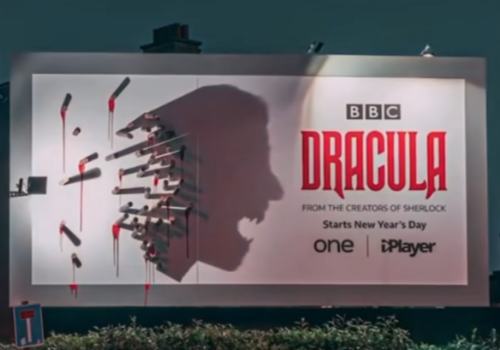

When the BBC started its Dracula series they did not use things, like QR codes or those special filters that change how you look on your phone. The BBC chose to do something that’s really easy to understand. And that was a very good idea.
During the day the billboard looked really messy. There were stakes sticking out of it and it did not make any sense.. When night came the billboard made sense. The lights that were put in the places made shadows that looked like the face of Dracula. The face of Dracula was easy to see. It was pretty cool.
One billboard. Two experiences. Zero digital gimmicks.
This was the type of creativity that stopped people in their tracks made them take a second look and got them talking to each other in person. Physical creativity, like this did not need anyone to scroll through their phones.
This campaign is really important now. The reason this campaign matters much at this moment is because it deals with issues that affect people every day. This campaign is about making a difference in peoples lives. People need to understand why this campaign matters now. The fact that this campaign matters now should make people want to learn more about it and get involved. This campaign matters now because it is trying to solve problems that have been around, for a time.
This wasn’t just a clever launch—it was a signal.
The internet is getting really crowded and expensive. Everything is starting to look the same. That is why companies are going back to doing things in person. When companies create real life experiences that people can see and touch it gets peoples attention in a way that computers cannot do. Offline events are a way for brands to make an impact because brands can make people feel something that brands cannot do on the internet. Brands want to make people remember brands. That is what happens when people see something, in person.
This change is not, about advertising. The shift is happening in areas too and it is not limited to advertising.
The return of offline connection
As we head into 2026 more and more Chief Marketing Officers are thinking about how they make decisions and where they make them. The Chief Marketing Officers have a 18 months coming up and it is going to be really important. The Chief Marketing Officers do not want to figure this out by themselves or just sitting at their computer.
That is why people are going back to, in-person formats. We are talking about executive dinners with a few selected people. These are closed-room conversations where people can really talk. The idea is to have people agree on things by talking to each other not by sending out messages to a lot of people.

At The Alliance you can already see that things are changing. There have been a lot of C-suite dinners in 2025. A lot of people want to attend them. The reason for this is that leaders want things that they cannot get from channels. They want to be able to trust each other. They want to be able to understand things in a way. They want to share their perspective with The Alliance and hear the perspective of leaders, at The Alliance.
So what does this tell us about the future? This information is giving us a clue about what the future will be like. The future is something that we’re all curious about and this is helping us to understand it a little better. When we think about the future we think about what the world will be like and how our lives will change. This is telling us something, about the future. It is making us think about what is going to happen. The future of our world is what this is telling us about.
The Dracula billboard and the rise of offline gatherings point to the same thing: they show that the Dracula billboard and these executive offline gatherings are really telling us something. The Dracula billboard is saying something and the executive offline gatherings are saying something too. They are both saying that people, like the idea of the Dracula billboard and executive offline gatherings.
The future isn’t anti-digital.
I am feeling really tired of everything being digital all the time. This is what I mean by -digital fatigue. Post-digital fatigue is a thing where people get exhausted from being, on their computers and phones. Post-digital fatigue is taking a toll on me.
In 2026 the brands that win will not just be loud on the internet. The brands that win will be more thoughtful about what they do, in the world. They will use spaces and face to face meetings to make the brands that win really mean something to people.
Expect fewer gimmicks.
More moments.
And a lot more real-world conversations—possibly coming to a city near you.