


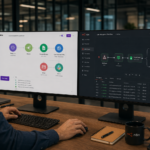




Google has introduced two new AI-powered tools inside Google Ads — Ads Advisor and Analytics Advisor — aimed at helping marketers make faster, data-backed decisions during peak retail moments.
On the surface, the rollout is timed for Black Friday and Christmas.
Underneath, it signals something larger:
Google is accelerating toward agentic marketing systems — where AI doesn’t just report performance, but actively guides strategy.
What Are Ads Advisor and Analytics Advisor?
Ads Advisor: Real-Time Strategy Guidance
Ads Advisor functions as an embedded optimization assistant inside Google Ads. It can:
- Suggest ROAS targets
- Predict short-term performance trends
- Flag budget allocation gaps
- Offer phased optimization recommendations
- Contextualize advice based on campaign objectives
Instead of generic best practices, it adapts suggestions to brand-specific inputs and historical data.
That shift — from static recommendations to contextual strategy guidance — is key.
Analytics Advisor: Conversational Data Analysis
Analytics Advisor tackles a different pain point: dashboard overload.



Rather than navigating multiple views and filters, marketers can:
- Ask natural-language questions
- Surface anomalies instantly
- Identify trend shifts quickly
- Generate summaries of complex datasets
The tool compresses analysis time — especially critical for global brands managing multiple markets during high-volume shopping windows.
In high-intensity retail cycles, speed is leverage.
Early Adoption Example: Samsonite USA
One early example highlighted in Google’s rollout was Samsonite USA.
According to early use cases, their team used the advisors to:
- Lock in November ROAS targets
- Forecast seasonal performance shifts
- Analyze early demand signals from new product launches
The headline benefit wasn’t automation alone.
It was accelerated strategic clarity.
Holiday campaigns don’t reward slow decision-making.
Why This Matters Beyond December
At first glance, this appears to be a seasonal enhancement.
Structurally, it represents a deeper transition:
Google is moving from:
Reporting platform
Optimization suggestion engine
to:
Embedded AI strategist.
That distinction matters.
Instead of marketers pulling insights from dashboards, insights are now pushed proactively, framed in strategic language.
The Rise of Agentic Marketing
Across the ecosystem, platforms are shifting toward agent-like systems:
- Meta expanding AI-led campaign automation
- Amazon enhancing predictive bidding
- Enterprises investing in internal AI copilots
The pattern is clear:
Manual micro-optimizations are declining.
AI-guided decision layers are expanding.
The marketer’s role evolves from:
Bid adjuster
to
AI supervisor and validator.
What Marketers Should Prepare For
If agentic tools become standard, competitive advantage will shift upstream.
Teams will need to:
- Ensure clean, reliable conversion tracking
- Define clear, measurable business goals
- Understand how AI interprets performance signals
- Validate and pressure-test recommendations
- Integrate AI outputs into planning workflows
The quality of inputs becomes more important than manual tweaks.
AI can only optimize what it understands.
The Bigger Strategic Shift
For years, digital advertising platforms centered around dashboards and manual analysis.
Now, they’re moving toward:
Proactive recommendations
Predictive scenario modeling
Natural-language interaction
Strategic summarization
This is not incremental UI improvement.
It’s a structural repositioning of Google Ads as a decision layer — not just a reporting layer.
Final Takeaway
Ads Advisor and Analytics Advisor are positioned as holiday accelerators.
In reality, they represent Google’s move toward fully agentic marketing systems.
In 2026, the defining question may no longer be:
“How do I optimize this campaign?”
But:
“How effectively does my AI optimize — and how well do I guide it?”