




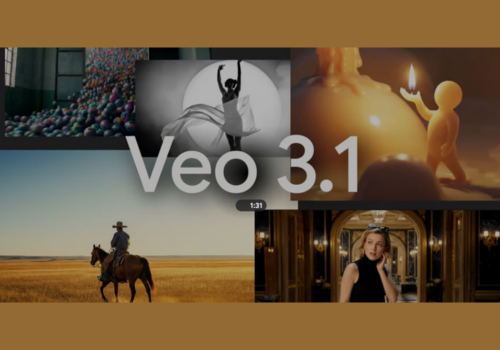

Google has expanded Veo 3.1 with integrated text-to-audio generation, enabling creators to produce synchronized dialogue, sound effects, and background audio from a single prompt.
While earlier AI video systems focused primarily on visuals, this update pushes Veo toward end-to-end multimodal filmmaking — where visuals and sound are generated as a unified output rather than stitched together afterward.
That shift is bigger than it looks.
Why Audio Changes Everything
Video without sound is unfinished.
Traditional production requires multiple layers:
- Script writing
- Voiceover recording
- Sound design
- Music selection
- Timeline editing
- Audio syncing
Each layer introduces friction.
By allowing creators to embed audio direction directly into prompts — e.g., “crowd cheering fades in,” “calm narrator voice,” “subtle ambient rain” — Veo compresses the production stack into a single generation loop.
That doesn’t just save time.


It restructures the workflow.
Instead of:
Visual generation → export → audio edit → sync → revise
It becomes:
Prompt → generate → refine.
For rapid content cycles, that difference is enormous.
The Competitive Landscape: AI Video Is Escalating
AI video development is accelerating across major labs:
- OpenAI emphasizes cinematic realism with Sora
- Runway focuses on creator-friendly tooling
- Adobe embeds generative AI inside Creative Cloud
The competitive edge is no longer “who can generate video.”
It’s “who can generate complete media artifacts.”
By adding synchronized audio, Google moves Veo closer to a system capable of delivering finished short-form content without external editing tools.
That narrows the gap between AI output and publish-ready production.
What This Means for Creators and Marketers
If text-to-audio performs reliably, it could reshape workflows across:
1. Explainer Videos
Script + narration + animation generated in one pass.
2. Rapid Ad Prototyping
Campaign concepts visualized and voiced within minutes.
3. Social Content Production
Short-form clips produced at scale without editing suites.
4. Small-Team Production
Lower dependency on:
- Voice actors
- Audio engineers
- Editing timelines
For agencies, this pushes creative strategy upstream — toward prompt engineering and narrative design — rather than post-production assembly.
The creative bottleneck shifts from execution to direction.
The Risk Layer: Voice, IP, and Authenticity
Integrated dialogue generation introduces new complexity:
- Synthetic voice authenticity concerns
- Brand tone consistency challenges
- Copyright implications for voice and music
- Risk of realistic but misleading media
As multimodal AI tools mature, governance frameworks will likely tighten.
The closer AI moves to producing indistinguishable audiovisual content, the greater the regulatory scrutiny.
Audio adds emotional authority.
With that authority comes responsibility.
A Broader Shift: Multimodal Synchronization
The deeper trend is not just “better video.”
It’s synchronized multimodality.
Modern AI systems are evolving from:
Text → Image
Text → Video
into:
Text → Video + Audio + Context + Narrative coherence
The competitive frontier is orchestration — ensuring all generated elements align:
- Timing
- Tone
- Lighting
- Sound
- Emotional arc
When systems coordinate modalities effectively, outputs feel intentional rather than assembled.
Why This Signals a Structural Change
For years, generative AI outputs were components:
- A script draft
- A static image
- A rough animation
Now the trajectory is toward full-stack generation.
If Veo can reliably:
- Sync dialogue to lip movement
- Align sound effects to motion
- Maintain narrative pacing
- Preserve audio quality
then it moves beyond “tool” into “production engine.”
That’s a structural upgrade, not a feature patch.
Final Takeaway
Text-to-audio integration in Veo 3.1 may appear incremental, but it represents a deeper milestone in generative AI.
The closer AI gets to producing complete, synchronized media from a single prompt, the closer it comes to automating segments of traditional creative production.
The industry is no longer asking:
Can AI generate content?
The more consequential question now is:
Can AI generate finished content — reliably, coherently, and at scale?