




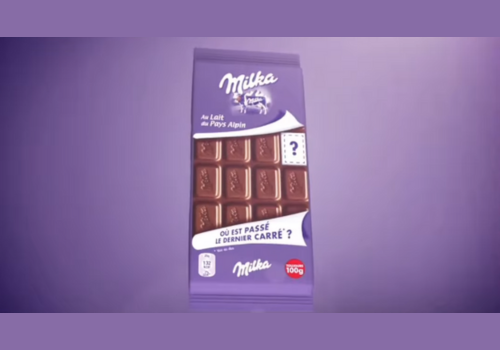

A Swiss chocolate brand recently tested an unusual packaging idea: releasing chocolate bars with one square intentionally removed.
At first glance, the missing piece looked like a manufacturing defect. But inside the wrapper, customers discovered a note explaining the concept. They could either:
- Request the missing square for themselves
- Send it to someone else with a personalised message
What appeared to be a flaw was actually a designed moment of participation.
This wasn’t a discount campaign. It wasn’t a limited-edition flavour drop. It was experience engineering—using absence as the trigger.
Turning Surprise Into Engagement
The campaign followed a clean psychological arc:
Disruption – The consumer notices something unexpected. A square is missing.
Explanation – The brand reframes the absence as intentional, not defective.
Choice – The customer decides what to do with the missing piece.
That final step is crucial. Instead of consuming passively, the customer participates. The chocolate bar becomes interactive—not digitally, but emotionally.
By introducing a small, controlled tension, the brand created a micro-story at the moment of unwrapping.
Why This Strategy Works in a Saturated Category
Chocolate is one of the most competitive FMCG categories in the world. Functional differences are minimal. Taste, texture, and packaging design can only stretch so far before parity sets in.
In these environments, emotional design becomes the differentiator.
Reframing Value
Most brands compete on:
- Premium ingredients
- Extra quantity
- Price promotions
- Indulgence positioning
This campaign competed on connection.
Instead of offering “more chocolate,” the brand offered “shared experience.” The missing square became a symbolic gesture—something to give rather than consume.
That reframing subtly shifts the purchase from self-indulgence to social expression.
Participation Over Promotion
Traditional loyalty mechanics depend on financial incentives:
- Cashback
- Points
- Bundle discounts
- Coupons
Here, there was no price incentive. The reward was emotional.
Consumers weren’t pushed to act—they were invited. And invitations feel lighter than promotions.
Participation-based engagement often generates stronger memory encoding than discount-driven behaviour because it requires a decision.
Packaging as the Medium
Perhaps the most interesting element is that the packaging itself carried the campaign.
There was no dependency on:
- Paid digital ads
- Influencer explainers
- QR-code-heavy mechanics
The message was delivered at the moment of use—when attention is highest.
This creates:
- Organic surprise
- Built-in social shareability
- Word-of-mouth curiosity
When packaging becomes narrative, the product becomes its own advertising channel.
The Psychological Mechanics Behind the Idea
The campaign cleverly uses three behavioural levers:
Expectation Violation
Consumers expect uniformity in chocolate bars. Breaking that pattern triggers attention immediately.
Loss Aversion (Softened)
A missing piece introduces micro-loss—but it’s resolved through explanation and agency.
Choice Architecture
By offering two clear paths (keep or share), the brand creates ownership over the decision.
These elements combine to create memorability without aggression.
The Risk Behind the Concept
Notably, this strategy carries execution risk.
If messaging clarity fails:
- Consumers may perceive a quality issue
- Complaints could increase
- Brand trust could weaken
This type of campaign depends heavily on:
- Clear in-pack communication
- Immediate reframing
- Confident tone
The difference between “clever” and “confusing” lies in explanation quality.
A Broader Marketing Lesson
This idea reflects a larger shift in modern consumer marketing:
Small structural changes can outperform large promotional budgets when they:
- Create curiosity
- Invite voluntary action
- Align with emotional rituals
- Respect the intelligence of the buyer
In markets where products are nearly interchangeable, experience design becomes the differentiator.
The product didn’t change. The interaction did.
Why This Matters Beyond Chocolate
This approach is transferable beyond FMCG.
Any category facing commoditisation can ask:
- What predictable pattern can we gently disrupt?
- Where can we introduce participation instead of persuasion?
- How can packaging or product structure carry narrative?
In saturated markets, engineered micro-moments often outperform macro-campaigns.
Final Takeaway
The “missing piece” strategy demonstrates how brands can use packaging not just to protect a product—but to activate engagement.
By converting absence into interaction, the brand moved from transaction to participation.
And in competitive markets, that shift may matter more than an extra square of chocolate.