





In today’s hiring market, experience alone is no longer enough. Increasingly, candidates are being evaluated not just on résumés, but on whether their professional presence is visible, legible, and current.
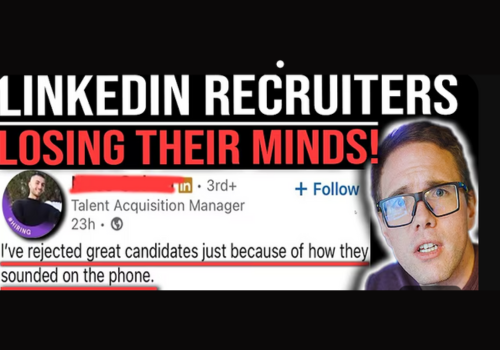
Recent discussion around hiring practices has surfaced a growing pattern: highly qualified applicants being filtered out early because their LinkedIn profiles appear incomplete, inactive, or unclear. In most cases, the issue isn’t skill or capability — it’s signal.
When Credibility Is Judged in Seconds
Recruiters rarely have the luxury of deep evaluation at the top of the funnel. In high-volume hiring environments, profiles are scanned in seconds, not minutes.
In that context, LinkedIn functions less like a biography and more like a credibility snapshot.
Profiles that lack:
- A clear, specific headline
- A visible and coherent work history
- Context around roles, scope, or impact
often trigger hesitation — even when the attached résumé is strong.
From a recruiter’s perspective, an incomplete or vague profile introduces uncertainty. The internal question shifts from “Is this person capable?” to “Can I confidently move this person forward?”
In fast-moving pipelines, uncertainty is often enough to pause — or pass.
Visibility Has Quietly Become a Hiring Filter
LinkedIn now plays a role similar to a pre-screening layer in hiring. Not formal verification, but informal validation.
Over time, this has reshaped hiring logic:
- Presence signals legitimacy
- Clarity signals confidence
- Activity signals relevance
Candidates who appear “invisible” — no photo, sparse descriptions, outdated roles — may be interpreted as:
- Disengaged
- Risk-averse
- Difficult to assess
- Potentially unprepared for client- or team-facing work
None of these assumptions may be true. But in a speed-optimised process, perception often substitutes for proof.
The Signal Problem: Silence Creates Doubt
An important shift has occurred: absence now communicates something, even if unintentionally.
When a profile provides little information, recruiters are left to infer. And inference in hiring tends to skew conservative. If two candidates appear equally qualified on paper, the one with clearer professional context often advances — not because they’re better, but because they’re easier to evaluate.
Invisibility doesn’t read as neutrality anymore. It reads as unknown, and unknowns slow decisions.
The Trade-Off Between Authenticity and Presentation
This dynamic also exposes a contradiction at the heart of LinkedIn.
On one hand, the platform rewards polish:
- Optimised headlines
- Narrative career summaries
- Confident, outward-facing language
On the other, it enables:
- Inflated titles
- Overstated impact
- Superficial endorsements
Visibility does not guarantee accuracy. But lack of visibility increasingly guarantees doubt.
As a result, many candidates feel pressured to participate — not to stand out, but simply to avoid being filtered out before the conversation starts.
A Reflection of Speed, Not Fairness
The root issue isn’t LinkedIn itself. It’s hiring velocity.
Compressed recruitment cycles mean:
- Faster screening decisions
- Less time for nuance
- Greater reliance on surface-level cues
In this environment, social profiles become proxies for readiness, not definitive measures of competence. Recruiters aren’t necessarily judging character or skill — they’re managing time and risk.
That doesn’t make the system fair. It makes it efficient.
What This Means for Job Seekers Today
For better or worse, professional visibility is now part of employability.
That doesn’t mean everyone needs to become a content creator or personal brand. But it does mean reducing ambiguity.
At minimum, candidates benefit from:
- A clear headline that explains what they do
- Understandable role descriptions with scope and outcomes
- A short summary that provides context and direction
The goal isn’t self-promotion. It’s removing uncertainty.
In modern hiring funnels, silence is increasingly interpreted as absence.
Why This Trend Is Likely to Continue
As hiring becomes more distributed, remote, and asynchronous, recruiters rely more heavily on tools that provide quick context. LinkedIn fills that gap — imperfectly, but consistently.
Until hiring slows down or becomes more personalised again, visibility will remain a prerequisite rather than a bonus.
Final Thought
The modern hiring process rewards clarity over mystery. In systems optimised for speed, being invisible can be mistaken for being unqualified — even when the opposite is true.
Whether that’s fair is debatable. But as long as platforms mediate first impressions, professional visibility is no longer optional. It’s part of how credibility is assessed before the first conversation even begins.