





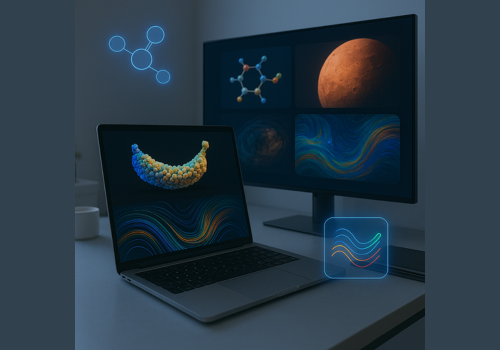

Recent attention around a new image-generation model from Google has sparked widespread discussion—but the real significance goes far beyond social media buzz. What’s changing isn’t just how good AI-generated images look. It’s how complex scientific and technical ideas are being understood, communicated, and shared.
We’re entering a phase where visualization is no longer a final presentation step. It’s becoming a thinking tool—one that shapes understanding as ideas are formed, not after they’re complete.
From Illustration to Interpretation
For decades, visualizing advanced scientific concepts was resource-intensive.
It typically required:
- Specialized 2D/3D software
- Technical illustrators or designers
- Multiple revision cycles
- Significant time and budget
As a result, many ideas were explained with simplified diagrams—or not visualized at all.
AI-generated scientific visuals collapse that entire process into minutes. But the real breakthrough isn’t speed alone. It’s that these visuals don’t merely illustrate concepts—they interpret them.
Abstract ideas like:
- Neural network loss landscapes
- Attention mechanisms in transformers
- Protein folding structures
- Fusion reactor dynamics
are inherently difficult to explain with text alone. High-quality AI visuals reduce cognitive load, allowing viewers to grasp relationships, scale, and flow intuitively—often without oversimplifying the underlying science.


This is a fundamental upgrade in how complexity is communicated.
Why These Visuals Resonated So Strongly
The recent surge of interest in AI-generated scientific imagery reveals deeper shifts in how people engage with information.
Visual Fidelity Is No Longer the Bottleneck
Lighting, depth, realism, and composition—once the domain of expert designers—are now baseline capabilities. That means the quality ceiling has risen dramatically, even for individuals without design training.
Accuracy Is Catching Up With Aesthetics
What stood out wasn’t just how polished these visuals looked, but how faithfully they represented real systems. The ability to preserve structural integrity while improving clarity is what gives these images credibility beyond art.
Speed Changes Behaviour
When visuals can be generated instantly, people experiment more. Researchers test different explanations. Educators try multiple teaching approaches. Teams iterate faster because the cost of “showing” an idea has dropped close to zero.
When friction disappears, curiosity scales.
What This Means for Education and Learning
For education, the implications are profound.
AI-generated visualization enables:
- Faster creation of lecture materials
- Clearer explanations of abstract or invisible systems
- More engaging textbooks and digital courses
- Better comprehension across different learning styles
Students no longer have to imagine complex systems from text alone. They can see them—often from multiple angles and levels of abstraction.
This narrows the gap between expert understanding and beginner comprehension, making advanced topics more accessible without diluting rigor.
A Breakthrough for Research Communication
In research environments, visualization has always been a bottleneck—especially when communicating across disciplines.
AI-generated scientific visuals improve:
- Collaboration between technical and non-technical teams
- Grant proposals and funding presentations
- Internal alignment on complex models
- Public-facing explanations of research outcomes
When scientists can quickly generate accurate visuals, they spend less time translating ideas and more time refining them. The result is better collaboration and fewer misunderstandings.
Why This Matters for Brands and Marketing Teams
Beyond academia, this shift has major implications for how technical brands communicate value.
Industries such as:
- Artificial intelligence
- Climate and energy
- Engineering and manufacturing
- Healthcare and biotech
- Deep tech and infrastructure
often struggle to explain what they actually do. Dense copy and generic diagrams fail to convey differentiation.
AI-generated scientific visuals allow brands to:
- Explain complex systems visually
- Replace stock diagrams with tailored explanations
- Educate prospects instead of overwhelming them
- Build credibility through clarity
In markets where products are complex and trust is critical, clarity becomes a competitive advantage.
Visuals as a Thinking Interface, Not Just Output
The most important shift isn’t aesthetic—it’s cognitive.
AI tools are moving upstream, into:
- Ideation
- Explanation
- Sense-making
Visualization is no longer just the end product. It’s becoming part of the reasoning process itself. As visuals become more accurate and contextual, the line between “design tool” and “explanation engine” starts to blur.
This mirrors a broader trend in AI: tools are no longer just producing content—they’re shaping how people think through problems.
Why This Sets a New Standard
Once people experience complex ideas explained clearly and visually, expectations change.
Text-heavy explanations feel slower.
Generic diagrams feel insufficient.
Ambiguity becomes harder to justify.
AI-generated scientific visuals raise the baseline for what “good explanation” looks like—across education, research, marketing, and decision-making.
Final Thought
AI-generated scientific visuals mark a turning point in how complex ideas travel.
When anyone can produce clear, accurate, and compelling representations of advanced concepts, understanding scales faster than expertise alone ever could. The true impact of these tools won’t be measured in likes, shares, or novelty.
It will be measured in:
- Faster learning
- Better collaboration
- Clearer decisions
- Broader access to complex knowledge
In that sense, AI visualization isn’t just improving communication—it’s quietly reshaping how knowledge itself moves through the world.