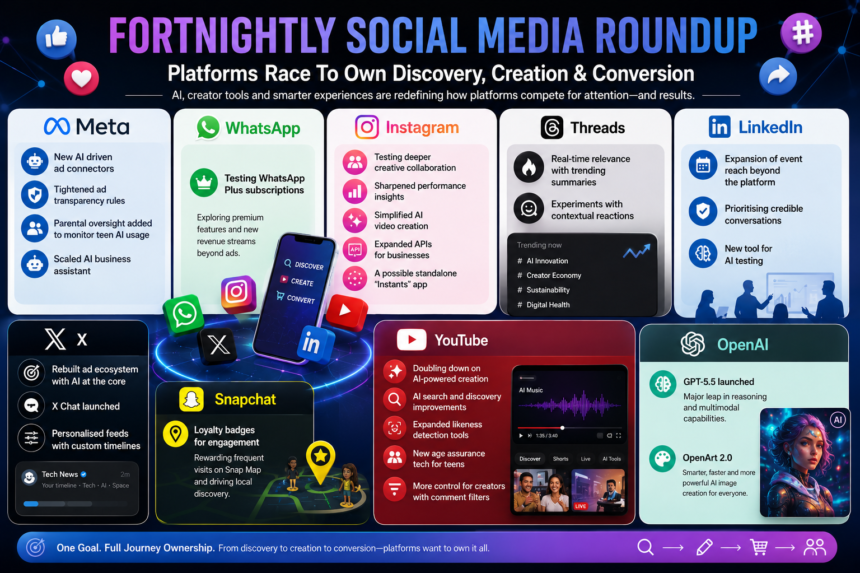








Meta’s advertising platform has been moving toward deeper automation for several years. What has changed recently is how that automation is being shaped. Instead of removing advertiser control completely, Meta is redesigning control so it works alongside the algorithm rather than against it.
- From Hard Filters to Soft Influence
- Why Conversion Location Matters Today
- Value Rules as Communication, Not Control
- The Trade-Off: Better Alignment but Higher Costs
- What This Update Reveals About Meta’s Strategy
- When Advertisers Should Use Conversion Location Rules
- When It May Not Be the Right Approach
- Practical Takeaways for Advertisers
- Final Thoughts
The introduction of “conversion location” within Value Rules clearly shows this shift. Instead of forcing advertisers to decide in advance which conversions matter most, the system allows them to communicate their priorities and lets the algorithm optimise delivery accordingly.
This may look like a small update, but strategically, it represents an important step in the evolution of advertising platforms.
From Hard Filters to Soft Influence
In the past, advertisers who wanted to prioritise certain conversion sources—such as website leads instead of Instant Forms—had limited options. Most relied on separate campaigns for each conversion type, manual exclusions, narrow audience targeting, or complicated reporting structures.
While these methods worked, they created several challenges. Campaigns became fragmented, management became more complex, and the algorithm had less data to learn from. In many cases, performance suffered because the system was restricted rather than guided.
Value Rules introduce a different approach.
Instead of blocking certain conversion types, advertisers can now influence how much the system values each conversion type. By assigning higher or lower weights to conversions based on their source—whether a website, an app, or Instant Forms—Meta keeps campaigns broad while still allowing advertisers to guide delivery.
In an automation-driven environment, this distinction is critical. Algorithms perform best when they have room to explore and optimise.



Why Conversion Location Matters Today
Modern advertising funnels rarely depend on a single conversion source. Most businesses now operate across several environments.
A typical funnel may include website conversions for high-intent actions, app events for repeat usage or loyalty, and Instant Forms for fast lead generation and higher volume.
However, these conversions rarely deliver the same business value. A website lead may generate significantly more revenue than a form submission, while Instant Forms may produce higher lead volume but require stronger filtering later in the sales process.
Until now, advertisers often handled this difference after the campaign finished. They analysed results inside CRMs, spreadsheets, or sales dashboards to determine which leads actually mattered.
Conversion location rules move that decision earlier in the process.
Instead of cleaning up low-quality leads after they arrive, advertisers can guide the platform to prioritise the types of conversions that historically perform better. This helps improve efficiency across the entire funnel.
Value Rules as Communication, Not Control
A key point about this update is understanding what Value Rules are designed to do.
They are not a targeting tool, and they do not guarantee delivery. They also do not replace proper measurement or conversion tracking.
Instead, Value Rules act as a communication layer between advertiser priorities and Meta’s algorithm.
By telling the system which conversion types are more valuable, advertisers move away from micromanaging campaign mechanics. Instead, they communicate the outcome they want while allowing the algorithm to determine the best way to achieve it.
This approach aligns with Meta’s broader strategy of reducing manual campaign adjustments and increasing signal-based optimisation.
The Trade-Off: Better Alignment but Higher Costs
Meta has been clear that using Value Rules may affect costs.
If advertisers increase the value assigned to a specific conversion location, the system may shift delivery toward those conversions. This can improve perceived lead quality but may also increase the cost per result depending on competition and available inventory.
This highlights an important reality. Value Rules are not shortcuts for cheaper results.
They are strategic tools designed to align campaign optimisation with business priorities. If advertisers increase conversion value without confirming that those conversions truly drive revenue or long-term customer value, they may simply pay more for similar outcomes.
The rule rewards clarity, not assumptions.
What This Update Reveals About Meta’s Strategy
Looking at the bigger picture, the conversion location rule fits perfectly into a wider pattern across Meta’s advertising ecosystem.
The platform is gradually reducing rigid campaign configuration options, limiting the need for manual exclusions and segmentation, and increasing reliance on value-based signals.
At the same time, Meta continues to place greater trust in algorithmic decision-making.
This shift means the platform is no longer built for advertisers who want to control every technical detail. Instead, it is designed for advertisers who understand their business goals clearly and can communicate those priorities through data signals.
When Advertisers Should Use Conversion Location Rules

This feature works best when advertisers clearly understand the differences between conversion sources.
If a business knows that website leads consistently generate higher revenue than Instant Form leads, assigning higher value to website conversions can help the system focus on higher-quality prospects.
The rule is also useful when advertisers have reliable data about post-conversion performance, such as sales conversion rates, retention metrics, or customer lifetime value.
In these situations, Value Rules help align advertising performance with actual business outcomes.
When It May Not Be the Right Approach
However, the feature may be less effective in certain situations.
If all conversion sources perform similarly, adjusting value by location may not produce meaningful improvements. The same applies when advertisers lack reliable post-conversion data.
Without clear insight into which conversions truly matter, increasing or decreasing conversion value becomes guesswork.
In those cases, Value Rules may simply amplify noise rather than improve results.
Practical Takeaways for Advertisers
Before applying conversion location rules, advertisers should first analyse how conversions perform across different sources. Understanding which locations drive real business value is essential.
It is also important to begin with small adjustments rather than extreme value changes. Gradual optimisation allows the algorithm to adapt while providing clearer performance insights.
Most importantly, performance should be evaluated on both cost and quality. A lower cost per lead does not always translate into better business results, and higher costs may still be justified if the leads convert into revenue more effectively.
Strong measurement should always come before optimisation.
Final Thoughts
Meta’s introduction of conversion location within Value Rules may not appear dramatic at first glance, but it represents a meaningful step toward smarter ad automation.
The update reflects a broader shift in digital advertising. Platforms are moving away from rigid manual controls and toward systems that rely on intent signals and algorithmic learning.
Success in this new environment will not come from fighting the algorithm or trying to control every campaign variable. Instead, it will come from understanding business outcomes clearly and communicating those priorities through the right signals.
In that sense, this update is not about losing control. It is about using a more intelligent form of control that works with automation rather than against it.