





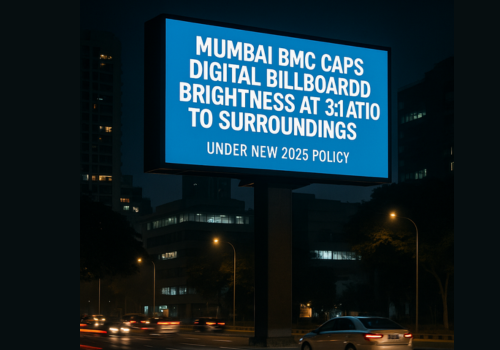

Mumbai’s latest outdoor advertising guidelines introduce a strict cap on digital billboard brightness—limiting screens to no more than three times the brightness of their surrounding environment. While the rule is officially positioned around road safety and visual comfort, its implications go much further. It marks a turning point in how digital outdoor advertising (DOOH) will be planned, designed, and evaluated across the city.
- Why Brightness Has Become a Critical Advertising Constraint
- From “Stand Out” to “Fit In”: A Shift in Creative Thinking
- What the Policy Signals About the Future of Digital OOH
- Why Indoor Screens Suddenly Become More Valuable
- Safety, Accountability, and a Higher Compliance Bar
- How Advertisers Will Need to Adapt in Practice
- Why This Matters Beyond Mumbai
- Final Thought
The update, introduced by the Brihanmumbai Municipal Corporation, applies to all outdoor digital billboards across public spaces. LED screens inside controlled environments such as malls, multiplexes, airports, and private commercial complexes remain exempt—creating a clear divide between public and managed visibility.
For advertisers, agencies, and media owners, this isn’t just a compliance update. It’s a strategic shift.
Why Brightness Has Become a Critical Advertising Constraint
Over the last decade, digital billboards have multiplied across Mumbai’s roads, junctions, and high-traffic corridors. As competition for attention increased, brightness became a default weapon—especially at night.
High-luminance screens delivered instant visibility, but they also created problems:
- Driver distraction
- Visual fatigue for pedestrians
- Uneven lighting in residential areas
- Complaints around glare and safety
The new 3:1 brightness ratio directly addresses this escalation. Instead of allowing screens to overpower their environment, advertisers must now ensure their creatives blend proportionally with ambient light conditions.
This fundamentally changes the visibility equation.
Going forward, success will depend less on how bright a screen is, and more on:


- Design clarity
- Contrast efficiency
- Message hierarchy
- Context-aware placement
Brightness is no longer a competitive advantage—it’s a regulated baseline.
From “Stand Out” to “Fit In”: A Shift in Creative Thinking
One of the biggest impacts of the rule will be on creative strategy.
For years, DOOH design often followed a simple logic: brighter screens equal higher recall. That assumption no longer holds. Under the new rules, overly complex or colour-heavy creatives may actually lose legibility when brightness is capped.
This pushes advertisers toward:
- Bolder typography
- Fewer visual elements
- Stronger contrast instead of saturated colours
- Disciplined motion and animation
- Clear messaging that lands within seconds
In effect, Mumbai’s policy nudges digital OOH closer to good design principles, not spectacle-driven execution.
What the Policy Signals About the Future of Digital OOH
The updated framework replaces outdoor advertising guidelines that had remained largely unchanged since 2008—a time when large-scale digital billboards were far less common.
That gap matters.
Since then:
- Digital screens have replaced static hoardings in premium locations
- Programmatic DOOH has grown
- Dynamic, animated creatives have become the norm
The BMC’s move signals that regulators are now treating digital outdoor media as urban infrastructure, not just advertising inventory.
For brands and agencies, this translates into:
- Tighter scrutiny of formats and placements
- More rigorous approval processes
- Less tolerance for aggressive visual tactics
- Greater emphasis on compliance and planning
This is not Mumbai-specific in spirit. It reflects a global trend where cities are reasserting control over digital advertising in public spaces.
Why Indoor Screens Suddenly Become More Valuable
An important detail in the policy is what it doesn’t regulate.
Digital screens inside:
- Shopping malls
- Commercial complexes
- Multiplexes
- Airports and private venues
are not subject to the same brightness limits because they operate in controlled lighting environments.
This creates a strategic shift:
- Premium digital budgets may move indoors
- Mall DOOH networks gain pricing power
- Advertisers seeking high-impact visuals may prefer controlled environments
- Outdoor roadside screens become more about reach than spectacle
For media planners, location selection will matter more than ever—not just for footfall, but for creative freedom.
Safety, Accountability, and a Higher Compliance Bar
Beyond brightness, the new rules reflect a broader push toward accountability in outdoor advertising.
Stricter permissions, clearer luminance standards, and defined enforcement mechanisms suggest that authorities are no longer willing to rely on self-regulation by media owners.
For advertisers, this raises important considerations:
- Compliance checks must happen earlier in planning
- Creative approvals may take longer
- Non-compliant campaigns carry higher risk of takedown
- Long-term partnerships with compliant media owners gain importance
Outdoor advertising is moving from a “set and forget” medium to one that demands ongoing governance.
How Advertisers Will Need to Adapt in Practice
To remain effective under the new brightness cap, advertisers will need to rethink execution, not abandon digital OOH.
Winning strategies are likely to include:
- Designing for legibility at lower luminance
- Testing creatives in real lighting conditions
- Aligning messaging with dwell time instead of shock value
- Using motion sparingly and intentionally
- Integrating OOH with mobile and contextual cues
In regulated environments, subtlety often outperforms excess. Messages that feel integrated into the cityscape—not imposed on it—are more likely to resonate.
Why This Matters Beyond Mumbai
Mumbai often acts as a bellwether for Indian advertising policy. What works—or is enforced—here tends to influence other metros.
If similar brightness regulations spread to cities like Delhi, Bengaluru, or Hyderabad, the entire Indian DOOH ecosystem may need to recalibrate:
- Creative norms
- Media pricing
- Measurement of effectiveness
- Definitions of “impact”
The industry’s response in Mumbai will likely shape how quickly others follow.
Final Thought
Mumbai’s new digital billboard brightness cap isn’t just about reducing glare—it’s about redefining effectiveness in outdoor advertising. As cities tighten controls on digital media in public spaces, raw luminosity is losing its power as a differentiator.
The future of digital OOH lies in precision, design intelligence, and contextual relevance, not brute brightness. For advertisers willing to adapt, the constraint may become an advantage.