
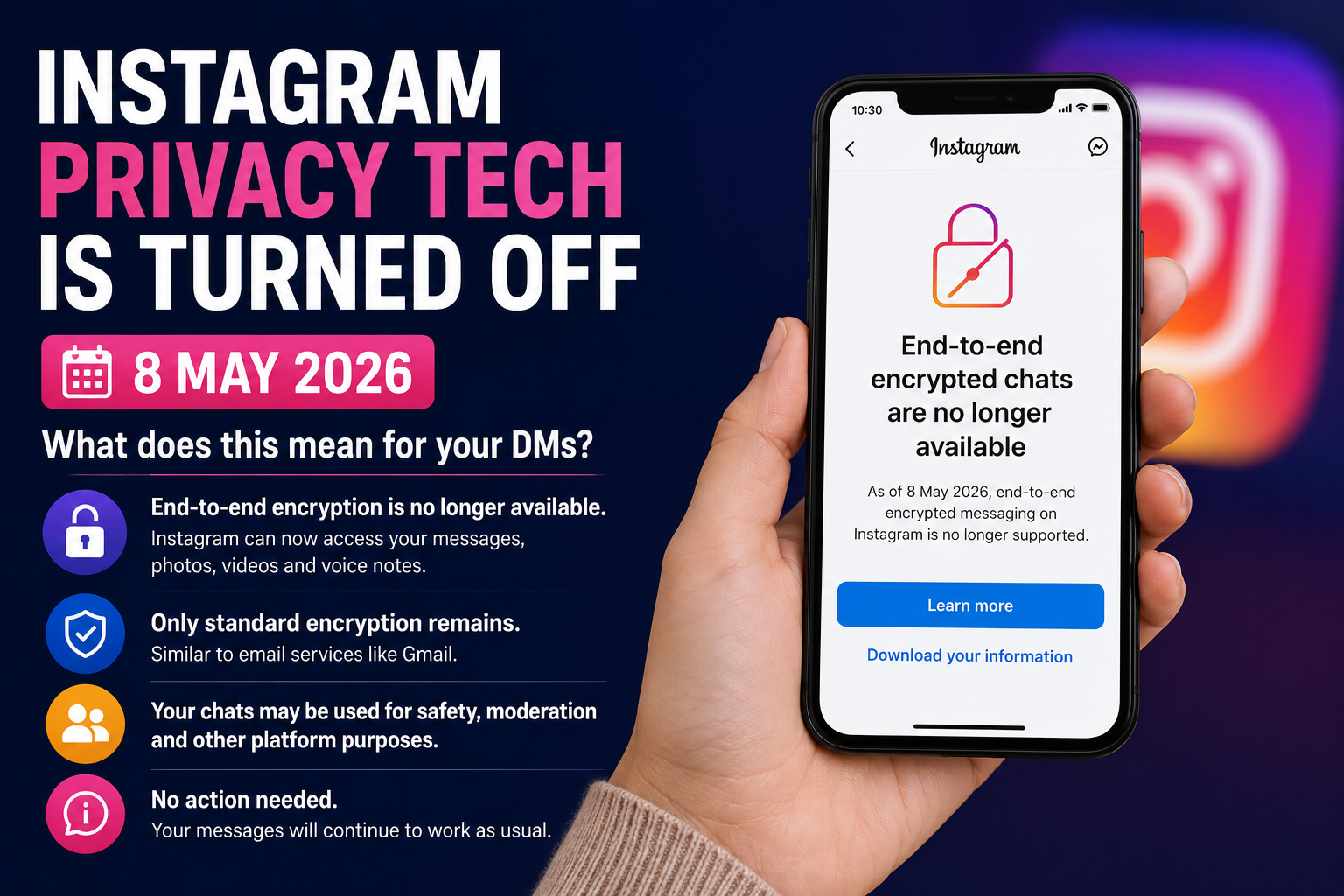

Instagram users across the world are waking up to a major shift in how private messaging works on the platform. On 8 May 2026, Meta officially discontinued end-to-end encrypted direct messages (E2EE) on Instagram, reversing a privacy strategy the company had publicly championed for years.
For many users, the change may feel technical or invisible at first glance. Messages still send. Chats still function. Photos, videos, and voice notes still appear exactly as before. But beneath the surface, the way Instagram handles private conversations has fundamentally changed.
The decision marks one of the most significant privacy reversals in recent social media history and raises important questions around user data, digital safety, targeted advertising, AI training, and the future of private communication online.
What Was End-to-End Encryption?
End-to-end encryption, commonly called E2EE, is considered the highest standard of privacy for digital communication. It ensures that only the sender and the recipient can read messages. Even the platform hosting the conversation cannot access the content.
This technology is widely used by messaging platforms such as:
- Signal
- iMessage
- Facebook Messenger
Meta itself once described private encrypted communication as “the future of messaging.” In 2019, CEO Mark Zuckerberg publicly committed to expanding encryption across the company’s platforms.
That is why this reversal is so significant.
What Exactly Changed on Instagram?
Instagram had introduced encrypted DMs as an optional feature, with plans to eventually make them standard for all users. However, Meta quietly updated Instagram’s terms and conditions in March 2026, confirming that the feature would no longer be supported after 8 May 2026.


As a result:
- Instagram can now access the content of DMs if required
- Images, voice notes, and videos are no longer protected by E2EE
- Standard encryption remains active
- Ultra-private encrypted chats are no longer available
This means Instagram messages now function more like Gmail or traditional cloud-based communication systems, where service providers technically retain access capability under certain circumstances.
Why Did Meta Remove the Feature?
Meta claims the decision was based on low adoption rates, saying too few users actively enabled encrypted messaging.
However, critics argue that optional privacy tools almost always see lower adoption because most users never manually activate advanced settings. The friction of opt-in privacy naturally limits usage.
Others believe the decision reflects broader business priorities around:
- AI model training
- data monetization
- targeted advertising
- moderation visibility
- regulatory pressure
Cybersecurity expert Victoria Baines suggested the issue may go beyond user adoption, pointing out that messaging data itself holds enormous strategic value in the AI era.
The AI Factor Behind the Decision
The timing of this move is especially important because major tech companies are aggressively expanding AI systems that depend on massive datasets for training and optimization.
Private conversations represent one of the richest forms of contextual human data available online. They contain:
- intent
- emotion
- preferences
- behavior patterns
- purchasing interests
- communication habits
Even though Instagram has previously stated that DMs are not used for AI training, the broader industry trend suggests messaging ecosystems are becoming increasingly valuable assets in the AI economy.
This mirrors the larger shift happening across digital platforms, where AI-driven personalization and conversational systems are rapidly reshaping marketing and platform strategy.
- https://allmarketingupdates.com/performance-marketing-chatgpt-integration-adobe-openai/
- https://allmarketingupdates.com/fortnightly-social-media-roundup-ai-platform-updates/
Why Child Safety Groups Support the Move
Not everyone opposes Meta’s decision. Child safety organizations such as the NSPCC have welcomed the rollback of encrypted messaging.
Their argument is straightforward:
When platforms cannot see message content, detecting harmful behavior such as grooming, exploitation, or illegal content becomes significantly harder.
Supporters of the change believe removing E2EE will make it easier for authorities and platforms to intervene in dangerous situations involving minors.
This debate has become one of the central tensions of the modern internet:
👉 privacy versus safety.
Why Privacy Advocates Are Concerned
Privacy campaigners view the decision very differently. Organizations like Big Brother Watch argue that encryption protects ordinary users from surveillance, hacking, and misuse of personal information.
Critics worry that weakening encryption creates long-term risks including:
- increased vulnerability to data breaches
- expanded platform surveillance
- reduced digital privacy standards
- normalization of accessible private communication
Many experts also fear that if Instagram abandons E2EE, other social platforms may slow or reverse their own encryption efforts.
What This Means for Businesses and Creators
For creators, influencers, and brands, the change may also affect how Instagram DMs are used for business communication and customer interaction.
Many businesses increasingly rely on Instagram messaging for:
- customer support
- influencer negotiations
- brand partnerships
- product discussions
- ecommerce interactions
Without E2EE, brands may need to reconsider what type of sensitive information is shared through Instagram DMs.
This becomes especially important as businesses increasingly integrate AI-powered customer communication systems and CRM workflows into social platforms.
- https://allmarketingupdates.com/top-crm-with-marketing-automation-tools/
- https://allmarketingupdates.com/best-ai-tools-for-social-media-marketing/
The Bigger Industry Shift
Instagram’s move may signal a broader change in how social platforms view privacy. For years, the industry direction pointed toward stronger encryption and more private digital communication.
Now, platforms appear to be balancing privacy against:
- AI development
- content moderation
- regulatory concerns
- monetization opportunities
This could fundamentally reshape how “private” social media communication operates over the next decade.
FAQs
Did Instagram remove end-to-end encrypted DMs?
Yes. Instagram discontinued E2EE messaging globally on 8 May 2026.
Can Instagram now access DM content?
Yes, under standard encryption systems, Meta can technically access message content if necessary.
Are Instagram messages still encrypted?
Yes, but only with standard encryption—not end-to-end encryption.
Why did Meta remove encrypted DMs?
Meta cited low adoption rates, though critics believe broader AI and business motivations may also be involved.
Conclusion
Instagram’s decision to abandon end-to-end encrypted messaging marks more than a technical update—it reflects a larger shift in the balance between privacy, platform control, AI development, and digital safety.
For ordinary users, the app may look exactly the same. But the philosophy behind how private communication is handled has changed dramatically.
The internet spent years moving toward stronger encryption and more private messaging ecosystems. Instagram’s reversal suggests that the next phase of social media may prioritize visibility, moderation, and AI-driven intelligence over absolute privacy.
And that shift could influence the future direction of the entire social media industry.