






By Mohammad Owais
OpenAI has officially begun rolling out ChatGPT Go across every country where ChatGPT is available, introducing a new low-cost subscription tier designed to make advanced AI more accessible to everyday users.
Priced at $8 per month, ChatGPT Go offers a significant upgrade over the free version — including 10x more messages, more file uploads, image generation, a longer context window, expanded memory, and unlimited access to GPT-5.2 Instant.
For many users, this positions Go as a practical middle ground between the free plan and premium subscriptions like Pro or Business.
But the bigger announcement lies in what comes next.
Ads Are Coming — But With Clear Boundaries
OpenAI confirmed that in the coming weeks, it will begin testing ads in the Free and Go tiers of ChatGPT. Alongside this, the company shared its advertising principles early, aiming to set expectations before the rollout begins.
And the message is clear: ads will not control the AI.
According to OpenAI:


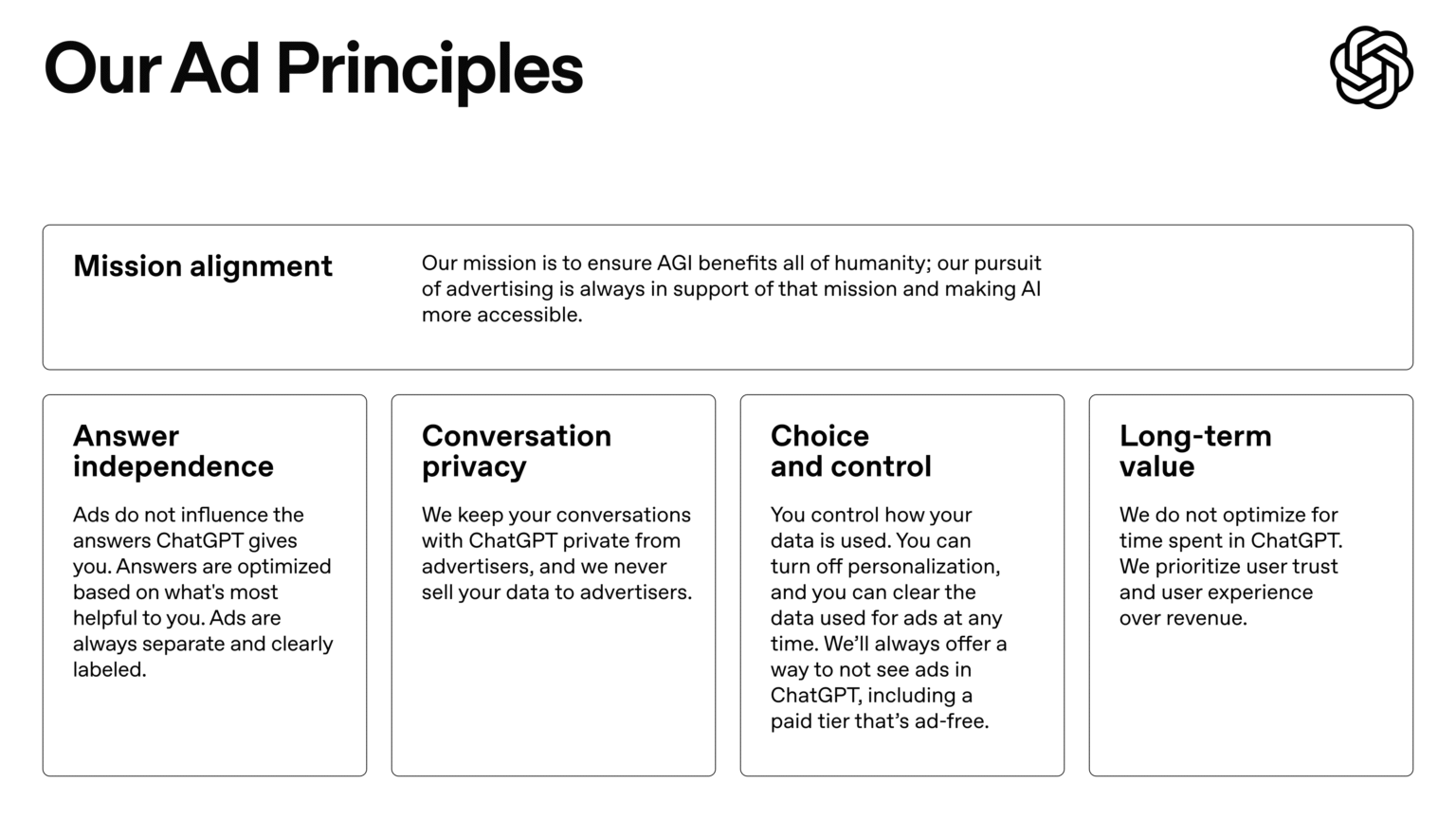
- ChatGPT’s answers will never be influenced by ads
- Ads will be clearly labeled and separated from conversations
- User conversations will remain private from advertisers
- Users will have control over personalization and data usage
- Pro, Business, and Enterprise plans will stay completely ad-free
OpenAI also emphasized that it is not optimizing ChatGPT for time spent or ad revenue, but for long-term user trust and experience.
Why This Matters
For users, this means AI access is becoming more affordable without compromising integrity.
For marketers, it signals something bigger:
ChatGPT is not becoming another attention-economy platform. It is positioning itself as a trust-first AI product where advertising exists, but does not interfere with intelligence.
And for OpenAI, this move balances sustainability with responsibility — keeping AI accessible while protecting user independence.
The Bigger Picture
ChatGPT Go represents a shift in how AI products may be monetized in the future:
not by forcing influence into answers, but by protecting credibility while expanding access.
As OpenAI puts it, their mission remains to ensure AGI benefits all of humanity — and advertising, if used, must serve that mission, not distort it.
In a world where platforms often trade trust for revenue, OpenAI is attempting something different:
building a business model that still respects the user.
And that may be the most important innovation of all.